
Solar mounting rail cutting starts with the mounting-system parts list and approved rail drawings. Turn those requirements into identified cutting groups, verify the specified ends and count complete kits before handoff. A correct overall piece count can still hide a missing rail type.
This guide follows an illustrative 24-rail order from drawings to packing. It covers manufacturing organization. The mounting-system designer must establish the rail design, installation arrangement and structural requirements.
One job, three views
- The drawing defines each required rail.
- The cutting record tracks the pieces produced and checked.
- The kit record shows which matched groups are ready to transfer.
Follow the order
The order: 12 pairs, not just 24 rails
Illustrative job: the approved parts list calls for 12 rails of type A and 12 rails of type B. Each transfer kit needs one of each. These invented quantities explain planning; they do not describe an installed solar array or a JiurunCut production result.
Give A and B separate part identities. Record the relevant drawing revision, section code, material, finish, finished length, end condition and quantity for each. Do not combine the entries simply because both are called solar rails.
Ask the drawing owner to resolve missing or conflicting information before treating the job as ready. The number of panels on a project is not a reliable replacement for its actual rail parts list. Connections, layout and required components belong to the approved system design.
Hydro’s solar extrusion overview identifies rails, frames, clamps, brackets and other PV-related components. That range of applications illustrates why a solar order needs specific part definitions. It does not identify your rail or validate a substitute profile.
Identify the section before solar mounting rail cutting
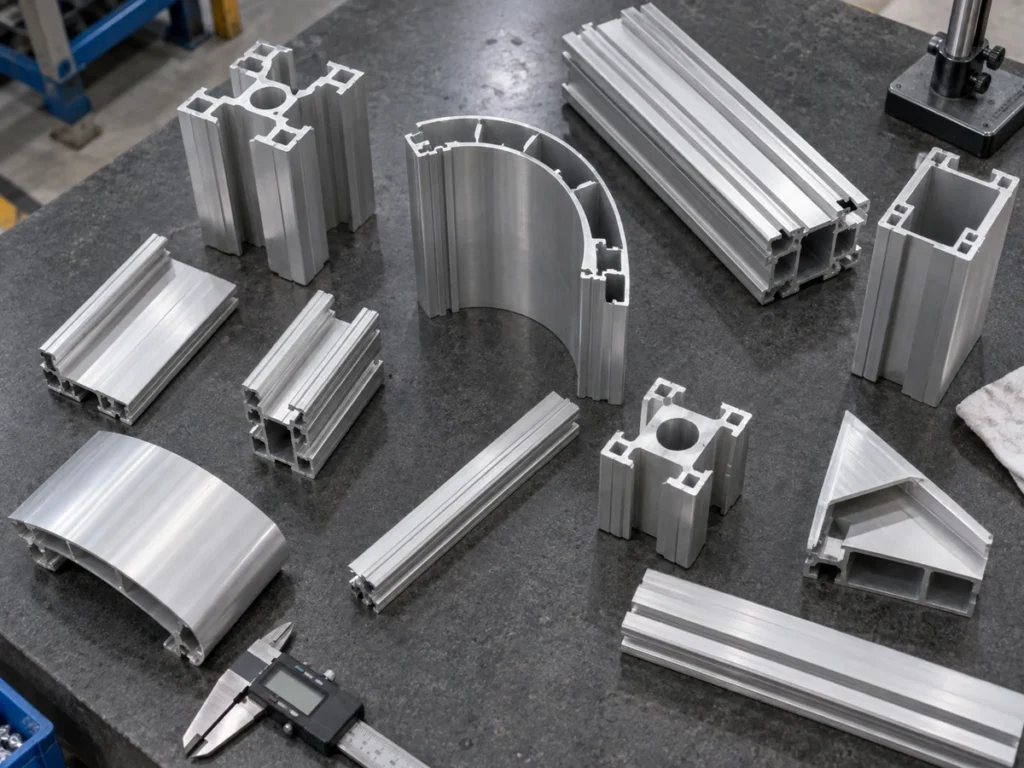
Match the incoming stock to the section drawing and source documentation. Include projecting flanges, grooves and any asymmetric features in the review. A simple overall width and height do not fully describe a connector interface.
Identify the specified alloy, temper and finish from the order documents. A silver surface does not establish the material grade or finishing process. Keep stock from different identified lots connected to the appropriate cutting records.
Review the required orientation as well as the section size. Show which surfaces locate the profile and which finished faces must remain protected. If a proposed orientation changes the relationship between the part’s features and the cut, request clarification.
The cutting capacity guide explains dimension-pair checks. A profile fitting a machine envelope does not establish that it is the correct solar rail or that its grooves fit the approved connectors.
Plan the stock-to-part route for A and B
Make separate cut-list entries for the two rail types. Use the finished lengths and end references shown on their drawings. Include any later machining or finishing operations that determine whether the saw-cut piece is an intermediate blank or the completed part.
Do not shorten a rail to make a stock layout more convenient without drawing approval. Keep the required finished geometry fixed while evaluating stock usage. The kerf calculation guide shows how trim, kerf and remaining stock enter the material balance.
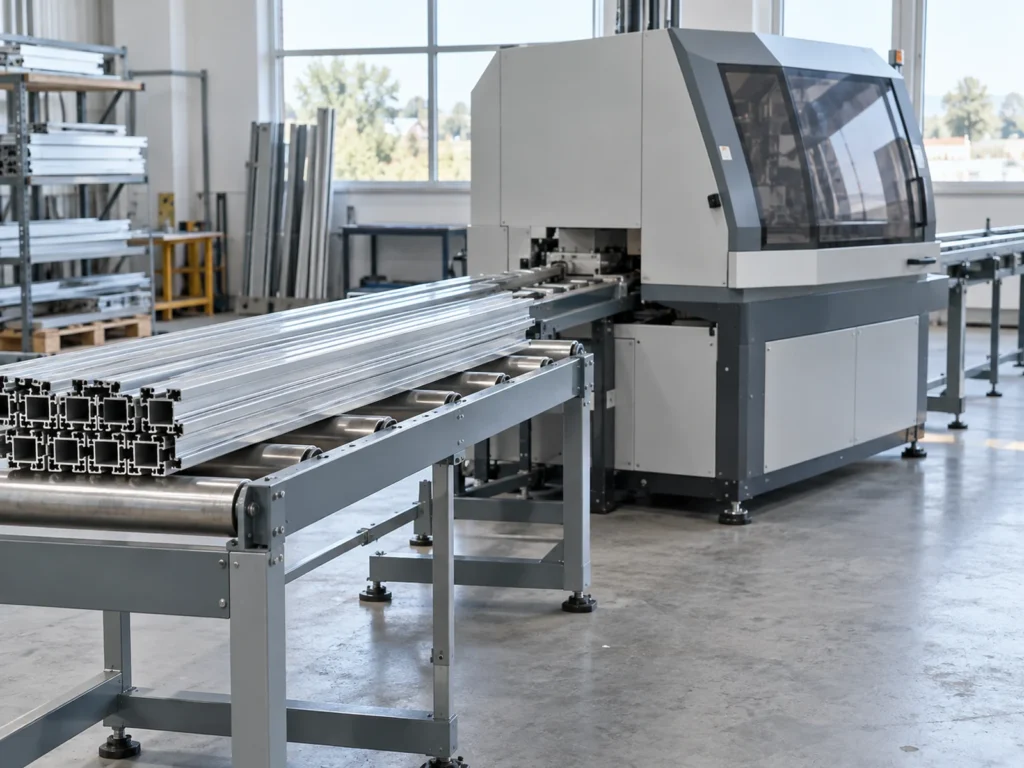
Review incoming stock length, supports, clamping, feeding and part collection with the machine supplier. Include the actual profiles and the full finished-length range. Automatic feeding does not, by itself, confirm every short-part or long-rail handling requirement.
Schedule the change between A and B so that their identities remain visible. Keep the relevant program, drawing and collection group together. The cutting traceability guide explains how source material and cut groups stay connected during a split or changeover.
Inspect the end features that the drawing actually requires
Identify the finished-length datum, end angle and cut-face or edge requirements. Where the rail has a specified connector interface, ask which surfaces and features are included in its fit review. Keep the approved connector identity linked to that check.
A visually clean end is not proof of length, angle or connector compatibility. Record the required dimensional observations using the agreed method. If a representative assembly check is needed, document the rail and connector combination actually reviewed.
Distinguish a saw-cut blank from a component needing holes, slots or another operation. The saw and machining-center comparison shows why the complete finished drawing matters. A cutting machine should not be assumed to supply unconfirmed drilling or milling functions.
Keep the specified surface and end-face condition visible through later processing. The anodized cutting guide separates an existing finished surface from a new cut face. Follow the actual finish requirement rather than inferring it from appearance.
The count: how 23 released rails make only 11 complete kits
Return to the example. The cutting groups contain 12 A rails and 12 B rails. One A rail remains held after the agreed review; the other 11 A rails and all 12 B rails are released. There are 23 released pieces in total.
Complete kits ready
Calculation: each kit needs one released A and one released B. The smaller available quantity is 11, so only 11 complete kits can be assembled. Those kits contain 22 rails: 11 A plus 11 B.
Pieces outside complete kits
Remaining groups: one released B rail is available separately, and one A rail remains held. Keep both identities and statuses visible. A package containing 23 released rails should not be described as 12 complete two-rail kits.
What resolves the shortage?
Follow the agreed review and disposition for the held A rail. If a replacement is required, create an identified replacement record linked to the current drawing and material source. Recount complete kits after the release decision rather than assuming an additional cut automatically closes the order.
The example describes kit arithmetic only. It sets no acceptable defect rate, inspection sample size or replacement policy. Those requirements come from the order and the responsible quality process.
Prepare the handoff so the next team can see the same plan
Identify each complete kit and its A and B contents. Record the quantity transferred and the material or cutting-group references required by the order. Keep any separate spare or held part outside the complete-kit count.
Agree the packing arrangement for long members and protected surfaces. Avoid losing part identity when pieces move between racks, containers and packages. The packaging guide covers the relationship between released counts, package contents and surface protection.
If later processing is still required, state that stage on the transfer record. “Cut and counted” does not necessarily mean ready for installation. The receiving team needs a clear description of the work completed and the remaining operations.
Include any customer-required inspection and material documents with a matching reference. A useful handoff lets the receiver answer three questions: what is in the package, which job does it belong to, and what status does it have?
Use the order to review a machine configuration
For a JiurunCut equipment review, provide the approved section and finished-part drawings, stock length, A and B quantities, surface requirements and collection plan. Ask the supplier to review the intended route with representative samples.
Send the rail drawings and batch plan to discuss a suitable cutting configuration. Confirm any labeling, sorting or downstream integration separately. This example does not establish solar-system approval or a specific machine’s capacity, accuracy or output.
Common questions
Can I choose a rail length from the number of solar panels?
Use the approved system parts list and drawings. Panel count alone does not define the rail layout, joints, mounting arrangement or finished lengths required for that project.
Does the same outer section size mean two rails are interchangeable?
No. Confirm the complete profile, material, finish and connector interface against the approved system definition. Similar outside dimensions do not establish the same geometry or suitability.
Does a saw-cut end need later work?
Follow the finished-part drawing and process route. Some orders specify a saw-cut component; others need additional end treatment, machining or finishing. Confirm the required handoff stage before comparing equipment.
Why count kits as well as pieces?
A kit can need several distinct part types. The total released piece count can look sufficient while one type is short. Count the required combinations and keep separate pieces outside the complete-kit total.