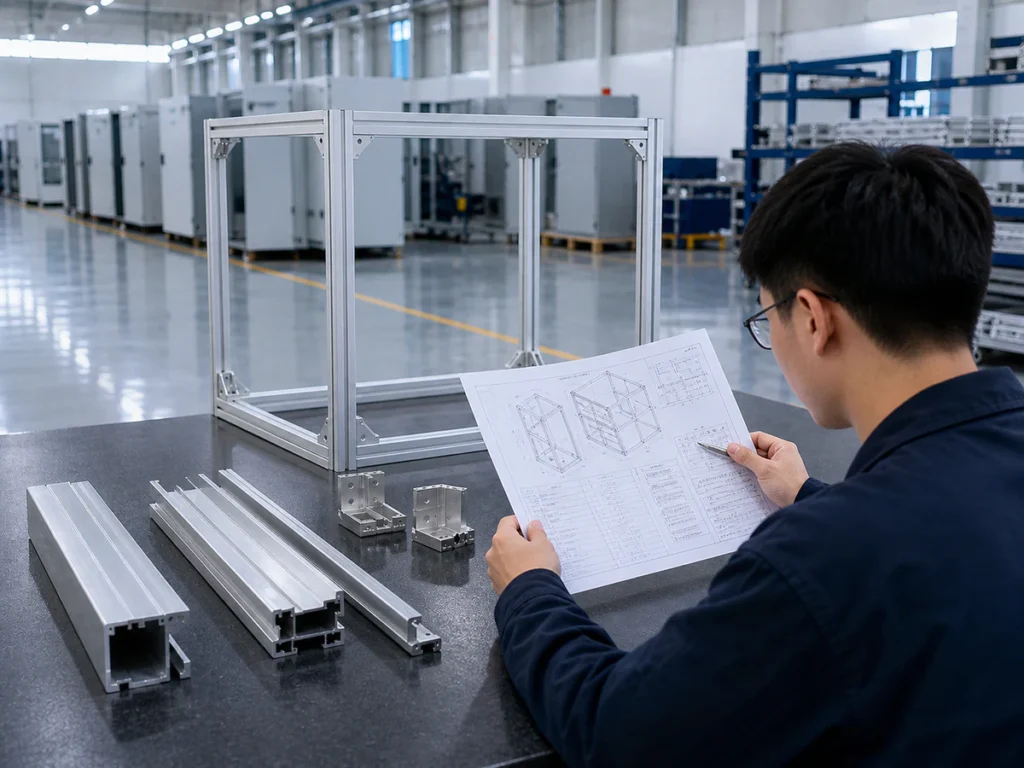
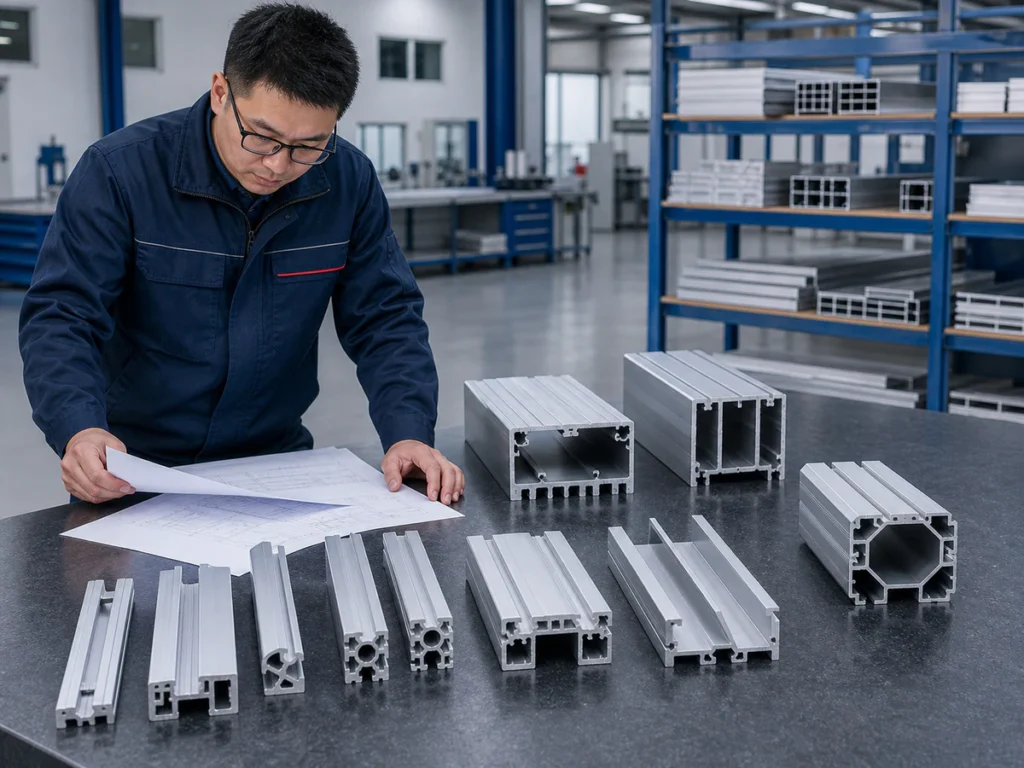
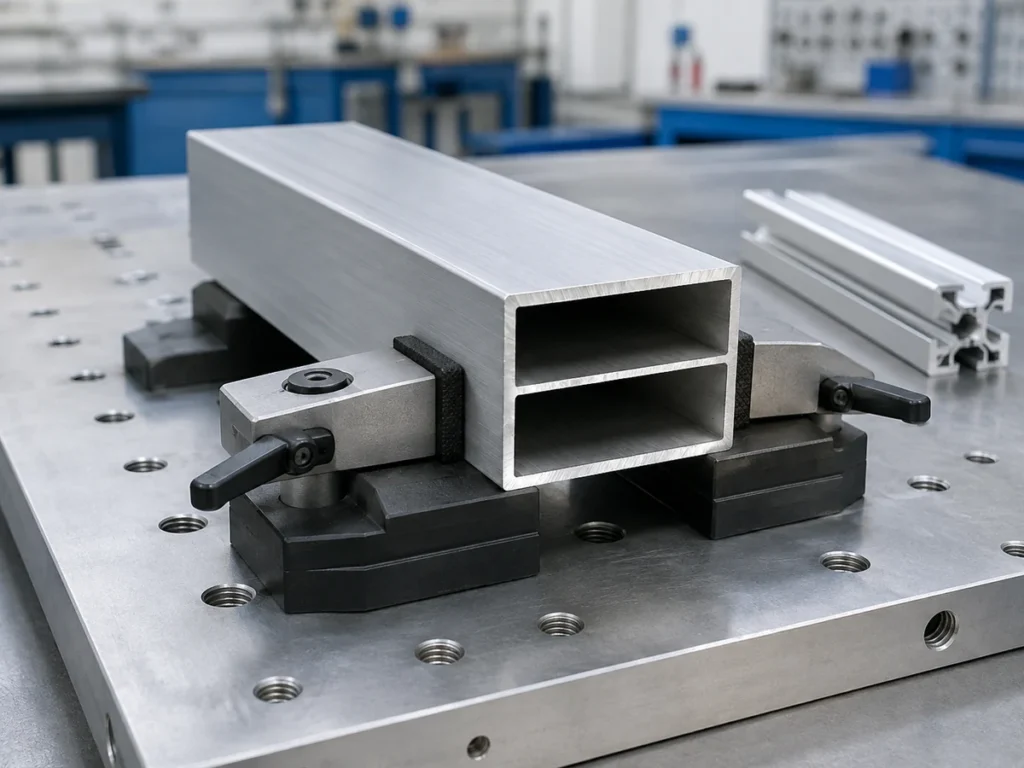
Zero-tail cutting does not mean you can use every millimeter of a bar. A machine may reduce tail waste at the end, but the saw still removes material with each cut. End trimming, unused lengths and rejected parts also affect waste. To compare a claimed saving, check where the whole bar goes under the same job conditions.
Three things to remember
- Record material removed by the saw, end trimming, the final tail and reusable leftovers separately.
- Compare the same bars, required parts and rules for accepting finished pieces.
- Count parts that pass and leftovers you can use. One good demonstration is not the whole production picture.
On this page
Where does the material go?
Kerf is the cut gap where the saw blade removes material. Record the material lost across this gap for each cut. Trim is material you remove to prepare or finish an end. Record trim separately from kerf so you do not count the saw-cut loss twice.
Also record finished parts that pass your checks, leftovers you can reuse and scrap you cannot use. Reducing tail waste does not automatically reduce all the other losses.
Use this tail waste guide to compare whole-bar material use. It does not promise a Jiurun tail length, material-use percentage or saving.
What exactly does the supplier call tail waste?
Ask the supplier to show which leftover piece the quotation counts as tail waste. Confirm how that piece is held or transferred, and which profile shapes, sizes and lengths the claim applies to.
A photo of a short offcut does not prove that every profile will give the same result. Check how the material is handled, which parts the cut list requires and whether the finished pieces pass.
Match any tailless description in the supplied brochure to the stated machine configuration and job conditions. It does not guarantee production without material loss.
How can you account for the whole bar?
For one uniform profile family, this simple balance assumes there are no rejected parts:
Incoming stock = accepted finished length + kerf + trim + remaining stock.
Split the remaining stock into pieces you can reuse and scrap. In a real job, also record rejected pieces separately before calculating the final share of material that becomes accepted parts.
A remnant is a leftover piece of stock. Count it as reusable only if you can identify, store and use it. A piece is not necessarily scrap just because the current job does not need it.
Do not add together lengths of profiles with different cross-sectional areas or materials to compare the whole factory. Compare each profile family separately, or compare by mass using the same accounting rules.
What does this look like for one bar?
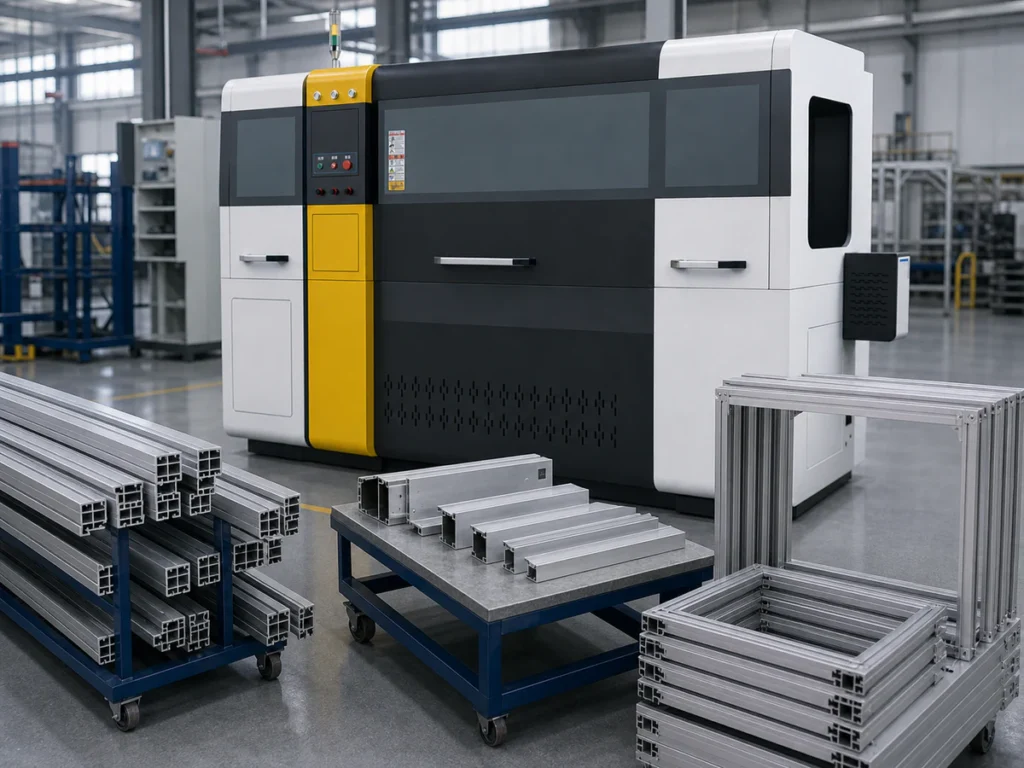
This calculation is an illustrative example, not a JiurunCut test result or production performance claim. Start with one 6,000 mm bar. Five accepted parts total 5,000 mm. Recorded kerf is 18 mm, and trim is 12 mm, excluding that kerf.
6,000 − 5,000 − 18 − 12 = 970 mm remaining.
| Illustrative category | Length |
|---|---|
| Incoming stock | 6,000 mm |
| Accepted parts | 5,000 mm |
| Kerf | 18 mm |
| Trim, excluding kerf | 12 mm |
| Remaining stock | 970 mm |
You can check the total: 6,000 = 5,000 + 18 + 12 + 970 mm. In this simplified example, accepted parts use 5,000 ÷ 6,000 of the incoming length, or about 83.33%.
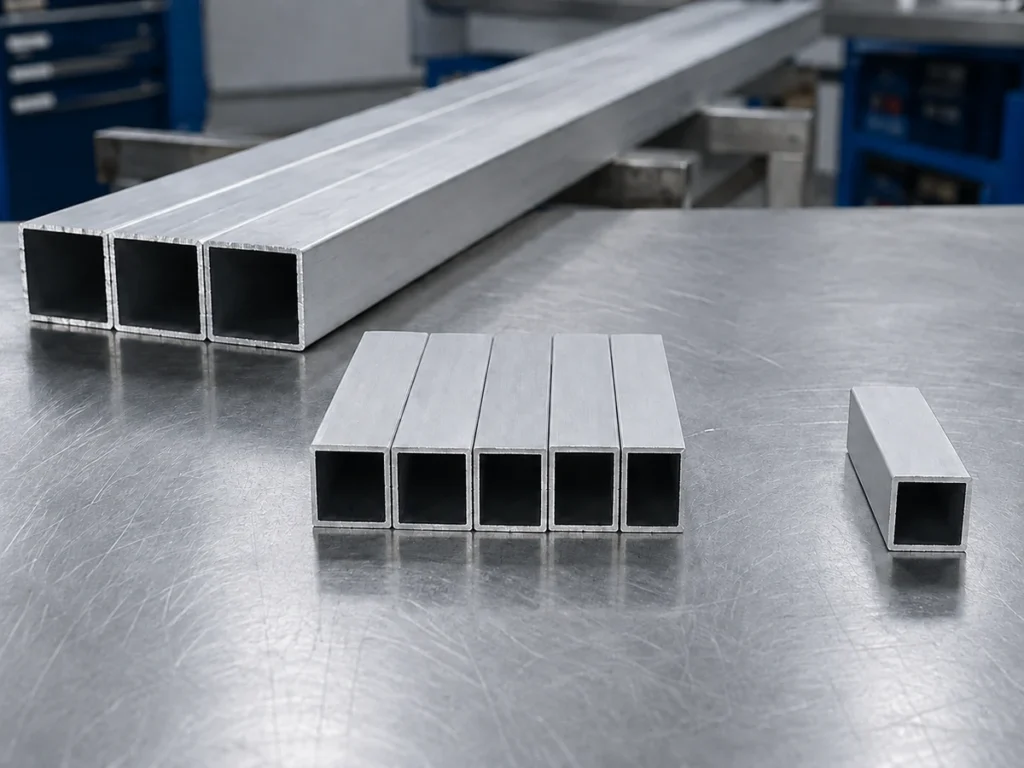
Whether you can reuse the 970 mm depends on future jobs, what your machine is permitted to handle and your rules for keeping leftovers. The example does not tell you the cut count or settings for your machine.
What can the machine change about tail waste?
A machine configuration may reduce a limit on how material is handled near the end of a bar. It does not change the finished lengths and quantities your customer needs.
Compare the same stock lengths, required parts, material family, trim rules and checks for finished parts. Ask whether the proposed cutting order is simply workable or has been optimized using a stated method.
Nesting means planning how to arrange the required parts across the stock you have. A supplier can review a list manually; that does not prove the machine includes automatic nesting software. Ask whether that software is actually included.
Can you really use the leftover on another job?
Record the profile, remaining length, required material or batch details, storage location and any surface or handling restrictions. Your production team needs this information to decide whether the piece suits a later job.
An unidentified offcut is not the same as a recorded, reusable piece. Labeling and storage take work too, so include that effort when comparing options.
For mixed frame kits, check whether reusing leftovers means more stock changes or interruptions. Using more of each bar is only one part of running the job well.
How can you check a claimed saving in tail waste?
Compare parts that pass across a mix of jobs that reflects your production. Include normal setup losses and rejects. Comparing the best demonstration with your worst past batch will not give a fair answer.
First compare how much material becomes accepted parts. Then calculate money separately, using your actual material cost. State whether you have included scrap value, storage and handling.
An assumed aluminum price is not a current quotation. Ask which measured loss the proposed machine can reduce, and which losses still depend on the cut list or the requirements for accepted parts.
Compare a straight-cut order with a bar-by-bar material record
Give each supplier the same material specification, profile drawing, incoming-stock lengths, required part lengths and quantities, and acceptance criteria. Agree whether both proposals must follow the same cut order or may propose different arrangements. If arrangements differ, require each complete sequence and its result; do not credit a plan that leaves required parts short or makes extra unwanted pieces merely to improve its percentage.
For this length-based comparison, use one uniform, constant-section profile family with square end cuts and lengths measured along the same axis. Do not combine different sections, mix length and mass, or apply this balance to angled ends, tapering material or parts with other material-removal operations. Those jobs need a separately agreed measurement method. The cut-list guide connects the requirements to their drawings.
Identify each incoming bar, the trial or plan, its configuration and the matching cut list. Record every saw pass in order, including end preparation, sample or corrective cuts. Enter the loss for each pass from a confirmed planning input or an observed record and label which it is. Do not automatically use the part quantity as the number of cuts. One machine motion can also cut several parallel bars; account for its effect on each bar without confusing blade motions with individual material losses. The kerf calculation guide explains why the sequence matters.
Record the remaining solid pieces. Give each accepted part, rejected part, trim offcut and remnant an identity linked to its original bar. Keep these categories separate from the saw-cut loss: a physical trim offcut excludes the kerf that separated it. For rejected parts or setup samples, record where their remaining material goes rather than hiding it in accepted production.
For a completed bar with all material destinations recorded, check:
Incoming length = accepted required-part length + all other solid-piece lengths + total saw-cut loss.
The categories must be exclusive. “Other solid pieces” includes rejected parts, pending inspection or rework, setup pieces, trim offcuts and remaining stock. Every physical segment belongs to one category at the stated snapshot. Do not add a minimum clamping reserve to this equation if that length is already inside the recorded remnant. A reserve is a restriction on the plan; it is not additional material. Identify which remnant contains it, and ask the supplier to confirm the actual holding and last-cut conditions. Unknown reserve requirements remain unconfirmed.
Calculate accepted-order length utilization = total length of accepted pieces allocated to this cut list ÷ total incoming length issued to it × 100%. Keep the unit and accounting boundary consistent. Include issued stock consumed in setup, trials and rejects within the agreed boundary. Do not quietly remove an unsuccessful bar from the denominator or count overproduction outside the order as accepted-order output.
A reusable remnant is inventory, not a finished part for this order. Record its section and material identity, measured length and condition, storage identity, intended order or demand, and the supplier-confirmed requirements for using it. “Long enough” alone does not establish reuse. Mark unresolved remnants as reuse to be confirmed, rather than accepted parts or proven savings. If that remnant later becomes stock for another job, transfer its identity to the new record; do not count both the stored remnant and the resulting parts as output in a combined calculation.
Before comparing percentages, check the bar balances, required quantities fulfilled, inspection evidence and the disposition of every remaining piece. A balance discrepancy is a question to investigate, not an automatic scrap allowance. Record the measurement method and any agreed reconciliation rule; do not invent a universal allowable discrepancy. Label a planned result as an estimate until the recorded cutting and acceptance evidence supports it.
Ask the supplier to provide the complete sequence, identified output, actual remnants and inspection results for the same order and quoted configuration. Also ask which “zero-tail” statement describes the handling of the last piece and which evidence supports the claimed material percentage. A model name or a short-tail photograph does not establish 100% utilization of your order.
To discuss the record with JiurunCut, send your straight-cut list and stock data, including your end-preparation rules, required checks and restrictions on remnant reuse. Missing inputs can stay “to be confirmed”; they must not become zero loss in the comparison.
What should you prepare for a tail waste comparison?
For each profile family, gather stock lengths, finished lengths, quantities, angles and trim rules. Add your current cutting order, restrictions on using leftovers and how you decide which remnants to keep.
The cut-list guide explains how to organize this information. For frame projects, the energy-storage cutting solution shows the related application context.
What else should you know?
Does a shorter tail always mean less waste overall?
No. You still need to count kerf, trim and rejects, and consider the mix of required parts and leftovers you can reuse.
Can I compare material use with just one part length?
You can use one length for a clearly defined example. To compare a production proposal, use the actual lengths and quantities you need within the profile family.
Does Jiurun's brochure prove my project can run without waste?
No. The brochure describes machine configurations. To assess your material use, you need the actual cut list, setup and agreed production conditions.
Sources & Scope
- Jiurun machinery brochure supplied by the owner. 九润画册 PDF physical pages 6–19. Machine categories and configuration identity only; not test results or an operating manual.
- Tooling reference: LEUCO aluminum-profile blade dimensions, including cutting width. Use the blade approved for your machine when recording actual cutting losses.