
Long aluminum cut-part staging is the handoff between an accepted saw cut and a protected shipping pack. It deserves its own decision in an outsourced cutting order or a new saw-cell plan. A long member can meet its length and end-condition drawing at the machine, then be scratched, mixed with another revision, bent by poor support, or moved into a pack without a clear release decision. The buyer needs to know where finished parts wait, how each group stays identifiable, and who checks the condition before packing.
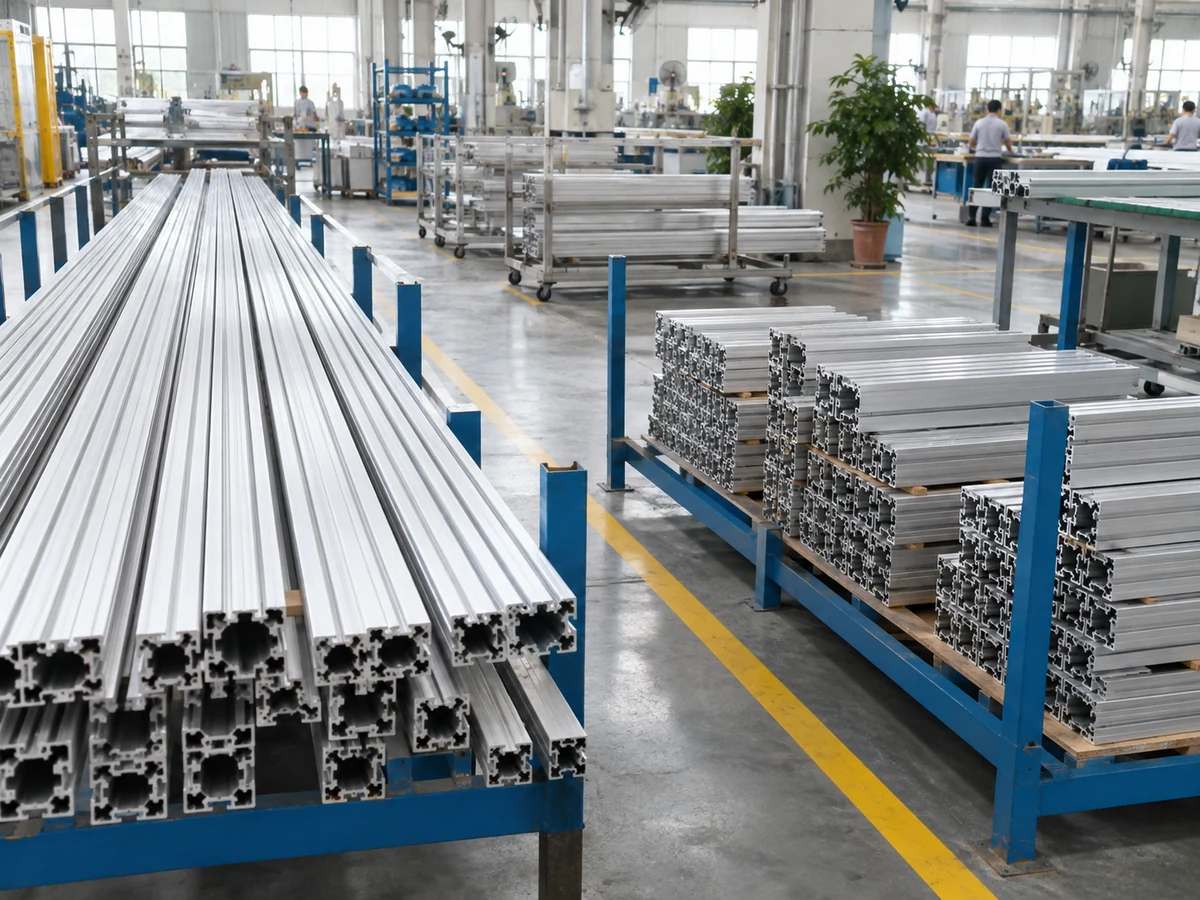
This guide addresses finished cut members after the saw. Incoming stock racks, the saw’s feed support, and transport packaging are related but separate scopes. Use your actual profile drawing, finish requirement, batch pattern and site risk assessment; no support spacing, allowable bow, stack height or acceptance tolerance is universal. The images are representative views from JiurunCut’s existing media library. They do not document a customer lot or prove a tested staging method.
Set the long aluminum cut-part staging boundary before comparing suppliers
Ask a prospective cutting supplier to draw the route from saw outfeed to first inspection, temporary storage, pack preparation and dispatch. Identify the physical transfer point at which a cut piece becomes a counted, identified part. If the supplier quotes only machine cycle time, the quote may omit the space, racks, separators, labor and inspection needed while long pieces wait. Conversely, a buyer planning an in-house saw should include the finished-part side of the cell, rather than assuming the infeed rack is also a safe outfeed buffer.
Define the longest and shortest finished lengths, the section’s mass and stiffness, visible faces, delicate flanges, cut-end condition, downstream operation and expected time in staging. A hollow or thin-wall section and a rigid bar of equal length may need different contact surfaces and lifting methods. A mitered or handed frame member also needs an orientation record, not just a length label. Ask for a representative layout review with the actual part family; do not turn the illustrative pictures below into a dimensional specification.
Separate incoming stock, accepted cut parts and unresolved pieces
The most important line in the floor plan is a status boundary. Incoming extrusion may carry a mill lot and stock length. Cut parts need the order line, drawing revision, cut length or kit position, quantity and inspection state. An operator should be able to see whether a rack position contains accepted finished pieces, a first-piece sample, work awaiting measurement, a rework candidate or stock that has been rejected. Color alone is a weak identifier unless a durable label or traveler explains its meaning.
Agree what happens when a late drawing revision or material-lot change reaches the cutting cell. Keep the prior state physically separate and identify the first affected cut piece. A shared long-parts rack can otherwise accumulate visually similar members from different orders. When the same extrusion section is cut to several lengths, define how a worker confirms the length group before adding a new piece. For mitered parts, identify left/right hand and datum face. If a part is damaged during staging, preserve its original order and batch identity while it is held for disposition.
The short cut-part sorting guide deals with small-piece bins. Long members raise different span, contact and transfer questions. If a lot is not ready to ship, the pre-dispatch hold guide explains the separate release decision. Staging should make that decision visible rather than erase it.
Design supports around the actual member, not a guessed interval
Long aluminum profiles need stable support and a transfer path that avoids uncontrolled overhang, sliding and contact between exposed faces. Review the support points with the part’s section drawing and finish condition. Check where a member rests immediately after separation, where it is lifted, how it is laid into a rack, and whether a support edge touches a specified appearance or joining surface. A soft separator can protect a finish, but its material, position and cleanliness still need a trial: contaminated pads can mark the next piece.
Do not publish an arbitrary support-spacing number in the purchase specification. The appropriate span depends on section stiffness, length, mass, orientation, stack arrangement and handling method. A buyer can instead request a sample staging demonstration: place a representative long piece in the proposed rack, move it along the real path, check the visible faces and end condition, and measure any straightness or fit feature that the drawing actually controls. Record the contact points and handling sequence so the method can be repeated after a shift change.
Hydro’s profile transport, storage and handling guidance discusses avoiding profile-to-profile rubbing, protecting opened packs from shifting and contamination, and using racks. It is guidance for profiles, not a certificate for this supplier or a substitute for the part’s agreed limits. In a US workplace, OSHA 29 CFR 1910.176 addresses clear mechanical-handling aisles and stable storage; each facility must apply its own applicable safety rules and equipment limits.
Keep the route from saw outfeed to pack observable
Ask who removes the cut member, how many people or what approved handling aid are needed, which end is controlled during transfer, and where the next piece may wait while the first is measured. A long part can project into an aisle even when it sits safely on the saw outfeed. Include the full turning envelope of carts, racks and lift devices in a site review. For a new machine RFQ, the buyer should distinguish machine-included outfeed equipment from facility-supplied staging fixtures and material handling.
Choose a first-off and running-check location that allows the inspector to see the required end and surface without dragging the part across another member. Put gauges, the traveler and the hold location within the actual workflow. When inspection is sample-based, state how the checked sample maps to the quantity in the rack. A part count from a saw controller is not automatically an accepted-piece count. Reconcile cut count, inspected/accepted pieces, held pieces, scrap and packed quantity before release.
At pack preparation, confirm that separators and supports preserve the condition achieved in staging. Check that long members cannot rub, shift or place concentrated pressure on a thin flange during the next handling step. The photographed arrangement below shows a possible separation concept, not an approved pack for a specific section or route. For the later freight and damage responsibility boundary, use the long-extrusion delivery guide; this article ends at the internal handoff to packing.

Use a staged-lot trial and a clear release record
Before approving a supplier method or a new cell, choose one representative part family and a realistic batch size. Follow an individual piece from cut to rack and pack preparation, then repeat after a length or revision change. Have the buyer and supplier agree what to check: part ID, quantity, length group, visible-face marks, cut ends, straightness or assembly fit where the drawing calls for them, and the time and owner of each acceptance decision. Inspect the rack after a normal waiting period and transfer, not just while the first demonstration piece is held by hand.
A useful record can be compact. It should identify the order and revision, material or extrusion lot, rack location, accepted quantity, held quantity, inspection reference, pack reference and responsible release person. If a label becomes detached or a mixed stack appears, hold the affected scope until identities and quantities are reconciled. Do not relabel uncertain pieces as accepted simply to make a dispatch date. If the staging method changes materially, repeat the relevant contact and handling check rather than assuming an old picture approves a new rack.
| Buyer decision | Evidence to request | Hold point |
|---|---|---|
| Can each long part be identified? | Order, revision, section, length/hand and rack-position record | Mixed or untraceable groups |
| Is support suitable? | Representative rack-and-transfer trial with defined contact points | Uncontrolled overhang, shifting or damage to required faces |
| Did inspection cover the staged lot? | First-off/running sample IDs and accepted/held quantity reconciliation | Machine count is mistaken for accepted count |
| Can packing take over? | Pack method, quantity and release owner linked to the same lot | Unreleased or damaged pieces enter the pack |
What to put in the RFQ or supplier work instruction
Send the supplier the section drawing and revision, incoming and finished lengths, maximum and minimum batch quantities, finish and visible-face map, required end and straightness checks, and any handed or matched-set relationship. Ask for the proposed saw-outfeed-to-rack path, rack capacity and control method, separator/contact material, identification scheme, inspection location, transfer equipment and pack handoff. Request a representative first-lot demonstration before approving the method for repeat supply. If you are buying an in-house saw, ask which outfeed and material-handling elements are included in the machine quote and which the site must provide.
Keep the acceptance statement tied to the real drawing and order. A staged pile of straight-looking aluminum is not a performance test, just as a good cutting video is not proof of a particular customer’s dimensions. The aim is an auditable route from an accepted cut to an identifiable, protected lot ready for packing.
General equipment video
The following video is from Jiurun Machinery’s YouTube channel. It shows a long aluminum profile feeding through a Jiurun cutting station. It is general equipment footage only: it does not show post-saw staging, the pictured racks, this article’s material or length group, a customer order, a trial, a particular purchased configuration, or measured performance.
Ask JiurunCut about the complete cut-part flow
If your project needs a machine recommendation, send JiurunCut your profile drawing, longest incoming and finished lengths, section and finish, batch mix, and the space available for outfeed and staging. Ask us to identify the quoted machine-side scope and the information needed for a representative cutting trial. Your organization and the cut-part supplier must approve their own finished-part staging, inspection and pack-release method.