
Long aluminum extrusion delivery can turn a well-priced profile order into an avoidable dispute if the buyer and supplier have not agreed what arrives, how it is supported, who unloads it, and how damage is documented. A quote for the same alloy, section, length and quantity may still represent different physical deliveries: loose full-length bars, separated bundles, protected cut members, or labeled job kits. The cheapest line on a quotation is not comparable until those boundaries are visible.
This guide is for a buyer sourcing profiles or cut members from an extrusion supplier or processor. It is a commercial and receiving checklist, not a packaging design standard. Jiurun makes industrial aluminum saws; it does not provide a cutting or freight service. If the buyer intends to cut stock in-house, the retained sawing job should be evaluated separately from the incoming material shipment.
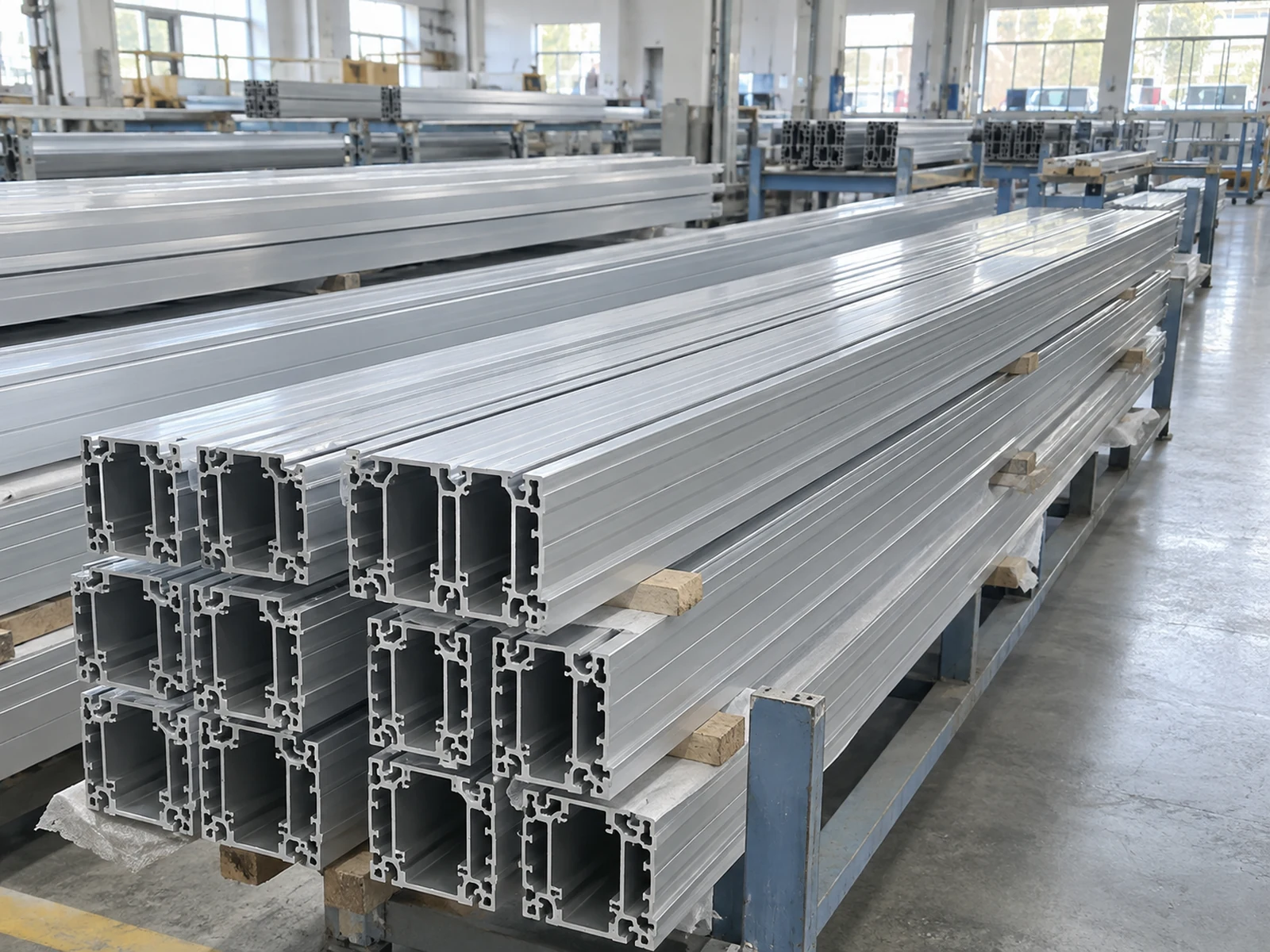
Long aluminum extrusion delivery starts with the accepted unit
Before asking for a freight price, describe the unit that can be counted and checked at the receiving dock. Is the purchase for full-length stock bars, a stated number of cut members by drawing revision, or kits containing several part numbers? Identify the finish or visible faces, the agreed length reference, quantity by profile and lot, and the point at which the supplier’s work ends. A bar price and a cut-piece price cannot be compared as if they buy the same accepted output.
Put the physical pack unit beside the commercial unit. A supplier may quote a number of pieces but ship those pieces in mixed bundles; the buyer may need each part number separated and labeled for line-side use. Ask for the proposed maximum bundle length and weight, number of pieces per pack, support or spacer arrangement, label content, and whether packaging is returnable, disposable, or charged separately. Do not invent a universal safe bundle size: it depends on the actual section, length, finish, handling equipment and route.
Write protection around the damage modes that matter
The public abstract of ASTM B660-23 identifies mechanical damage, including bending, crushing, dents, scratches, gouges and transport abrasion, as well as corrosion or water staining from external water or condensation. The full standard has not been reproduced here, and citing its abstract does not mean a shipment conforms to that standard. It is a useful prompt for specifying the risks a buyer wants the pack to control.
For a visible architectural face, ask whether adjacent sections can rub during vibration, whether separators will contact a critical finish, and which face must be oriented away from straps or hard supports. For hollow or thin-wall profiles, ask where the load is supported so the pack does not concentrate pressure on a weak edge. For a cut-member kit, ask how exposed ends are kept from marking adjacent pieces. For a long stock bundle, ask how the ends and unsupported spans are kept stable through lifting and transit. These are questions to resolve with the supplier, not claims that a photo proves a pack will perform.

Agree the route and unloading handoff before comparing prices
Ask each supplier to quote to the same named delivery point and to state what the freight line includes. Record who arranges the carrier, whether the quoted vehicle can carry the stated bundle length, whether a collection appointment or site access restriction applies, and who provides the unloading equipment and labor. A quote that stops at supplier dispatch is not directly comparable with one that includes delivery and unloading at the buyer’s site. The purchase order should identify the delivery term actually agreed by the parties; do not assume a term from an informal email or from a photo of a wrapped bundle.
The receiving team should know the largest pack footprint and lifting orientation before the vehicle arrives. If the site cannot unload that size or protect it from weather while waiting, the buyer can ask for shorter approved lengths, smaller packs, or a different delivery plan. Changing the length or pack after quoting may change the cutting scope, piece count, scrap disposition and price. Keep the drawing and accepted output unchanged unless a controlled revision is agreed.
Decide what evidence travels with each pack
At dispatch, request a packing list that ties each pack identifier to purchase order, profile or part number, drawing revision where applicable, alloy and temper where ordered, quantity, lot or batch reference, and actual shipped length or cut-piece count. Specify any mill certificate or process document needed by the purchase order rather than treating all paperwork as automatic. The pack label and document should let the receiver reconcile a physical bundle without opening every protected layer on the truck.
At arrival, record the vehicle or shipment reference, pack count, visible outer damage, wetness, broken restraints and any mismatch against the packing list before the load is put away. Define who is authorized to sign the delivery record, what exceptions that person should write, and the escalation route for concealed damage discovered during unpacking. A signature acknowledging receipt should not be described as automatic acceptance of every part unless the contract actually says so. The claim deadline and evidence requirements should be written into the agreed order or carrier terms, since they vary.

Make a claim path that can separate causes
Agree a practical sequence before there is a problem: preserve the pack and labels; photograph the whole load and the affected area before disturbing it; note the pack identifier and count; isolate suspect pieces without mixing lots; and tell the designated supplier contact promptly. The buyer and supplier can then compare dispatch condition, carrier handoff and receiving observations against the agreed acceptance criteria. Without those links, a scratch found at assembly may be difficult to connect to a particular transit event.
Define who pays for replacement material, cutting, repacking and repeat freight when damage is confirmed, and who may authorize a replacement release. Keep the distinction between external pack damage, a defect in the supplied extrusion, cut-end nonconformance and buyer-side handling after receipt. A single generic “damaged goods” line can conceal different remedies and delay usable stock.
Use one RFQ grid for every bidder
| RFQ field | Buyer input to hold constant | Supplier response to request |
|---|---|---|
| Accepted output | Profile, finish, length or drawing, revision and quantity | Full stock, cut pieces or identified kit |
| Pack unit | Receiving dock and storage constraints | Pieces per pack, longest pack, gross weight and labels |
| Protection | Visible faces, contact restrictions and weather exposure | Separators, support points, end protection and wrap description |
| Movement | Delivery point and unloading capability | Carrier scope, vehicle constraints, unloading responsibility and lead time |
| Exceptions | Inspection window and escalation owner | Dispatch record, claim evidence, replacement and freight cost rule |
Use the same drawing, delivery point and receiving assumptions in every RFQ. If one supplier proposes a different pack or transport method, keep it as a separately priced alternative rather than silently changing the comparison. The European Aluminium Association’s guide notes that extrusions are commonly protected in cases to reduce fretting in transit and should be protected from splash water and condensation during storage. That observation supports asking about contact and moisture control; it is not a universal guarantee for a specific consignment.
Stock bars and cut members need different receiving tests
If the buyer receives full-length bars for its own saw, the incoming check should focus on the ordered profile identity, usable stock length, visible condition and pack count. The buyer’s later cut-list yield and finished-part acceptance belong to its own process. The related call-off order comparison helps decide whether stock should be held as long bars or released as prepared members.
If the supplier delivers cut members, the receipt should also link each packed count to the approved drawing, orientation and cut-end requirements. Separate accepted parts from rejected or disputed pieces, and specify who owns offcuts or returns; our outsourced offcut terms guide covers that commercial boundary. Neither receiving a pack nor watching an equipment video establishes actual cutting accuracy: the applicable drawing and agreed inspection records do that work.
A purchase-order handoff to copy
Before release, attach or reference the approved profile or part drawing; identify the ordered material and finish; state whether the accepted unit is a stock bar, individual cut member or kit; require the pack list and labeling fields; record contact and weather protection requirements; state the delivery point and unloading owner; and agree the inspection, exception and replacement path. Ask the supplier to acknowledge any deviation before dispatch. This turns an ambiguous freight allowance into a checkable supply commitment.
Equipment video context: The following Jiurun Machinery channel clip shows general aluminum-saw equipment and profile handling. It is not footage of a shipment, this material or pack, a customer order, the model configuration proposed for your job, a trial cut, or a verified quality or performance result.
For a buyer moving some profile preparation in-house, contact Jiurun with the approved section drawings, stock lengths, cut list, finish and handling constraints. We can discuss the circular-saw preparation job and a suitable configuration review. Freight packing for purchased extrusions and the final acceptance terms remain decisions to agree with the material supplier and receiving team.