
Short aluminum cut part sorting becomes a purchasing problem when one saw order produces several lengths, revisions or delivery lots that look nearly identical. A good cut can still reach the wrong kit if accepted pieces, hold pieces and offcuts share a bin. Buyers should therefore specify the handoff after the blade, not merely the programmed cut list.
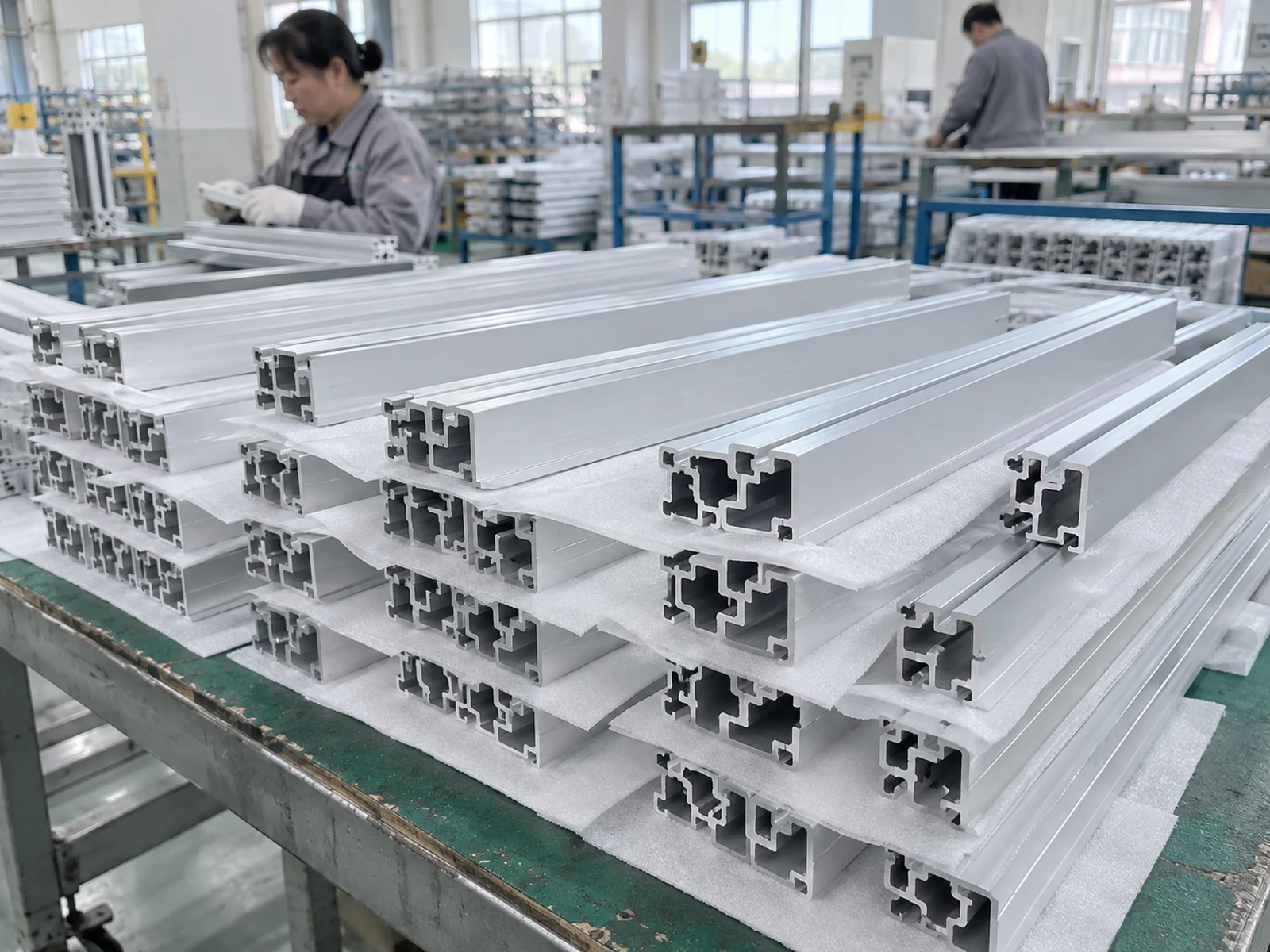
This guide is for buyers of cut-to-length aluminum profiles and for teams comparing a stand-alone saw with an outsourced cutting service. It explains what to define in an RFQ, how to see the segregation method during a trial, and what evidence to request before releasing a mixed-length shipment. The illustrative workshop images below are examples of handling concepts; they are not evidence of a particular order, measured length, customer or acceptance result.
Short aluminum cut part sorting starts with the releasable group
A purchase order may name a profile, alloy or finish, drawing revision, nominal cut length, quantity, lot and destination kit. Decide which combination makes one releasable group. If two lengths differ only slightly, a visible row on a table is a weak control unless each row is tied to its order line. If a revision changes a hole, end treatment or allowance, length alone cannot identify the part.
Ask the supplier to show how stock identity enters the cut record and how the output group inherits that identity. A practical label or traveler can carry part number, drawing revision, length designation, source lot, accepted quantity and hold status. The exact label scheme is contractual: GS1’s Logistic Label Guideline describes standardized identification for logistic units, but a buyer should require GS1 identifiers only if the receiving system actually uses them.
Separate accepted parts, suspect parts and recoverable offcuts
Before approving a saw route, define at least three physical destinations. Accepted parts go to the named part-and-length group. Parts awaiting measurement, burr review or drawing clarification go to a clearly marked hold area. Reusable remnants go to an offcut stream with their own identity and ownership rule. Scrapped ends need a separate disposition. A supplier should never improve the accepted count by mixing a short end or a rework candidate into the saleable bundle.
This separation is especially important when the operator alternates between short runs. The final piece of one job and first piece of the next may be visually similar, while setup verification is still open. Specify when the previous bin is closed, how the next bin is identified, and who authorizes release after a program or stock change.

Write a sorting rule that can survive a busy shift
For short aluminum cut part sorting, state whether each order-line group is a pallet, tote, rack lane, tray or individually tagged bundle. Make its capacity and stability part of the routing decision. A loose pile can obscure counts and expose finished ends to contact. A tote may protect small pieces but make a length mix hard to see. A rack lane can keep profiles aligned but needs a positive method to prevent one job drifting into the next.
The RFQ should ask for a simple flow: where the piece lands; where its first-piece and in-process checks occur; where accepted output waits; and how a full container is exchanged without losing its identity. Specify who applies labels and at what point. If the supplier says sorting is automatic, request the actual machine-and-operator sequence, including abnormal cases such as a jam, a short remnant, a rejected first piece or a power restart. Do not infer guaranteed segregation from an equipment photo or a video of cutting alone.
Stable storage is also a safety and damage-control issue. For U.S. workplaces, OSHA 29 CFR 1910.176 addresses clear aisles and secure storage of tiered bundles. It does not certify any rack shown here. Have the actual site assess its load, supports, traffic path and local requirements.
Use a mixed-order trial to expose the weak handoff
A trial containing one repeated length is too easy to sort. Ask for a representative sequence with two visually similar lengths, at least one job change and the relevant profile or revision changes. Record the starting stock and the planned accepted quantity for each order line. Observe how the last part of one group is removed and how the first part of the next group is identified. Then introduce a realistic hold: a questionable end face or a piece awaiting measurement. The question is whether it stays out of the accepted pack while production continues.
The trial record should reconcile input, accepted output, held output, offcuts and scrap. This is a count-and-identity exercise, not a claim that the saw itself measures finished-part accuracy. The measurement plan must separately establish length tolerance and any end or burr criteria on the actual part drawing. If the supplier cannot show which container a sampled part came from, a favorable sample measurement says little about the rest of the shipment.
Specify the release and packing handover
At release, one group should have a clear order-line identity, accepted count and documented hold disposition. The packing list should map containers to those groups, rather than merely reporting a total number of pieces. If several lengths share a shipment, ask whether they are physically partitioned and how receiving staff can check each partition without unloading every piece. If there is a customer kit sequence, state whether the supplier is delivering loose lengths, sorted groups or complete kits; those are different prices and responsibilities.
Protecting cut ends matters, but protection must preserve the sort. An interleaf or wrap that hides every label may prevent a receiver from locating the correct length. A representative pack review should check contact points, access to labels, count method and the ability to isolate a disputed group. For round stock, rolling restraint adds another concern; our round aluminum tube packaging guide covers that separate geometry.
What to put in the quote request
- Part identity: part number, drawing revision, profile and stock lot rule for every releasable group.
- Length mix: each cut length, tolerance reference, planned quantity, and whether near-identical lengths may run in one shift.
- Output route: accepted, hold, offcut and scrap destinations; bin or rack capacity; label timing; operator responsibility.
- Changeover: how the previous group is closed and the next group opened after a program, stock or revision change.
- Inspection: where checks occur, how suspect pieces are quarantined, and what record links a sample to its group.
- Shipment: partition method, container count, packing-list mapping, and receiving check.
Compare offers on the delivered, traceable group rather than on saw cycle time alone. A low cutting price can shift the cost of separating mixed lengths onto the buyer’s assembly line. If the supplier proposes a different tote, rack or label method, require a sample handover and update the quote scope before production release.
Video: general saw operation, not a sorting demonstration
The following video is from Jiurun Machinery’s YouTube channel. It shows general saw feeding and cutting footage. It does not demonstrate the short aluminum parts, length groups, equipment configuration, customer, sorting method, inspection result or performance described in this guide. Use it only as general machinery context; verify the output and handoff for the actual job.
Decision point
Approve a short aluminum cut part sorting route only when the supplier can show how every accepted piece reaches the correct length-and-lot group and how exceptions stay out of that group. For a specific mixed-length cut list, send JiurunCut the drawings, quantities and required handover format so the cutting and sorting scope can be discussed together.