
Aluminum saw clamp jaw travel is easy to misread on a quotation. A cylinder stroke or a maximum cutting section does not tell you whether the installed jaws can both clear your largest profile and hold your smallest one with the pads and supports you will actually use. The buying decision belongs to the complete workholding arrangement: open position, usable closing position, contact geometry, stock support and safe sequence. Ask the supplier to demonstrate that arrangement on the profile family you intend to buy the saw for.
Define the two ends of the job before asking for a clamp range
Start with a part-family sheet, not a single nominal size. For each extrusion or tube, identify the cross-section drawing and revision, intended orientation on the saw bed, external width and height at the clamping station, any soft or unsupported walls, protective film, and the required cut length. Mark the smallest outside dimension that a jaw must contact and the largest section that must pass through the open fixture. If the same profile can be presented in two orientations, list both. A drawing alone may omit the raised feature or cut-side projection that changes access near the jaw.
Choose representative pieces for a witnessed trial: the smallest section, the largest section, and the most easily distorted or asymmetric member. If one part combines these risks, say so; do not manufacture an arbitrary third test. Photograph each part against a ruler or other agreed reference and record its orientation. This makes it possible to compare a supplier’s proposed jaw arrangement with the actual buying case, without inventing a machine-wide size guarantee.
Aluminum saw clamp jaw travel: opening, closing reach and contact
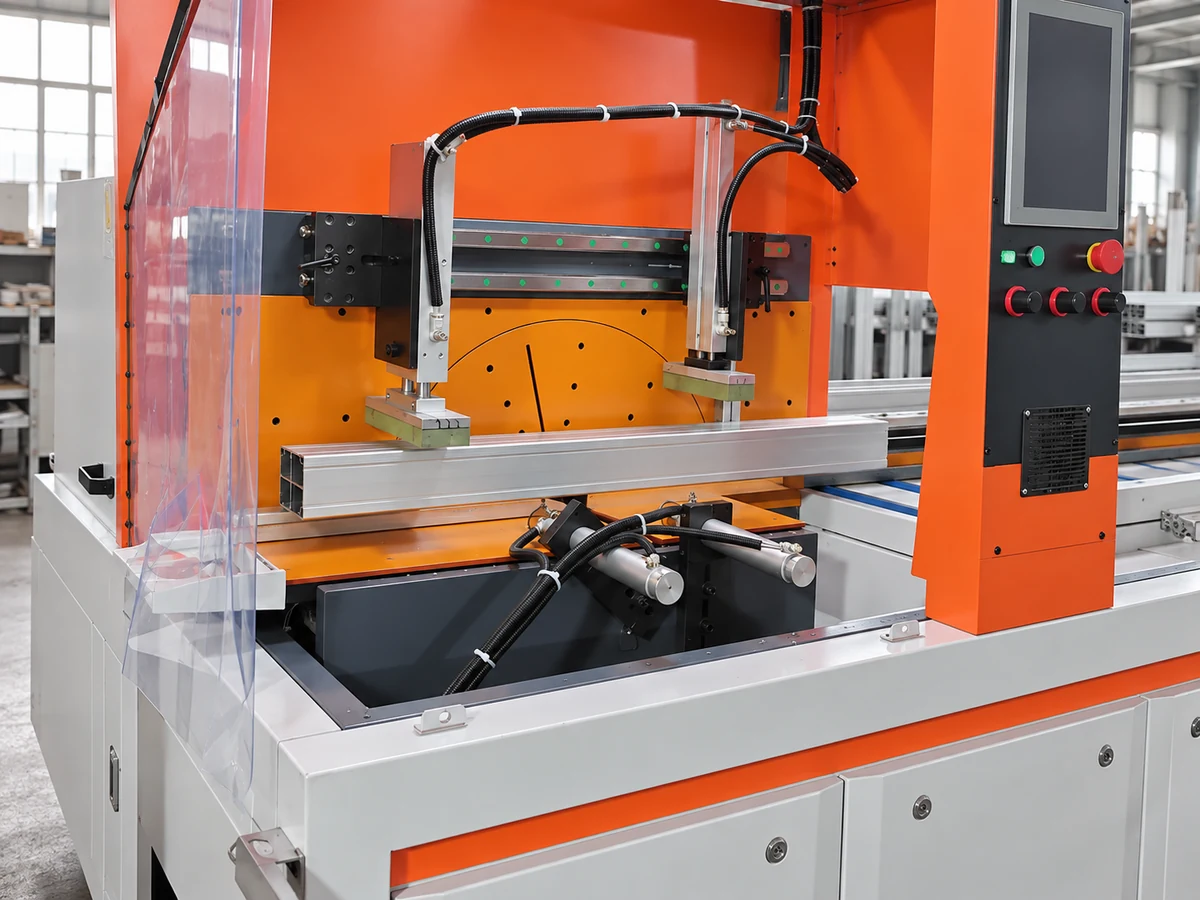
An advertised actuator stroke describes movement of an actuator in a stated configuration. It is not automatically the usable gap between installed jaw faces. Pad thickness, mounting position, stop setting, fixture brackets and profile support all change the workpiece space. Ask for the gap with the quoted pads and fixtures fully open, and for the position where the jaws make stable contact on the smallest profile. Note whether the adjustment requires a different pad, a moved bracket, a changeover operation or another fixture. A long stroke is of little value if the contact lands on a thin fin, a hollow unsupported wall or a corner that lets the part roll.
Also separate horizontal jaw clearance from vertical clamp clearance, bed support, blade path and guard opening. The tallest section might pass the jaws yet fail the guard or blade envelope. Conversely, a small section might fit the nominal machine capacity but be too low for the installed upper pad to reach its intended bearing surface. For that neighboring check, see our upper and lower clamp trial guide; this article concentrates on the two endpoints of usable jaw travel across a mixed profile family.
Put the quoted arrangement in one verification table
| Buyer input | Supplier evidence to request | Decision question |
|---|---|---|
| Smallest profile, exact orientation and pad contact face | Installed pad drawing, reachable contact position and a clamped trial image | Does the jaw close on a supported surface without bottoming out or relying on a loose spacer? |
| Largest profile and any projecting feature | Fully open gap with the quoted fixtures, plus loading and guard clearance record | Can the stock enter and leave without striking a pad, bracket or guard? |
| Fragile or asymmetric section | Support and contact layout, trial part and post-clamp inspection | Is the part held without visible damage, tilt or movement under the agreed trial? |
| Changeover between endpoints | Operator steps and required accessories | Is the needed adjustment included in the quote and practical for the intended mix? |
Do not substitute a single “maximum cutting size” line for this table. It answers a different question. Similarly, an output part tolerance is not proved by a feed-axis positioning figure. Ask for the actual cut-part acceptance method separately.
Run a witnessed endpoint trial, not a catalog comparison
Agree on a safe procedure with the supplier before any powered test. With the machine stopped and isolated as required by its instructions, inspect the open position and confirm the stock path. Fit the specified pads and supports. Place the largest sample in the quoted orientation and document entry clearance, seating and clamp contact. Then use the smallest sample without an unquoted improvised spacer. Document where the jaw stops and whether the contact remains on a supported surface. Repeat after changing back to the large sample so that the result does not depend on a one-off setup.
Only after the workholding arrangement is accepted should a supplier-operated cutting trial proceed under its normal guarding and operating procedure. Capture the sample ID, fixture settings, operator, revision and inspection outcome. Check for slippage, twist, indentation and changes to the intended cut reference. If the supplier proposes a different pad or dedicated nest, repeat the endpoint checks in that final quoted configuration. A demonstration on a convenient stock size is useful for observing machine motion, but it is not evidence that both of your endpoint profiles fit.

When the two endpoints need different hardware
A fixed setup may not serve a very broad family. The sensible answer can be an approved pad set, adjustable contact, dedicated nest, separate setup or a different machine. Request a priced bill of those items and a changeover method. Keep the two trial records attached to the final configuration so a later quote revision does not silently remove the parts that made the range possible. If no acceptable contact and clearance arrangement is demonstrated, leave the clamp-range claim open rather than treating a longer catalog stroke as a cure.
This is consistent with general clamp selection guidance: workpiece size and uniformity affect clamp choice, and exerting force differs from rated holding capacity. Neither number independently proves safe contact on a thin aluminum section. DESTACO’s clamp selection guide and its force terminology guide are useful terminology references, but the saw supplier must validate its own installed arrangement.
What a useful RFQ reply should contain
- The exact profile drawings and orientations the supplier reviewed, including their revisions.
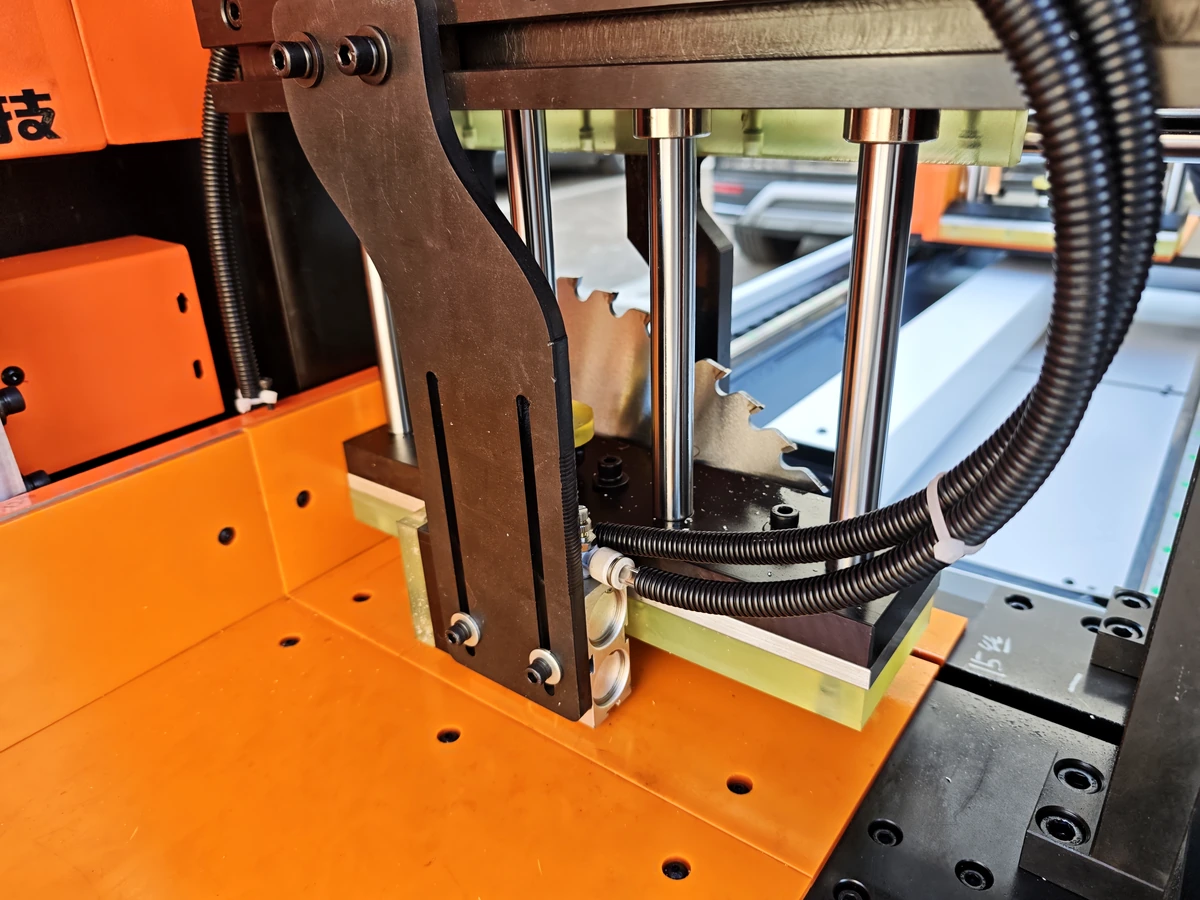
- The open jaw-face clearance and usable closed contact positions for the final quoted pads and supports, with the measurement locations identified.
- A fixture and pad list showing included items, optional items and changeover work.
- Separate confirmation of guard, blade-zone and infeed clearance for the largest section.
- Witnessed endpoint trial records for the smallest and largest profiles, plus the fragile member if different.
- An explicit exception list for profiles not demonstrated, and the proposed remedy for each exception.
For fixture-specific contact questions, our square-tube clamping guide and multi-cavity fixture guide address shapes that need more than a generic jaw-gap claim. For manual versus pneumatic actuation, see the separate clamping-method trial plan.
Equipment video: visual context only
The following video is from Jiurun Machinery’s own YouTube channel. It shows general aluminum-cutting equipment and a visible clamping/cutting area. It does not prove the jaw travel, profile range, exact configuration, customer material, witnessed trial or performance discussed above. Require the measured evidence and trial record for your own quoted machine.
Next step: Send JiurunCut your smallest and largest cross-section drawings, the intended clamp orientation, and a fragile or asymmetric sample description. Ask us to return a configuration-specific jaw and clearance checklist with the proposed trial scope before you place an order. Contact JiurunCut with your drawings and purchase questions.