
Multi-cavity aluminum extrusion clamping deserves its own line in a saw RFQ when one purchase must cut several hollow or webbed profiles. A drawing may give the nominal envelope, yet it does not decide which face becomes the locating datum, where the stock is supported, or how the clamp avoids distorting a wall before the blade reaches it. The buying decision is the complete fixture and verification route for the released profile family, not a claim that a larger clamp force will solve every section.
This guide is for a buyer specifying a new aluminum saw or a quoted fixture package. It covers the approved stock set, contact plan, changeovers, sample evidence and acceptance responsibility. It does not prescribe a clamp pressure, prove a particular Jiurun configuration, or replace the machine builder’s risk assessment and the buyer’s qualified setup procedure.
Define the stock family before requesting a fixture price
Start with the actual extrusion drawings and identify each section revision that the saw must receive. For every member, list the alloy and temper if specified, outer envelope, wall and web locations, open grooves, surface condition, stock length range, permitted bow or twist at receipt, intended cut length and subsequent operation. Mark which faces may be contacted and which appearance or assembly faces must be protected. A nominal width alone can hide a different internal web arrangement, so two profiles that fit the same opening may still require different locating or pressure contacts.
Ask the extruder or purchasing engineer to identify the controlling dimensions and tolerances on the released drawings. The Aluminum Extruders Council’s design guidance explains why extrusion cross-section, wall balance, hollows, ribs and other details matter to the profile design. That guidance informs the questions to ask; it does not approve a particular saw fixture. Define the receiving condition too: raw extrusion, cut stock, coated profile, or a mixed family may call for different contact protection and inspection evidence.
A useful RFQ attachment is a small profile matrix: drawing and revision; representative low, high and typical stock sizes; permitted contact zones; datum face; finish; required cut; downstream operation; annual and batch mix; and the trial pieces the supplier will receive. If a critical item is unknown, mark it as an open decision rather than letting the quotation silently assume a convenient sample.
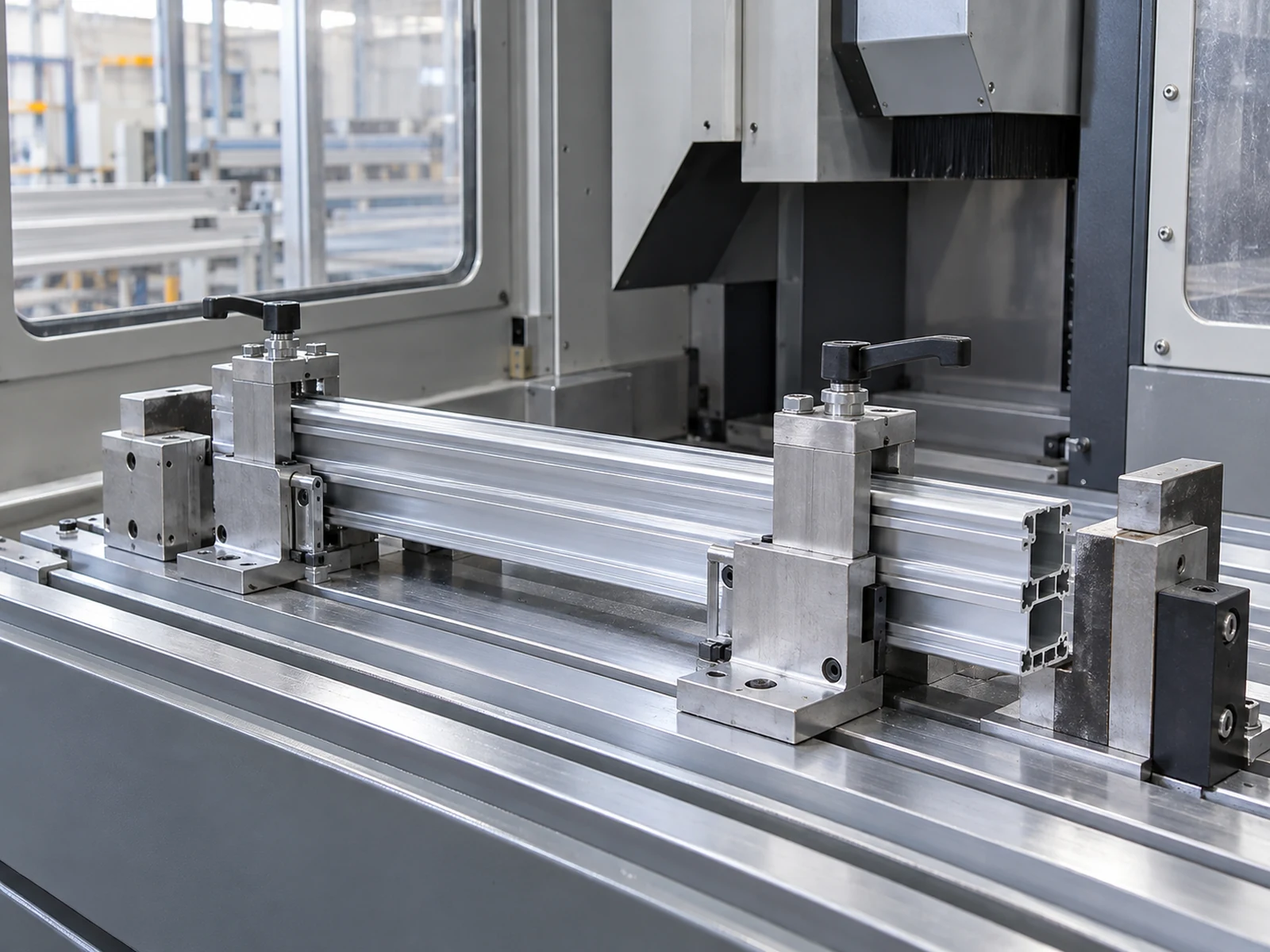
Multi-cavity aluminum extrusion clamping: locating, supporting and holding
Request a contact drawing rather than a single promise of secure clamping. The supplier should show the primary datum and stop, side location, vertical support, hold-down pads, support close to the cutting zone, and the location of any movable contact. A locating face establishes where the part sits. A support resists movement or deflection. A hold-down retains the stock through the cutting cycle. Those jobs may share components, but they should be distinguishable in the proposed setup and in the acceptance test.
For multi-cavity sections, ask which walls or webs carry contact load and which surfaces remain free. A broad pad is not automatically suitable when it presses across an unsupported opening. Equally, a pad positioned above an internal web is only helpful if the received extrusion, tolerance range and fixture alignment put the web where the pad expects it. The buyer should require a drawing or sample setup that makes these assumptions visible, then check the worst credible profile variation with the supplier. This is a design review, not a universal rule to clamp above every web.
Workholding suppliers illustrate the wider principle: SCHUNK describes contour-adapted contact for delicate or thin-walled workpieces. Its product is a different application, so do not transfer its capacity or performance claims to a saw. The relevant procurement lesson is to make contact geometry and deformation risk explicit. Ask the saw supplier to propose the actual pad material, adjustment method, replaceable wear items and permitted contact locations for the specified extrusions.

Check the whole length and the cut-end handover
A short sample held neatly at the blade does not establish how the full stock length behaves. Ask how the incoming bar is supported, guided and prevented from rotating or rocking as it advances. Identify where a trailing end loses support, where the newly cut piece is retained, and how an operator or downstream device receives it. Bring the shortest retained part and the longest normal stock into the trial plan. If a short remainder or a cut part cannot be handled within the proposed arrangement, ask the supplier to state the permitted operating boundary instead of assuming every part can run automatically.
Separate stock feed positioning from the finished cut length and end condition. A feed-axis number alone is not a part-accuracy promise. The acceptance method should define the reference face, measurement location, instrument, number and mix of pieces, and treatment of burrs or distortion. See the site’s acceptance measurement guide for a way to agree the measurement method before the trial, and its incoming-stock envelope guide for the stock-path boundary.
Specify changeover and exception handling
If the purchase is justified by a profile family, ask for a changeover demonstration rather than a single well-prepared setup. Which pads, jaws, side guides or support blocks are exchanged? Which reference points are adjusted? How is a correct fixture set identified against the drawing revision? Who authorizes the first piece after a change? The quote should distinguish supplied tooling from optional tooling, as well as any parts the buyer must machine or purchase separately. Request spare contact pieces, drawings and a documented replacement route if they are needed to sustain production.
Ask for a controlled response to a crooked bar, failed clamp confirmation, damaged pad or trapped offcut. A sales video cannot validate that response. The equipment supplier and the buyer’s safety team should agree safe access, guarding, isolation and restart procedures for the installed station. OSHA’s machine-guarding guidance describes point-of-operation protection and energy control; the applicable local rules and a site-specific assessment still govern the installation. Do not use an image of a person near a fixture as a setup instruction.

Build an acceptance test around the difficult members
Agree a sample matrix before ordering. Include a section with large unsupported spans, one with tight or asymmetric contact choices, the longest normal stock, the shortest retained piece, and any coated or appearance-critical section that changes contact protection. These are categories to select from the actual released family, not claims that every buyer has them. Record the drawing revision and receipt condition of each sample. If the supplier cannot test a member, put the remaining risk and a later acceptance action in the commercial agreement.
At the trial, observe setup and first-piece release, stable positioning, clamp confirmation, visible movement at the cut, cut-end handover, and the finished piece after unclamping. Record any witness marks or permanent section deformation against the agreed drawing and appearance criteria. Compare repeated pieces using the shared measurement method rather than judging one favorable sample by eye. The result should show which profile and setting passed, what was adjusted, and what remains unproven; it should never be turned into a blanket performance guarantee for all profiles or production conditions.
When a failure appears, decide whether it belongs to stock conformance, contact geometry, support, feed, blade/process selection, measurement, or handling. A revised pad or support may fix one condition but invalidate a different family member. Require a documented rerun of the affected samples after any material fixture change. Keep the original and revised evidence so the final accepted setup is identifiable to operators and maintenance staff.
Compare quotations on the same deliverable
Two prices are comparable only when they cover the same saw boundary and fixture work. Ask each supplier to identify the machine model and confirmed configuration, all included clamps and supports, profile-specific tooling, commissioning, guarded access, training, spare parts, sample trial, measurement responsibility and acceptance location. Price optional fixtures and later profile additions separately. Clarify who owns the fixture drawings and whether a new drawing revision triggers an engineering change.
A lower initial price may be appropriate if your work is limited to one stable profile and you can accept a manually verified setup. A broader fixture package may be justified when the released family, changeover frequency and rejected-part cost are real. Make the decision using your actual part mix and agreed trial evidence; do not infer a payback period or throughput from generic footage.
Questions to send with the RFQ
- Which released profile drawings and revisions are included, and which are excluded?
- Where are the datums, supports and clamp contacts for each section, and what surfaces must remain mark-free?
- What changes between profiles, and how is the correct fixture identified and checked?
- What are the accepted full-length stock, short-remainder and cut-part handover boundaries?
- Which representative parts will be trial-cut, measured and inspected after unclamping?
- Who owns unresolved sample failures, fixture revisions and the final release decision?
Send the drawings, batch mix, finish requirements and sample plan with the inquiry. Ask the supplier to return a marked contact layout, included/excluded tooling list and proposed trial protocol. Contact JiurunCut for a configuration discussion, with the understanding that a specific fixture and its performance require engineering review and an agreed test.
Equipment video: general example only
The following Jiurun Machinery channel footage shows a saw operating. It is general equipment footage only; it does not show the multi-cavity profile, fixture configuration, customer, trial or performance discussed in this article.