
The JR-455Q upper-lower clamp trial should answer a specific buying question: will the quoted semi-automatic saw hold each released profile without shifting, marking or deforming it while producing accepted cut parts through a realistic staffed cycle? A video of a covered blade and a clean-looking end is useful context, but it cannot settle that question for your stock. Build the request for quotation around contact points, support, first-part inspection and operator handoffs before comparing prices.
Jiurun’s catalogue lists the JR-455Q in its semi-automatic saw family and describes linked clamping, oil application and cutting functions. The company-channel video below shows a related semi-automatic saw, not the quoted JR-455Q configuration. Neither source proves the exact clamps, fixture, blade, guard, utilities or finished-part results of the version you will receive. Ask for a configuration drawing and a witnessed sample plan tied to the quotation. The semi-automatic versus CNC comparison is a separate decision; this guide tests the contact and acceptance boundary of a proposed JR-455Q station.
1. Define the incoming profile families and protected faces
Send the supplier released drawings and a stock list, not just a nominal extrusion width. For each family specify alloy and temper if relevant, cross-section, wall and fin features, incoming length range, bow or twist allowance, coated or visible faces, and the planned number of pieces per load. Identify the face that may touch the fence, the face that must not be marked and the datum from which the finished length is measured. If the factory receives both hollow sections and solid bars, do not assume the same clamp pad and support arrangement suits both.
Mark which drawings are recurring production and which are occasional repair or prototype work. The latter can impose a large setup burden even when the cutting motion is fast. Include the shortest intended accepted part and the longest incoming stock as separate handling cases, then ask for a layout showing infeed, standing space, cut zone, accepted-part collection and remnant storage. A photograph of a compact machine does not prove that the full material route fits your floor or protects a long profile from sag.
2. Map the clamp contacts before asking for a cut
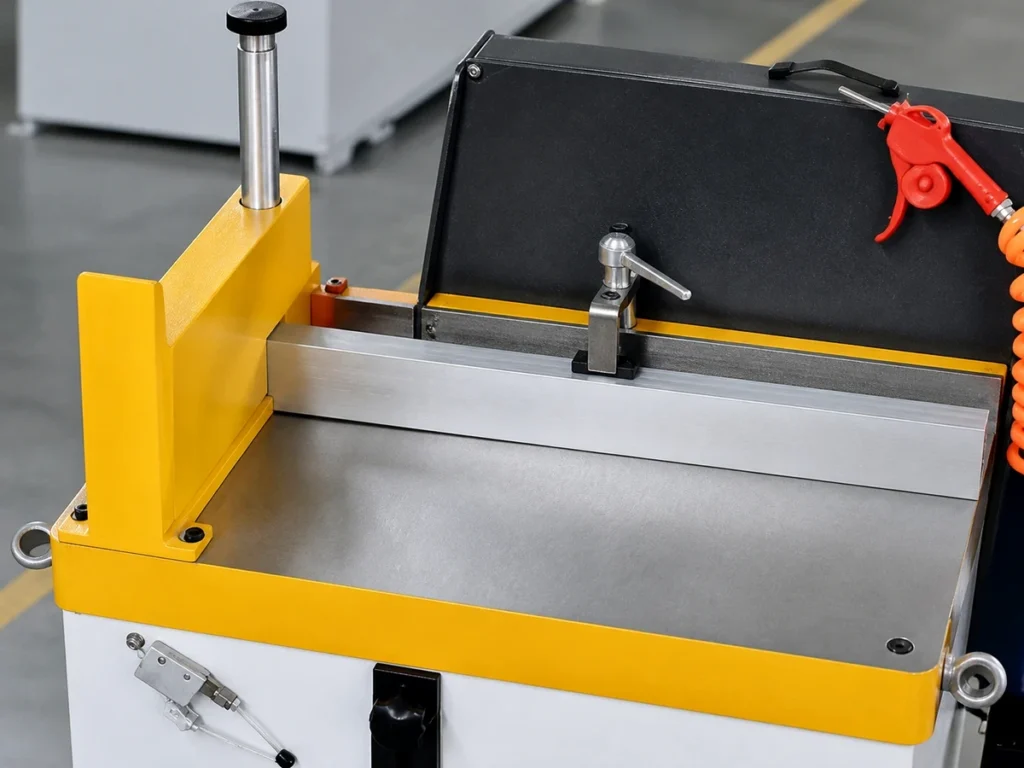
On the quoted machine, request a marked diagram of every proposed top, bottom and side contact surface, including optional shaped pads, stops and sacrificial protection. The visible yellow fence and top hardware in the illustrative media-library image help locate the questions, but the photograph does not certify the delivered clamp circuit or contact force. Ask the supplier to identify what moves the clamp, which adjustments are operator-set, how the stock is positioned against a repeatable datum and what prevents a slender wall from tipping or crushing. Do not infer clamp pressure or a safe setting from a video.
At the witnessed trial, present an untouched profile and watch a trained operator place and clamp it under the supplier’s documented procedure. Record whether the bar shifts when the contact closes, whether a protected face touches bare metal, and whether the far end rises or rolls. Mark the intended contact points on a sample drawing and photograph the actual trial fixture by agreement. If a pad, nested support or different stop is needed, add its part number and quantity to the quote. A good first cut made with an unquoted fixture is not evidence for the base-machine offer.
3. Select samples that expose the difficult contact case
Choose at least one ordinary section and one section whose geometry can make clamping difficult: a thin wall, uneven base, finned surface or protected visible face. The buyer should specify why each sample is in the trial, rather than accepting only the easiest stock selected by the seller. If the proposed process groups several pieces, define their count, orientation and identification method. A single successful group does not establish that every section in the purchasing mix can be cut together. Record when the supplier recommends single-piece loading instead.
Agree the sample sequence before the visit: first part after a fresh setup, consecutive parts without adjustment, first part after a profile change, and a representative remnant. Note who is allowed to alter the stop, pads or blade setting between samples. If the operator needs to reset contact after each bar, include that effort in the cycle. Keep a traceable sheet with stock ID, drawing revision, fixture, setup change, cut count, measured part and disposition. Do not describe an untimed demonstration as a throughput result.

4. Inspect accepted parts, not only a moving blade
Write acceptance criteria from the drawing: finished length from the correct datum, cut-face condition, squareness or angle if applicable, burr limit, surface marks and any machining allowance needed downstream. Identify the gauge, measurement points and sample quantity in advance. For hollow or flexible profiles, agree whether measurement occurs in free state or in the fixture used by the next process. Keep setup pieces, accepted pieces, holds and scrap in separate trays so that a photograph of one favorable end cannot stand in for a production lot.
For each profile family, compare the first piece with later pieces and record any drift, movement, clamp imprint or change in end condition. If an end needs deburring or a later machining step, state that boundary plainly. The saw may deliver a blank, not the final assembled component. Ask the supplier to sign the same acceptance sheet as the buyer and to note exceptions rather than relabeling them as general tolerances. Catalogued feed positioning or a promotional claim is not a finished-part accuracy guarantee.
5. Walk the staffed cycle and safe access boundary
Time the complete operator route: retrieve and orient stock, set a stop, place supports, clamp, initiate the cut, unload, inspect and segregate the part, then handle chips and remnants according to the supplier’s procedure. Identify work that happens outside the visible machine, including lifting a long bar, changing a shaped pad or cleaning a collection point. A semi-automatic cutting cycle does not automate sample selection, loading, measurement or output reconciliation. Compare accepted parts per staffed cycle, with the same labor boundary, rather than quoting only blade travel time.
Request the quoted guard and access arrangement, control locations, emergency-stop locations, blade-service access and maintenance documents. The operator should demonstrate under the supplier’s approved procedure. This article is a procurement checklist, not an operating instruction: do not improvise access to the cut zone or defeat a protective function to test it. A visible cover in a photograph or video does not verify an interlock, protective performance or the delivered machine’s compliance. Have trained personnel review the actual version and local site requirements.
6. Reconcile the quotation with the demonstrated setup
List the included machine release, blade, clamp pads, stops, infeed and outfeed supports, guard, lubricant or spray equipment, chip handling, utilities, installation, training and service documents. State what the buyer must provide, including floor space, power and any compressed-air or fluid connection confirmed for the quoted variant. If the sample demonstration uses an auxiliary roller table or special pad, price it explicitly. Ask which changes are standard adjustment, which require a different fixture and which require a different machine proposal.
The JiurunMachinery clip below shows related semi-automatic equipment and stock handling. It is general equipment footage, not proof of your material, the quotation’s clamp circuit or guard, a witnessed trial, burr-free accepted parts, blade life or cycle performance. Read its promotional labels as questions to verify on your own sample sheet.
7. Attach a witness matrix to the RFQ
Send a one-page matrix with each stock family, drawing revision, protected faces, allowed contact areas, expected load count, finished-part checks and planned annual mix. Ask the supplier to return the exact model/configuration, fixture and support list, trial schedule, sample count, operator boundary and method for recording rejected parts. A useful witness sheet has columns for stock ID, setup, contact map, observed movement, measured result, exception, corrective change and retest decision. Include the first part after a profile change, because it is often where setup assumptions surface.
The right JR-455Q purchase is the one whose quoted equipment and operator route can repeatedly produce the accepted blanks you need, with unproven assumptions visible before an order. Share your profile drawings and sample plan with the JiurunCut engineering team, and request a version-specific layout and witnessed test proposal. Preserve the signed results as the basis for installation acceptance rather than converting a short demonstration into a broad performance promise.