
Aluminum extrusion wall thickness needs more than one number on an inquiry. Buyers must distinguish the wall the extruder can make, the dimensional limits the drawing allows and the material that must remain after later work. A nominal value alone does not answer all three questions.
Start with the actual section drawing, alloy and manufacturing route. Then identify the critical wall features and the stage at which each requirement applies. This guide helps purchasing and engineering teams prepare that conversation without treating a general thickness rule as a supplier guarantee.
On this page
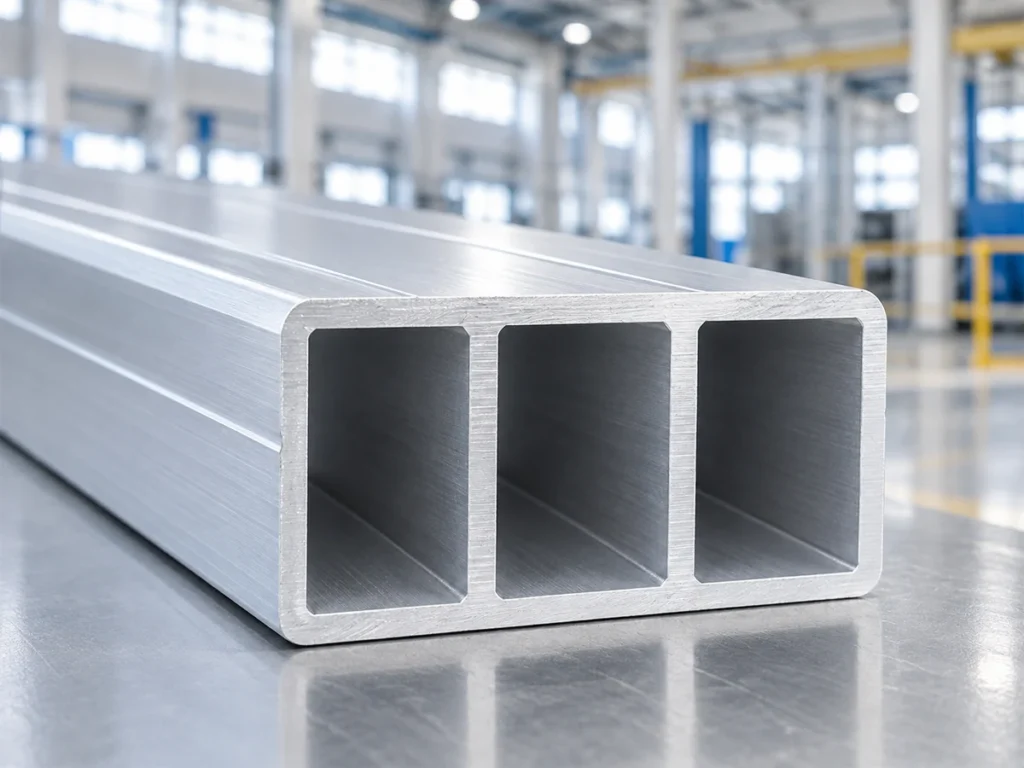
1. Review aluminum extrusion wall thickness with the actual section
There is no useful universal minimum that can be applied to every aluminum extrusion. The section geometry matters. A broad outer wall, an internal web and a small local feature can present different manufacturing questions, even when they belong to the same profile.
Capral’s 6005A alloy flyer describes the minimum available wall thickness as a function of section design. That is a reason to submit the complete shape for review. It is not a numerical minimum for another alloy, another profile or your supplier’s equipment.
Show where the critical walls are
Mark the walls that control assembly, fastening or later machining on a section view. Give each important feature an identifier so that the quote, drawing review and inspection plan refer to the same location. Include the drawing revision and requested material designation.
A supplier cannot reliably interpret “thin wall” when the inquiry contains only a photograph or an outside width and height. Internal geometry, local changes in thickness and the relationship between adjoining features may be important to the manufacturing review.
Hydro’s extrusion design discussion notes that uniform walls are simplest to produce, while walls within a section can vary. Use that distinction to ask about your design. Do not assume that every change in thickness is unacceptable, or that a uniform section is automatically approved.
The practical output is a recorded response: the design can be quoted as submitted, needs a specific revision or requires further review. Capture any condition attached to that response before comparing offers.
2. Separate nominal thickness from the lowest allowed value
The nominal dimension is the drawing’s reference value. A tolerance defines the permitted dimensional range. A minimum requirement can place an additional boundary on that range. Read the complete requirement rather than treating the largest printed number as the acceptance rule.
A small example makes the distinction visible
Consider an invented wall dimension of 2.00 mm with a tolerance of ±0.20 mm. Its arithmetic limits are 1.80 mm and 2.20 mm. The nominal value is 2.00 mm, but the tolerance permits a lower value of 1.80 mm.
If engineering also requires at least 2.00 mm on that same wall at that same stage, the requirement needs clarification. The shared acceptable range might be 2.00–2.20 mm, but only if that interpretation is confirmed by the drawing owner. Do not independently change the tolerance or overlook the minimum note.
| Requirement | Question to resolve |
|---|---|
| Nominal dimension | Which identified wall does the reference value describe? |
| Permitted range | What are its upper and lower limits? |
| Minimum wall | Does it apply to incoming stock or the finished feature? |
| Inspection basis | Where and how will that requirement be checked? |
This is an arithmetic example, not an extrusion tolerance recommendation. The values do not describe the illustrated profiles or prove their suitability for a structural, electrical or pressure application.
For the separate task of checking delivered material, see the aluminum tube wall thickness inspection guide. It covers measurement locations and records. Here, the decision is which requirement should exist before material is ordered.
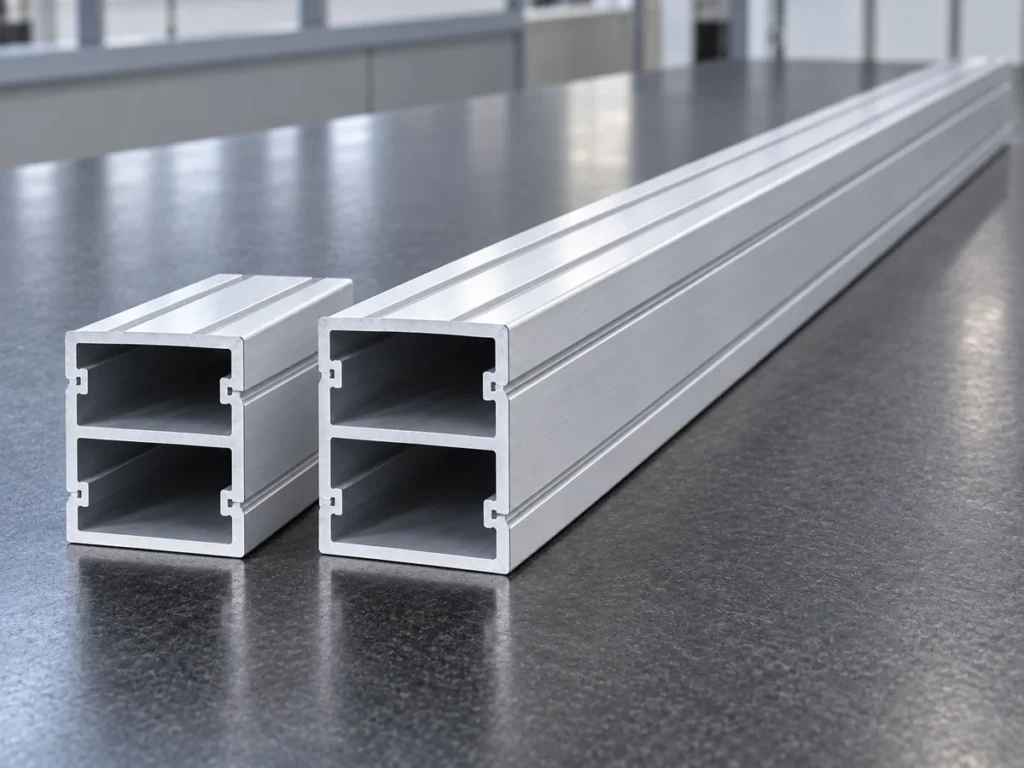
3. Check what remains after planned material removal
A wall that meets the incoming-stock requirement may still need a separate review if a later operation removes material from it. State the finished-wall requirement and the planned removal allowance together. Otherwise, the extrusion purchase and the machining plan may use different assumptions.
For a deliberately simplified, invented example, suppose a wall starts at 2.20 ±0.20 mm. Its lower incoming limit is 2.00 mm. If a later operation uniformly removes 0.10 mm from one face of that wall, the simplified remaining lower value is 1.90 mm.
Changing the invented starting value to 2.30 ±0.20 mm gives a lower limit of 2.10 mm. Subtracting the same 0.10 mm leaves 2.00 mm. That arithmetic shows why an incoming dimension and a finished minimum are different planning questions.
These assumptions exclude additional variations and do not establish a machining allowance, a safe finished thickness or a suitable profile design. Engineering must review the actual operation and all relevant requirements. Use the machining allowance and blank checks guide to prepare that handoff.
Keep wall removal separate from saw kerf
Saw kerf consumes material along the cut length. It does not, by itself, mean the profile’s wall becomes thinner. A length allowance for end finishing also differs from material removed from a wall face. Name the operation and feature so those allowances are not combined into one unexplained number.
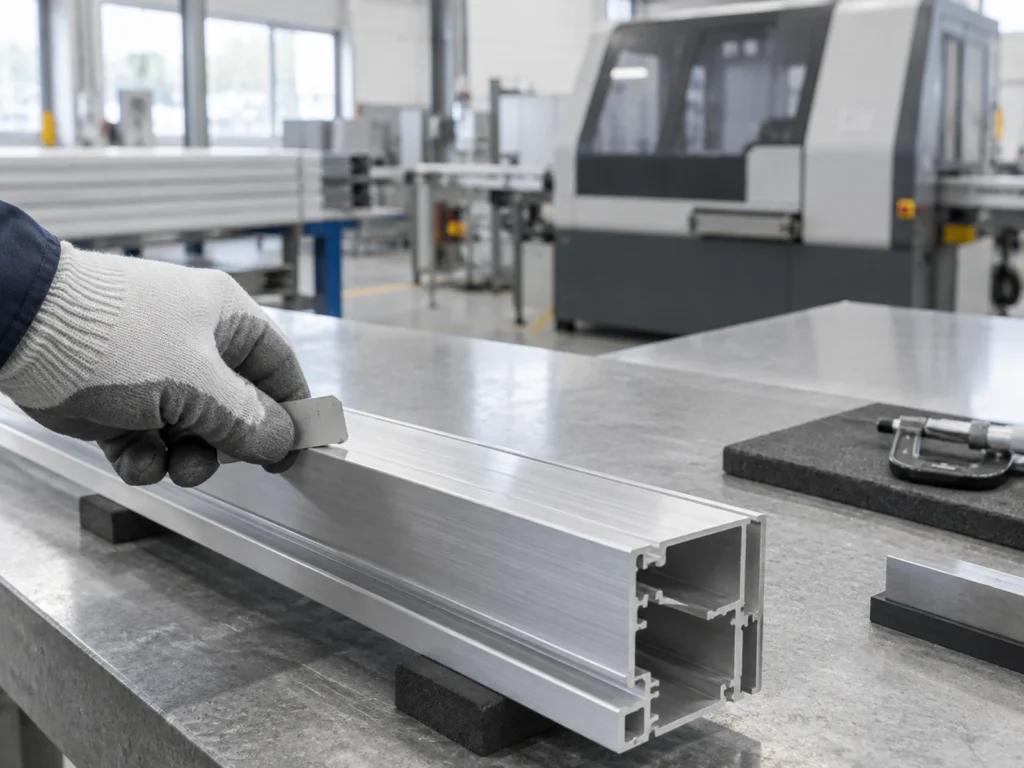
Prepare a clear supplier handoff
Send one controlled package containing the section drawing, material designation, revision, critical wall identifiers and dimensional requirements. Add any planned operation that could change those walls. Ask the supplier to state exceptions against that package instead of returning an unqualified “suitable” response.
Keep material identity and dimensional acceptance as separate checks. An aluminum material certificate can support material review, but it does not replace the agreed wall inspection record. Record both before releasing stock for the next operation.
Common wall-thickness questions
Is a nominal wall the same as a guaranteed minimum?
No. Review its tolerance and any minimum note. Also identify the stage and feature to which each requirement applies.
Can I borrow a minimum from another profile?
Use it only as a question for design review. A different section or material needs its own supplier confirmation.
Does cutting to length reduce the wall thickness?
Ordinary saw kerf concerns the cut length. Review wall thickness separately if another operation removes material from a wall face.