
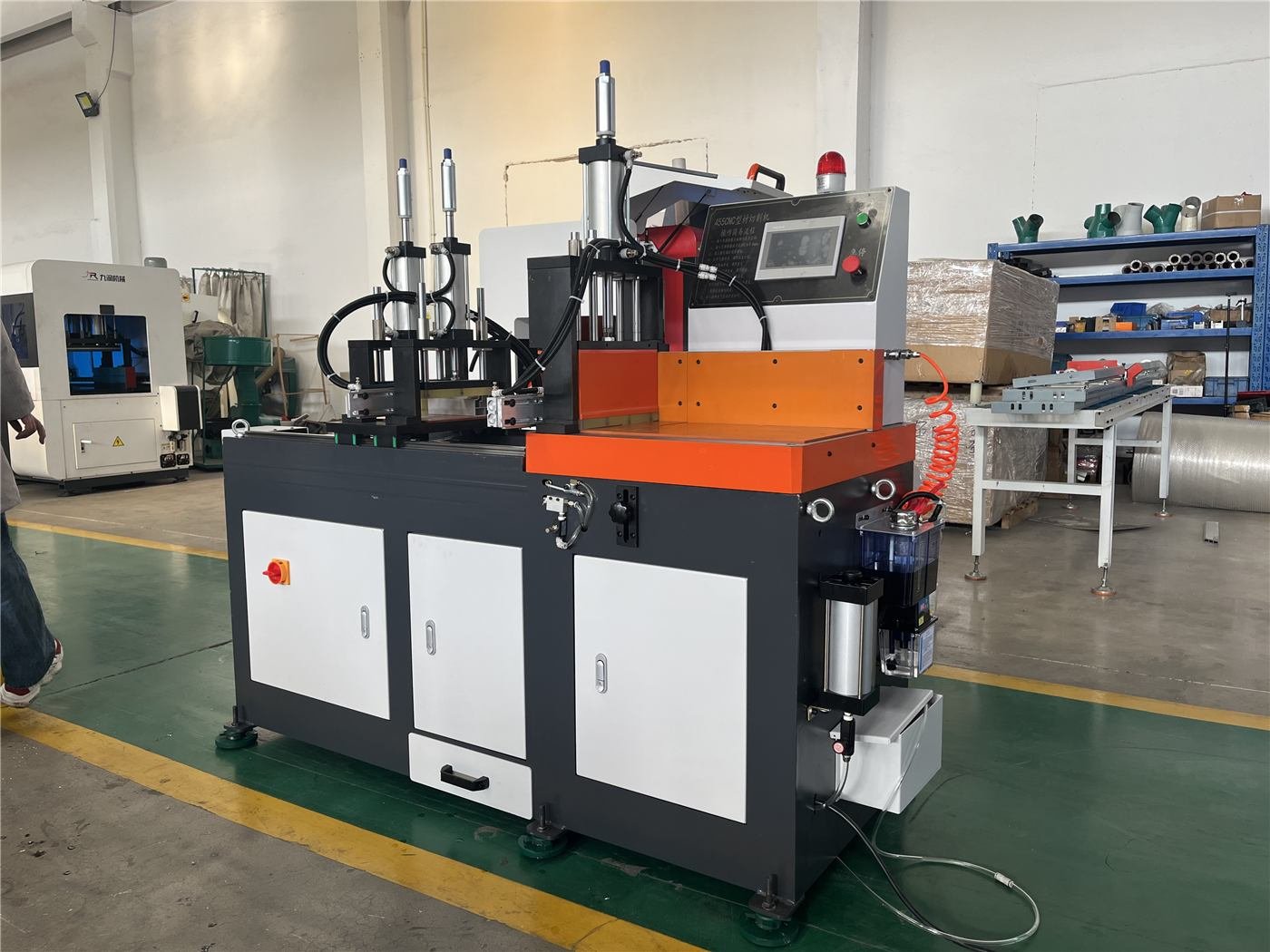
V-slot aluminum rail cutting has two acceptance questions: is each member the right cut length for its assembly, and is the V-wheel path still fit for the chosen carriage? A clean-looking end face alone cannot answer the second question. Before asking a saw supplier for a quote, identify the exact rail section, the wheel and carriage, the faces the fixture may touch, and the work that happens after the cut. This guide is an RFQ and sample-release checklist for straight rail blanks. It does not specify a universal machine setting or claim that a particular Jiurun model has passed your part.
What makes a V-slot rail different from an ordinary framing cut?
A V-slot profile combines framing slots with angled guide faces for a matching wheel. The published HandsOn Technology 2040 V-Slot data sheet describes one particular 20 × 40 mm aluminum rail, its section and its center hole. That is an example section, not a dimensional rule for every rail sold as “2040.” The supplier’s full cross-section drawing and the actual wheel determine fit.
Do not substitute a T-slot profile merely because the outside dimensions or framing hardware look familiar. The Aluminum Profile Works V-Slot overview describes the angled groove edges as wheel-running surfaces and tells buyers to match wheels, carriage and section. A T-slot can be a useful framing comparison, but its name does not confirm the required V contact.

Freeze the section and the motion hardware before quoting
Send the saw vendor the approved section drawing or an identified sample, not only a nominal outside size. Mark which V faces carry the wheels, which slots hold fasteners, whether a face is closed, and which end receives a plate or thread. Include the wheel and carriage drawings or part numbers. These inputs let the supplier distinguish a straight saw blank from a finished motion-axis component.
- Section identity: supplier, drawing revision, alloy and temper if known, finish, and the exact open or closed variant.
- Mating parts: wheel profile, carriage spacing, plates, nuts and any end fasteners that must fit this section.
- Cut list: individual member lengths and quantities, not just the assembled outside envelope.
- Post-cut work: tapping, drilling, deburring, cleaning, coating touch-up or protective packing, each assigned to a named supplier.
If the customer changes the rail source or wheel, treat it as an interface change. Recheck the drawing and sample rather than carrying a previous sample approval across silently. Our T-slot saw-trial checklist addresses framing and assembly ends; a V-slot job adds the wheel-running face to the release decision.
Choose a length datum and fixture contact that the section can actually support
State where length is measured: between the two finished end planes, between a cut end and a later machined feature, or through an assembled plate stack. If the rail will be tapped, the cut length and tapped-end requirement are separate entries. A center hole visible in a catalog section is not a finished thread. Mark which end is the reference end and whether both ends need the same squareness and burr condition.
For a V-slot aluminum rail cutting trial, show the operator the designated clamping and support faces. Avoid assuming that pressure on a V-running edge is harmless. The fixture proposal should identify jaw contact, stop contact, support along the stock, and the direction in which the bar is loaded. Check the smallest and longest requested members, including any short piece whose end is close to the clamp or stop. A short offcut can be useful for section fit, but it may not reproduce full-stock support or handling; see the trial stock-length guide.
Release the cut end and the wheel path as separate checks
Specify the agreed length tolerance, end squareness reference and burr acceptance on the drawing or inspection plan. Then inspect the V-running faces at the entry and exit of the cut. Look for a raised lip, dent, embedded chip, finish damage or a mark from a stop or clamp. The objective is to protect the contact path, not to demand a cosmetic appearance that the buyer has never defined.
Use an agreed wheel and carriage to check the first sample over the required travel and at both ends. Record where contact changes or the carriage catches. A passing caliper length does not replace this mating test; conversely, a smooth hand roll does not document cut length. If the rail must join end to end, inspect the joint with the intended plate or connector as a separate operation.
V-slot aluminum rail cutting: a practical sample plan
- Incoming stock: Show the exact section and finish against the approved drawing or identified sample. Buyer asks whether this is the intended rail and wheel interface.
- Setup: Show jaw, stop and support contact on the actual section. Buyer asks whether the running faces remain protected during feed and cut.
- First cut: Report length and end-face results at the stated datum. Buyer asks whether the blank meets the drawing rather than a shop convention.
- Motion fit: Run the agreed wheel or carriage over both ends and the required travel. Buyer notes any end catch, damage or change in contact.
- Repeat lot: Mark several pieces by setup and stock lot. Buyer separates accepted parts from setup cuts.
- Handoff: Identify who deburrs, cleans, packs and taps. Buyer confirms whether delivery is straight blanks or completed members.
Ask for photos or a brief record of the clamping points and the measured samples. Define the number of samples, measurement method and pass criteria in the RFQ. This checklist is a proposed acceptance structure, not proof that any pictured sample has passed it.
Related saw demonstration
The video below is a general cutting-equipment demonstration from Jiurun Machinery’s own channel. It illustrates an equipment process only. It does not show or verify the V-slot rail, its alloy or finish, an exact machine model/configuration for this RFQ, a customer project, the proposed trial, or performance on the wheel path.
Send a V-slot rail cutting inquiry that can be tested
For V-slot aluminum rail cutting, attach the section drawing and revision, an individual cut list, the mating wheel/carriage information, the permitted fixture-contact faces, end-work drawings, and the inspection and packing requirements. Ask the vendor to identify what it will supply and what it expects the buyer to supply for a meaningful trial. If the wheel or carriage is unavailable, record that the sample can only receive preliminary dimensional inspection; leave motion fit open.
Example RFQ wording: “Quote straight cut blanks from the attached V-slot rail section and revision. Protect the marked wheel-running faces. Measure length between finished cut planes to the drawing requirement; review burrs and finish at the wheel path; test the first-off and repeat samples with the named carriage. Quote end tapping and protected packing as separate lines. Do not infer an approved wheel fit from the section name alone.” Replace those fields with your own drawings and acceptance limits.
For a machine or cut-part inquiry, contact JiurunCut with the section, cut list and mating parts. We can then discuss an actual trial scope rather than promising a result from a generic photo or video.
Frequently asked questions
Is a V-slot rail the same as a T-slot framing bar?
Not automatically. Some profiles combine attachment slots and V-wheel guide faces, but the section name alone does not establish wheel geometry or hardware compatibility. Compare the full approved drawings and a mating sample.
Does a straight, burr-free end prove the wheel path is acceptable?
No. Check the contact faces along the required travel and at both ends with the intended wheel or carriage. Record the separate length and end-face measurements as well.
Can the saw supplier quote without the wheel assembly?
It can quote a defined blank and dimensional trial if the section and cut requirements are clear. A final wheel-fit acceptance needs the relevant wheel/carriage drawing or physical parts and an agreed test.