
A T-slot aluminum extrusion saw trial should answer a specific buying question: can the proposed saw, support, workholding, and part-control method deliver the approved mix of frame members to the next operation? A single neat cut through an easy square section cannot answer that question for a factory that also cuts wide, light, short, or connector-dependent profiles. Build the trial from the released product family and judge complete usable parts, not only the blade crossing one bar.
This guide is for a buyer specifying a new saw or comparing supplier quotations for T-slot extrusion cutting. It does not design a structural frame or certify a connector system. If your immediate problem is turning a frame drawing into member lengths, start with our T-slot frame planning guide. The procurement decision here starts after the responsible designer has approved the profile family and the intended joints.
Define what the saw must deliver
Ask for a released member schedule rather than a photograph of an assembled machine frame. For each line, record the profile supplier and series, exact section identifier, stock length and condition, finish state, part identifier, cut length reference, end form, quantity, and the operation that receives the cut piece. Identify any parts that arrive already cut or machined; they should not silently inflate the expected work of the new saw. A 40-series label by itself is not enough to infer slot geometry, connector fit, or a clamping surface across brands.
Make a separate route decision for every end: plain square cut, approved angle, or a cut followed by drilling, tapping, counterboring, or other machining. 80/20 distinguishes external connections that can mount through the channel from internal fasteners that may need end or cross-hole machining. A Bosch Rexroth framing catalogue likewise gives connector-specific profile preparation. These are examples of why the frame-system drawing and chosen hardware control the route. They are not evidence that a Jiurun saw performs those downstream operations.
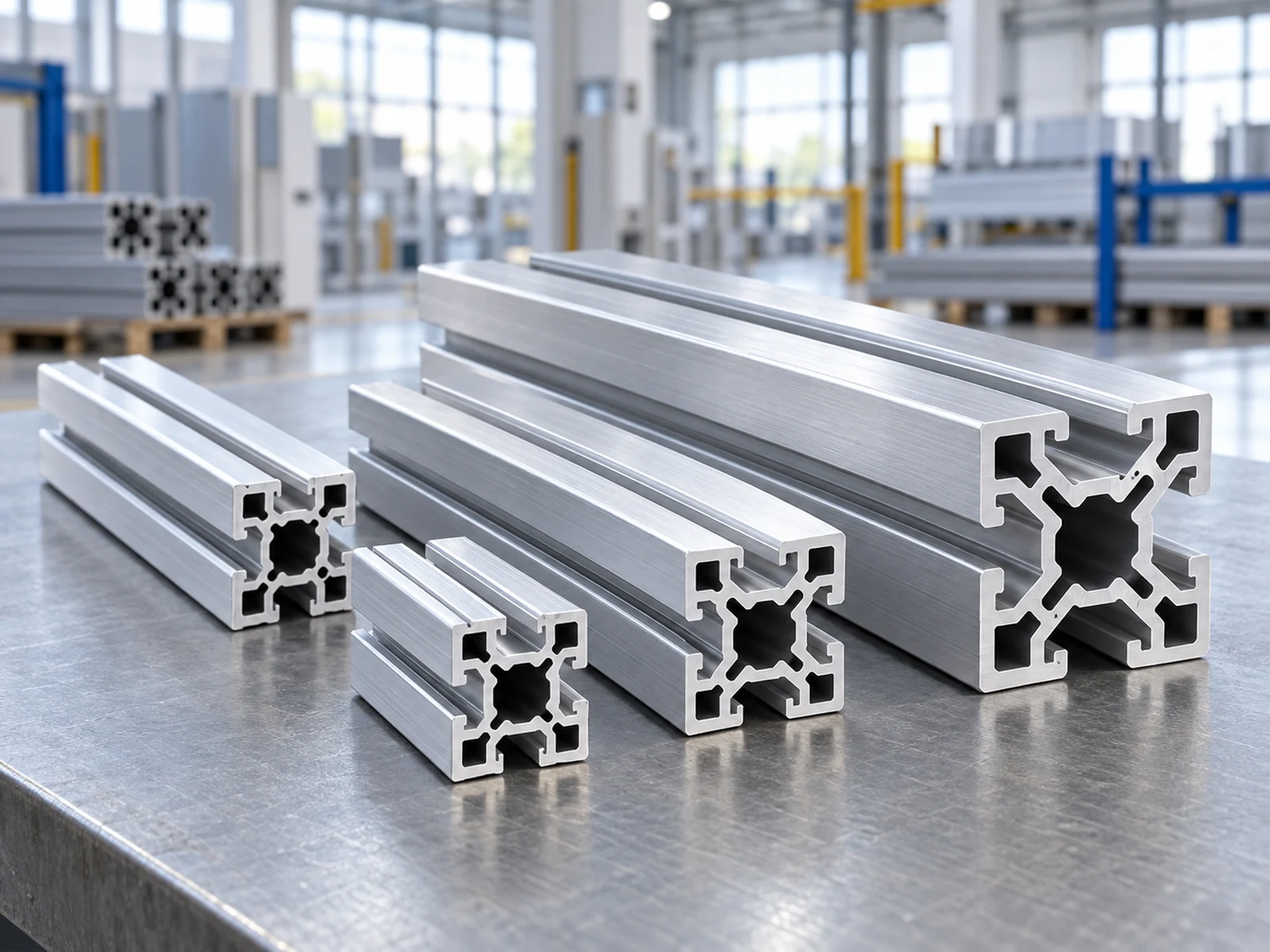
Build a T-slot aluminum extrusion saw trial matrix
Select trial pieces from the real release mix. Include the most common section, the largest or most difficult section, a light or narrow member, and at least one end condition that matters to assembly. If the factory has both short and long parts, include both. A long stock bar may feed and support differently from a pre-cut blank. If finish is applied before sawing, include that finish state instead of claiming that a bare extrusion proves surface protection.
The matrix should specify the actual stock envelope, cut length range, angle or square-end requirement, orientation of any reference face, and whether the end will be visible, joined, or machined later. Pair each trial row with a released drawing and a receiving criterion. Avoid inventing a universal tolerance: the accepted values belong to the approved part and assembly specification. Ask the supplier to state what can be checked at the saw, what needs an independent measurement station, and what remains an assembly fit check.
- Profile family and revision: one approved drawing and stock condition per trial row, including the slot face used as a reference.
- Incoming state: full bar or approved blank, straightness and surface condition as received, plus any protective film that must remain.
- Required output: part identifier, cut length convention, end angle or square condition, visible-face protection, and next-operation label.
- Acceptance method: measuring instrument or fit gauge, who owns it, sample quantity across repeat runs, and the decision if one member fails.
Do not compare quotations on blade cycle time alone. Include profile changeover, locator or pad changes, handling of long stock and short offcuts, inspection, labeling, and any downstream machining still required before a frame kit can be assembled. The same accepted member package is the comparison unit for both suppliers.
Review contact and reference faces before asking for speed
An open T-slot is useful to an assembler but may be a poor surface for a broad clamp pad. A narrow lip, a hollow core, and a visible anodized face present different contact risks. Ask each saw supplier to mark the proposed support, side datum, clamp contact, and direction of the cutting force on the actual section drawing. Then show those contacts on the physical trial sample. A schematic contact proposal is a review tool, not a safe-force setting or a promise of cut accuracy.
Inspect the stock before and after the trial for lip damage, slot obstruction, witness marks, deformation, and movement from the intended datum. Check whether the piece can still accept the approved nut or connector where relevant. This is a fit question for the actual system hardware, not an invitation to force a connector into a questionable cut. The final test should use the approved hardware and the responsible assembler’s acceptance rule.

Separate cut quality from connector preparation
A saw can produce a length and an end form, but the chosen fastening method determines whether the part is ready for assembly. For a plain cut with an external bracket, record whether the cut end clears the bracket and whether the specified length reference is correct. For an internal fastener, record the additional preparation needed and name the machine or supplier that will provide it. If the quote includes an integrated processing cell, ask for a station-by-station scope and a trial of the complete accepted output.
Do not classify every T-slot part as a mitered frame member. Butt joints, brackets, concealed connectors, and panel or guard interfaces can demand different end access and finishing routes. Our T-slot access article explains why hardware access must be planned before closing an end. For a cut-list question at intersections, consult the frame cut-list intersection guide after verifying that its drawing assumptions fit your system.
Make the trial evidence usable after the demonstration
Label every physical sample with its profile and part revision, incoming stock condition, programmed target, actual orientation, and trial sequence. Capture separate measurements for the first part after setup and later parts after a representative run. Retain both an accepted example and any failed example with the relevant observation. A photo of a single attractive cross-section does not show repeatability, fixture changeover, or connector compatibility.
Ask for an evidence pack: setup photograph with guarding intact, fixture/contact sketch, approved sample list, measurement method, part-level results, anomalies, and a clear pass/hold/retest disposition. When a sample fails, identify whether the issue is material, datum selection, support, clamping, blade condition, programming, or downstream joint expectation before another run. Do not accept a faster second run as a substitute for explaining the first failure.

Compare quotations at the same handover point
Put every supplier quote against one defined receiving state: cut-only blanks, cut-and-identified members, prepared connector-ready members, or complete frame kits. List purchased connectors, separate machining, inspection, packing, and rework outside the saw scope. Otherwise a low machine price may conceal expensive handoffs, while a higher quote may include work the buyer has already budgeted elsewhere.
For each option, ask how many released profile families can be supported by the quoted fixture set, what changeover parts are included, how long stock enters and exits the cell, which minimum and maximum part cases remain unproved, and who supports a later profile revision. Treat a brochure envelope as a screening claim until the actual section and setup have been reviewed. Where the supplier offers a specific machine configuration, tie every claimed capability to that configuration and the sample evidence rather than to another model’s catalogue value.
Video: a general saw-process example
This Jiurun Machinery channel video shows general saw equipment footage. It is an equipment/process example only. It does not prove the T-slot sections, fastening system, exact machine model or configuration, customer application, trial result, cut quality, accuracy, or performance discussed here. Request a separate trial on your approved profiles.
Practical RFQ decision and next step
Send the supplier one controlled pack: the released section drawings, member and revision list, stock states, required end forms, selected connectors, sample matrix, measurement plan, receiving point, and expected batch mix. Ask the supplier to return a configuration-specific scope, exclusions, fixture concept, trial plan, and evidence format. If these items cannot be reconciled, keep the purchase decision open even if the demonstration cut looks clean.
For a Jiurun equipment discussion, contact our team with the approved T-slot drawings and representative parts. We can review which cutting questions a proposed saw trial should answer and identify where separate machining or assembly verification remains necessary. No output or tolerance is guaranteed without the actual material, configuration, and acceptance method.