
A slow aluminum saw clamp release can seem like a cylinder fault even when the cylinder is healthy. On an aluminum saw, the time between a release command and a jaw clearing the profile includes several separate events: the control permits release, the directional valve changes state, air leaves the cylinder, and the jaw moves away from the stock. Treating that entire interval as one “clamp speed” number hides the useful evidence.
If a saw is being evaluated for production, ask the supplier to show where the delay begins. A phone video of the operator command, valve indication and jaw movement, with the machine operated under its normal guards and instructions, often makes a better starting record than an unsupported claim that one adjustment will fix the cycle.
Slow aluminum saw clamp release: locate the first pause
Record two moments separately: command to first movement and first movement to clear jaw. Repeat the observation with the same profile, clamp setting and operating mode. Note whether every cycle is slow or only the first cycle after a stop. Do not infer a valve fault from an HMI button alone; interlocks and sequence logic may intentionally delay the release command.
1. Long pause before any jaw motion
Ask the supplier to check: the command, permissive state, valve actuation and retained pressure. This does not prove: that the cylinder is undersized.
2. Jaw begins promptly but travels slowly
Ask the supplier to check: the return-side air path, flow control, silencer, tubing and mechanical drag. This does not prove: that a faster valve alone is the answer.
3. One jaw is slow and another is normal
Ask the supplier to check: which circuit and physical contact differ between stations. This does not prove: that the entire plant air supply is at fault.
4. Jaw frees only after stock shifts
Ask the supplier to check: workpiece geometry, support, chip contact and jaw alignment. This does not prove: that the exhaust path is restricted.
This sequence keeps an electrical or control delay separate from the time the air circuit actually needs to exhaust. It also prevents a mechanical bind from being misread as a pneumatic problem.
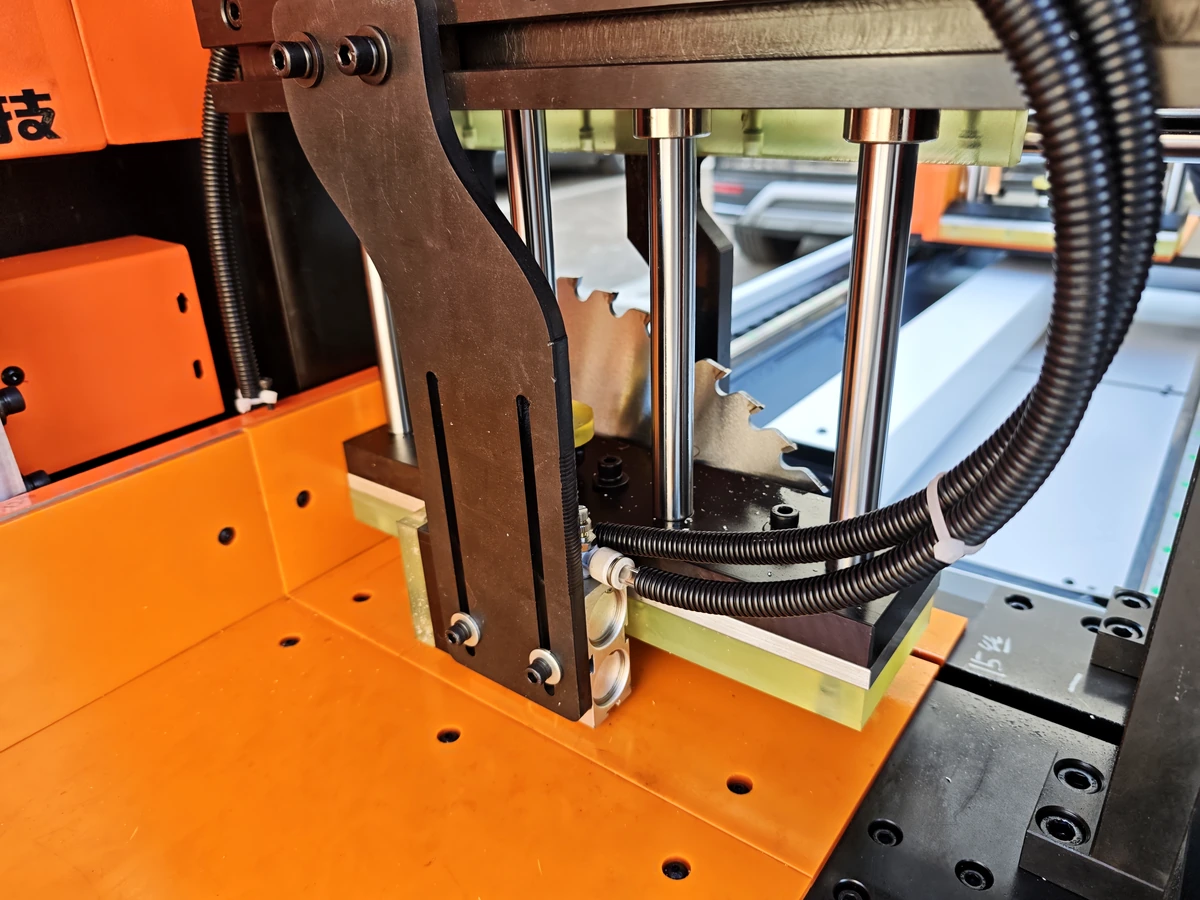
Follow the return air, without assuming every saw has the same circuit
In a double-acting pneumatic cylinder, one side is supplied while the other side exhausts. A flow control can deliberately meter that exhaust to manage motion. Festo describes a one-way flow control valve as allowing free flow in one direction and adjustable flow in the other. The actual direction and port arrangement on a saw must be confirmed from its pneumatic drawing; a component name alone is not enough.
Ask for a marked drawing that identifies the cylinder ports, directional valve, speed controls, silencers and the route to atmosphere. Then compare the drawing with the installed machine. A kinked tube, a clogged silencer, a misidentified port or an intentionally conservative setting may each produce a different remedy. Inspection or modification of pressurized pneumatic parts belongs to qualified personnel following the machine maker’s isolation procedure.
A quick exhaust valve is one possible design choice, not a universal upgrade. Festo’s SE/SEU documentation explains that air can leave through a local exhaust when control pressure falls and that the valve must be mounted at the cylinder connection for the specified fast exhaust function. SMC also describes a speed-exhaust controller that combines local exhaust with flow adjustment. Neither document establishes that such a part is installed on a particular Jiurun saw or that it would cure a given delay. Adding one without checking the circuit, noise, motion control and safety behavior can change how the clamp releases.
For reference, see Festo’s explanation of one-way flow control, its SE/SEU quick exhaust datasheet, and SMC’s speed-exhaust controller description. These are general component references, not a parts list for this machine.

Separate air-path delay from jaw contact
A jaw may move normally when empty yet linger against a particular extrusion. That comparison is useful, provided it is made through the approved operating mode and guarding. A thin wall can deflect under contact; a long section can twist or load the jaw if support differs along its length. Chips at a pad or guide can also prevent the final few millimeters of clearance. Such effects are distinct from the interval before the cylinder starts to retract.
Document the profile cross-section, which face is clamped, overhang and support points. A photograph of the finished cut does not show when the jaw released. A more useful supplier review pairs the actual section drawing with a timed, guarded cycle and records the jaw’s first motion and final clearance. If the issue occurs only with one profile, keep that observation separate from any general machine setting.
What to request in a buying or service review
- A sequence sketch: the release command, permissive checks, valve state, air exhaust and jaw clearance in order.
- A circuit reference: cylinder ports, flow controls, exhaust points and any silencer or quick exhaust device actually fitted.
- A matched observation: the same stock and operating mode for repeated cycles, with the time of first movement and full clearance recorded separately.
- An exception note: whether the delay occurs only after idle time, with one jaw, or with one profile geometry.
- An agreed corrective action: who will inspect it, what may be changed, and how the revised release behavior will be checked under the machine’s normal safety controls.
For an idle-pressure symptom rather than a slow jaw, see our separate guide on clamp pressure rising at idle. A slow saw head return is another circuit and has its own diagnostic path.
Related equipment video
The following video from Jiurun’s own channel shows a different upper-and-lower compression aluminum saw in operation. It is a general equipment view; it does not demonstrate the clamp release fault, the pneumatic layout or a result for the machine in this article.
If a slow aluminum saw clamp release affects your extrusion plan, send the section drawing and the release sequence you need. Ask for the pneumatic configuration and a guarded demonstration that records jaw clearance on your specified stock. A clear sequence is more actionable than a generic promise of “fast clamping.”