
Outsourced aluminum cutting MOQ is often treated as one number, yet a cutting supplier may mean several different minimums: the raw-stock purchase, the economical production batch, the number of finished pieces released to the buyer, or the smallest shipment. If these are conflated, a buyer may accept a low unit price while taking unwanted finished inventory, or reject a workable supply route because a small weekly delivery seems below the supplier’s production minimum. This guide helps a buyer separate those commitments before issuing an RFQ or recurring release. It does not claim a universal MOQ for aluminum cutting; the part, route, supplier capacity and written agreement determine the answer.
Outsourced aluminum cutting MOQ: ask what the minimum covers
Start with the exact part number and drawing revision. Then ask whether the quoted minimum is per part, per profile section, per setup family, per purchase order, per production run, or per shipment. A supplier who buys dedicated stock may have a stock purchase lot even when the saw can cut a smaller quantity. Another supplier may use common stock but needs a minimum number of pieces to justify fixture setup and first-piece inspection. A third may make one batch and deliver it in smaller releases. Those are three different commitments, and the RFQ should name each.
Do not pool unlike parts merely because both are aluminum. Two sections may need different clamps or supports; two cut lengths may have different yield; a mitered part may require an entirely different verification method. If the supplier proposes a combined family minimum, request a family map identifying the shared stock, tooling, inspection and packing basis. The image below shows different aluminum profile cross-sections for an illustrative quotation discussion. It is not evidence that these profiles can share one actual setup or MOQ.

Why production batch and delivery release can differ
A saw job often includes more than blade time. The supplier may receive and identify the bar stock, change supports or clamps, set the stop or program, make and verify a first piece, cut the lot, segregate rejects and offcuts, and pack accepted pieces by release. Some steps recur once per run; others recur with every piece or every shipment. An economical production batch may therefore be larger than the buyer’s weekly consumption, but that does not make every piece immediately due for delivery. The buyer needs a separate decision about who owns, stores, protects and counts the undelivered pieces.
The opposite can also occur. A supplier may advertise a small cutting MOQ but require a full raw-bar purchase, a minimum stock commitment or a fixed setup fee. Ask for the complete payable package, not just the number of finished pieces. A lower quoted unit price is not a saving if it creates obsolete stock after a drawing revision. Conversely, repeated tiny runs may consume setup and inspection resources that a consolidated run would avoid. The actual cost and lead-time difference must be quoted; no single batch-size formula fits every part.
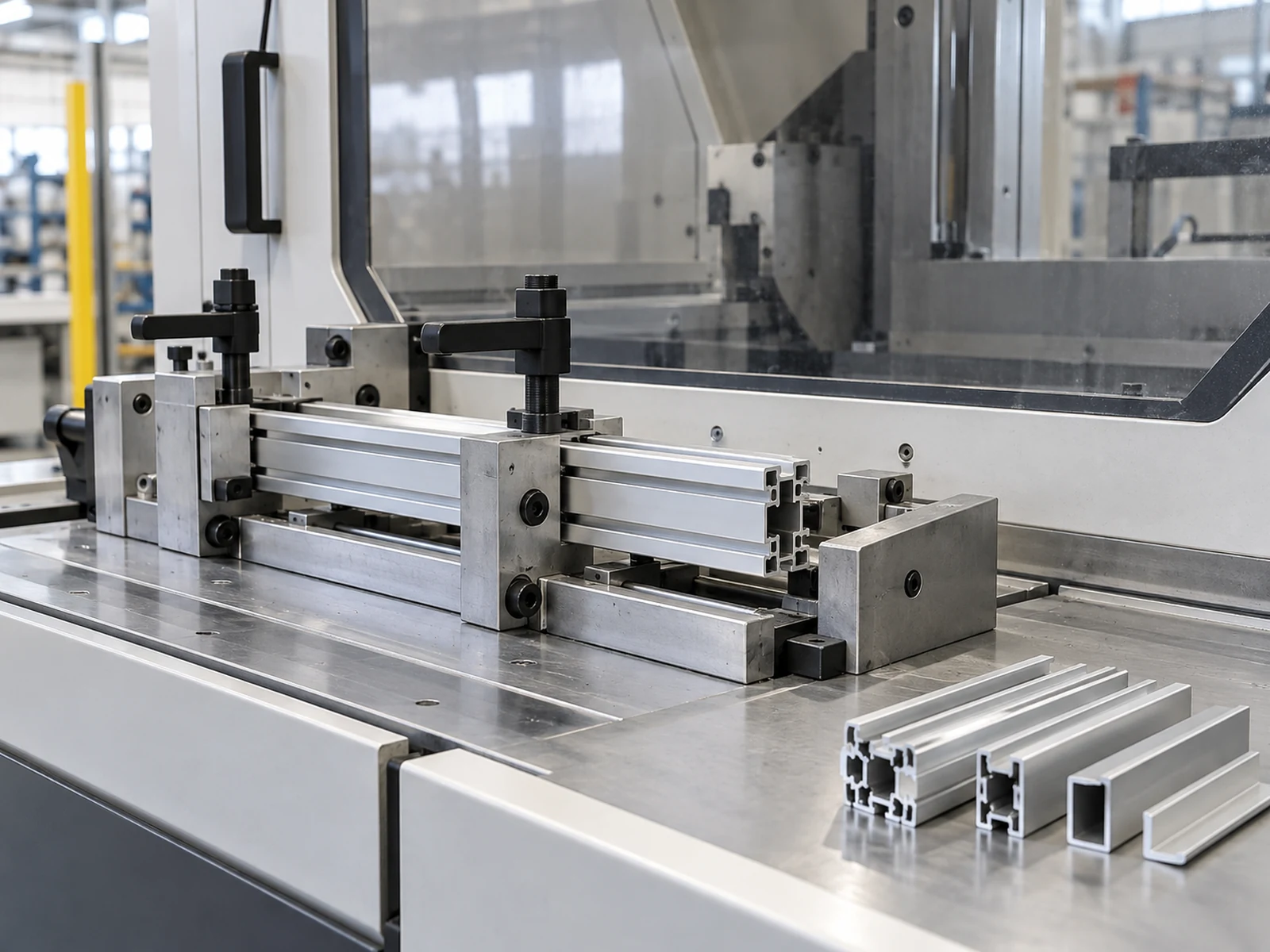
The existing-library image below illustrates a clamped profile at a saw. It helps identify what a changeover discussion should cover, but it does not prove a specific machine configuration, cycle, setup duration, customer job or supplier charge.
Build the quote around four quantities
Request four numbers on one line for each part and revision: stock commitment (bars or kilograms purchased or reserved), minimum production run (accepted pieces or cut attempts, clearly defined), minimum release (finished pieces the buyer must call off), and minimum shipment (pieces or packages sent on one date). State whether the production quantity includes first-article pieces, destructive checks, expected rejects, spare pieces, or a rounding allowance. Ask who pays for each category and how accepted quantity is counted. Without this separation, two suppliers’ prices may refer to different physical outputs.
For recurring work, also ask for the quote period, maximum stock hold time, storage conditions, labeling, inventory report cadence, and end-of-term disposition. Are uncalled pieces already buyer-owned, supplier-owned until delivery, or subject to an agreed buyout? Do not infer ownership from where the pieces sit. A call-off stock versus precut-kit decision has its own stock-location and release questions; the MOQ decision here concerns the four minimum quantities that shape that route.
Use a small example to expose the commitment
Suppose a buyer expects 2,400 pieces over a quarter, with demand of about 200 per week. A supplier proposes a minimum production run of 800 pieces and a minimum shipment of 200. Under a hypothetical agreed arrangement, the supplier may cut 800 and ship four 200-piece releases. Before accepting, the buyer asks: who owns the remaining 600 after the first shipment, how are they labeled and stored, when must they be taken, what happens if the drawing changes, and what records show the physical balance? These are example figures, not an industry MOQ or production recommendation.
Compare that option with three other routes: four separate 200-piece runs at a documented setup charge; a smaller run on a different machine or stock route if technically qualified; or one 800-piece delivery with buyer-held inventory. For each route, total the accepted pieces, setup and material commitments, storage and handling, delivery charges, inspection effort, cash timing and obsolescence exposure. If a supplier will combine multiple SKUs in a setup family, retain each SKU’s acceptance and traceability separately. Do not trade away inspection or revision control solely to reduce a minimum.
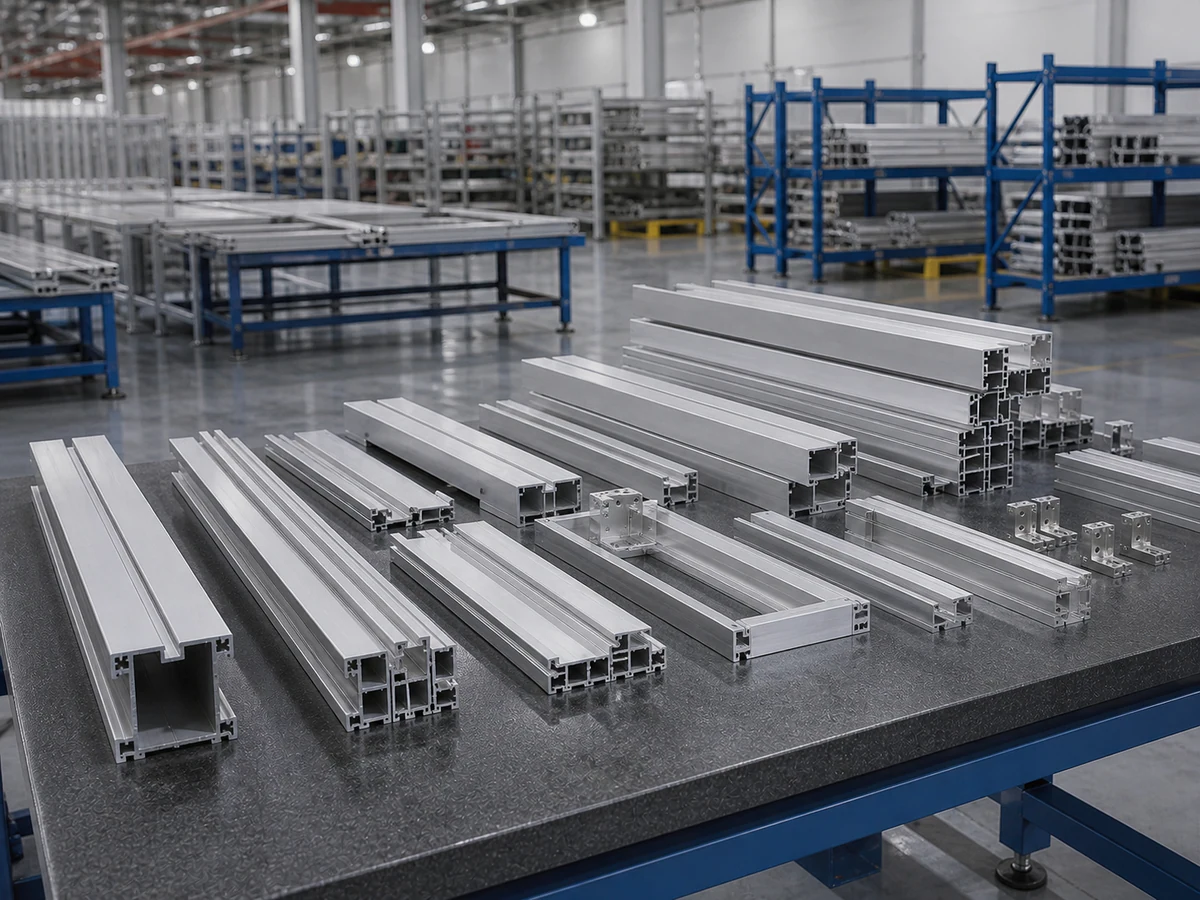
The conceptual image below shows different-length aluminum members grouped for a batch discussion. It is not a real MOQ calculation or proof that mixed sections can be cut together.
Do not let MOQ hide yield or offcut terms
A cutting batch starts with bars or sections and ends with accepted pieces, rejected pieces and remaining material. The available bar length, cut length, kerf, trim allowance and part mix affect the number of good pieces per bar. Ask whether the MOQ is quoted in ordered pieces or accepted pieces and who owns unused stock and offcuts. The buyer should not pay for an unexplained rounding up to a full bar without seeing how the residual material is handled. Our offcut ownership and quote-credit checklist addresses the separate return or credit decision.
Quality gates matter too. A large production batch can lock in a mistake if a drawing revision, fixture change or first-piece result is unresolved. Agree whether a first-piece approval is required before releasing the full batch, what constitutes acceptance, and how nonconforming pieces are held. The minimum production run should not be used as a reason to skip a hold point. If a test lot is needed, quote it as a distinct pilot or validation phase with its own acceptance and disposition, rather than quietly folding it into full-rate supply.
Write an MOQ schedule that receiving can use
| Line to agree | What it should state | Why it matters |
|---|---|---|
| Part identity | Drawing, revision, alloy/temper when specified, stock section and finish | Stops unlike parts being pooled as one MOQ |
| Stock commitment | Who buys stock, minimum purchase, residual ownership | Exposes raw-material exposure |
| Production run | Minimum accepted output, setup, first-piece hold point | Separates run economics from delivery |
| Release and shipment | Minimum call-off and minimum shipment, dates and packaging | Fits buyer consumption without vague storage promises |
| Inventory evidence | Lot labels, balance report, condition and audit access | Makes undelivered finished pieces traceable |
| Change and exit | Revision change, expiry, cancellation and residual settlement | Prevents orphaned stock and disputed invoices |
On a phone, swipe the table horizontally if needed. Keep the MOQ schedule attached to the accepted quote and purchase releases. A receiving team should be able to match the arriving package to the correct part, revision, lot and release quantity. A finance team should see which accepted pieces and approved charges are payable; see our invoice-reconciliation guide for that later stage. If demand drops or the program ends, use the agreed cancellation and stock-disposition terms instead of silently carrying obsolete pieces.
Why setup reduction can change the answer
The U.S. National Institute of Standards and Technology’s Manufacturing Extension Partnership describes quick changeover and setup reduction as work to reduce the interval between the last good piece of one run and the first good piece of the next. Its small-batch case study shows how a manufacturer used process mapping and work balance to test smaller batch sizes. Those sources support the general tradeoff between setup work, flow and inventory; they do not establish an MOQ, savings percentage or capability for Jiurun machinery or any cut-part supplier. Request evidence for the actual profile and routing before assuming a smaller lot is practical.
Questions to ask before accepting the quote
Can the supplier demand one MOQ for all profile variants? Only accept family pooling after the supplier identifies which stock, fixture, program and inspection steps can actually be shared. Keep each part’s revision, ordered quantity and acceptance record distinct.
Does a production MOQ mean the buyer must receive everything at once? No automatic answer. Production and delivery can be separated if both parties agree to storage, ownership, release dates, inventory evidence and final disposition. Write that agreement explicitly.
Should the buyer use a trial lot below MOQ? A pilot can be useful when section fit or quality is uncertain, but quote it separately with clear acceptance and what happens to samples and unused stock. Do not call it production approval until the agreed evidence exists.
What if a later order falls below the quoted minimum? Ask for a clear alternative: a documented small-lot setup fee, a different qualified route, a combined release within the same approved family, or a revised delivery plan. Any changed price or scope should be approved before the release, as explained in our price-adjustment guide.
See a general cutting process
This Jiurun Machinery video shows general aluminum saw operation. It is a process example only. It does not prove the article’s profile mix, model configuration, customer, trial cut, setup time, MOQ, yield, release schedule, acceptance, price or performance.
Need an aluminum cut-part quotation? Send JiurunCut the drawing and revision, profile section, stock ownership, accepted-piece demand by date, inspection method and delivery pattern. Ask the supplier to state stock, production, release and shipment minimums separately before comparing unit prices. Contact JiurunCut with your part and batch requirements.