
Outsourced aluminum cut-part fixtures can become a quiet dependency in a purchase order when a supplier cuts profiles to your drawing. A fixture can locate an asymmetric extrusion, support a thin wall, or hold a cut angle consistently. The purchase price of that fixture is only one decision. Before approving the first production order, establish who controls the physical tool, how its condition is recorded, who may change it, and what happens if you move the work.
This guide is for buyers of outsourced aluminum cut parts who need a practical fixture agreement alongside the part drawing and quality plan. It is a procurement checklist, not a universal legal rule. Ask your commercial and legal teams to put the chosen terms into the contract that governs your supplier.
Start with the fixture, the drawing, and the process scope
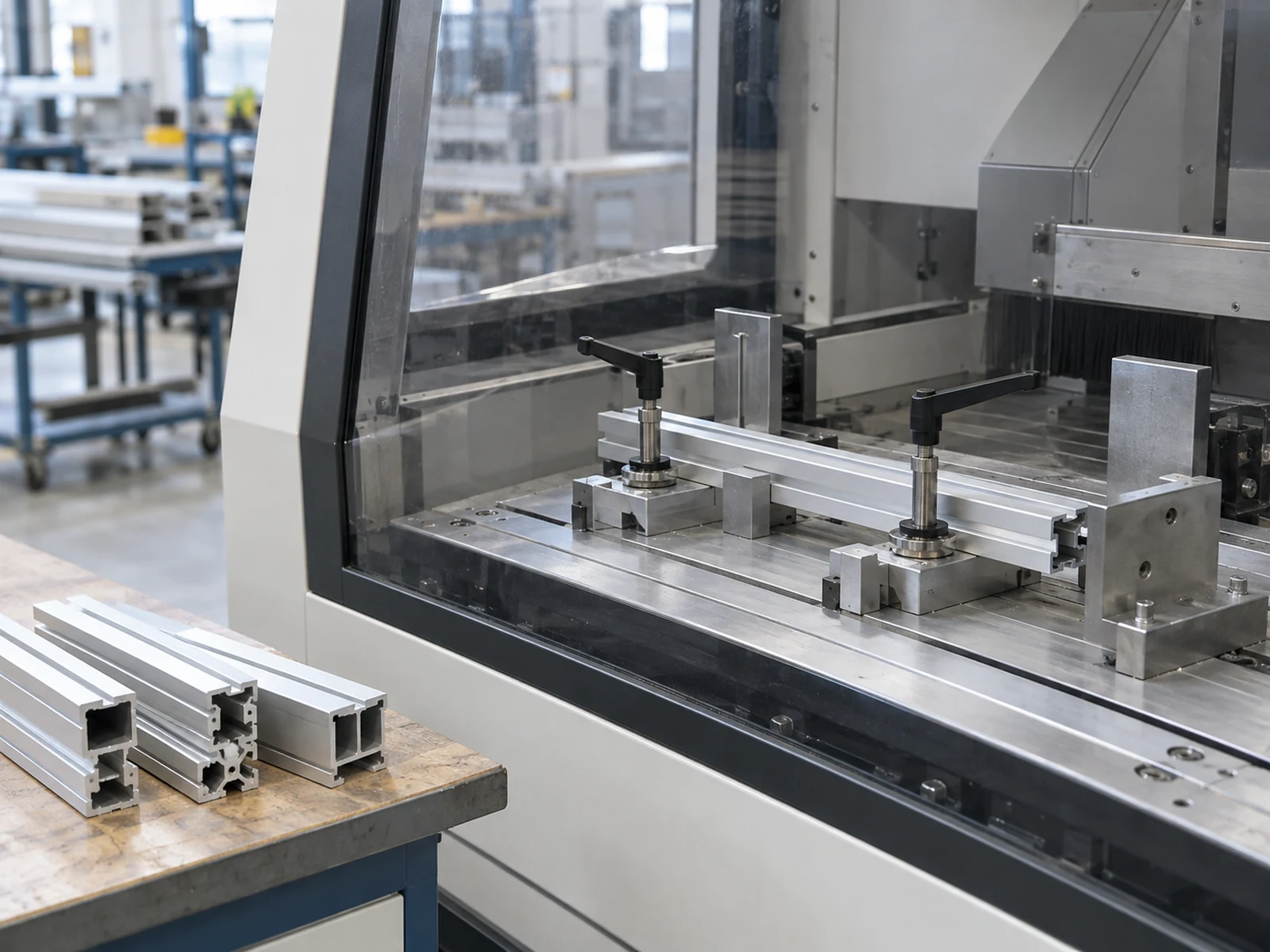
List every item that is genuinely dedicated to your part: locating stops, nest plates, soft jaws, profile supports, drill templates, gauges, and any software or setup document needed to reproduce the cut. A supplier’s standard saw, general clamps, and ordinary hand tools are a different category. Do not assume that paying a one-time setup charge bought all of these items.
Identify the part number, profile revision, cut length and angle, critical datums, acceptable surface-contact areas, and annual or batch demand. The fixture record should link to that controlled drawing revision. A photo alone cannot show the datum scheme or prove that a cut part meets tolerance. For irregular or multi-cavity profiles, agree where clamping is allowed and how the supplier will prevent visible marking or wall collapse. Our separate multi-cavity extrusion clamping guide covers the machine-side questions to include in a trial.
Separate physical ownership from design and intellectual-property rights
A buyer-funded fixture can remain on the supplier’s floor while the buyer owns the physical asset. A supplier-owned fixture can be included in the part price. A third arrangement may recover a buyer’s share through a stated quantity or amortization schedule. None of those labels alone settles who owns the fixture drawing, CAD files, process notes, or improvements. Record those rights separately, including what the supplier may use for other customers and what the buyer may share with a replacement supplier.
For example, a purchase order might identify “fixture F-17, revision B” as buyer-owned, stored at the supplier’s named site, while a separate license covers the supplier’s pre-existing fixture design. Another agreement might make the supplier owner and promise only a defined transfer package on exit. The commercially workable answer depends on the design contribution, price, and bargaining position. The UK government’s guidance on managing IP when working with others recommends written terms for existing and newly created IP; it also cautions against assuming that payment alone transfers IP. Treat that as a prompt to specify rights, not as a rule for every jurisdiction.
Outsourced aluminum cut-part fixtures: compare ownership models
| Model | What to ask for | Main exit question |
|---|---|---|
| Buyer-funded, buyer-owned physical fixture | Separate fixture price, asset ID, acceptance evidence, storage and maintenance terms | When and in what condition can it be collected or transferred? |
| Supplier-owned fixture in part price | Unit-price assumptions, minimum volume, replacement responsibility, continuity plan | Can a second supplier reproduce the process without the tool? |
| Amortized or shared cost | Recovery schedule, quantity basis, early termination balance, ownership trigger | What is owed if volume or supplier changes? |
Ask the supplier to break out fixture design, build, proof-out, routine maintenance, replacement wear items, storage, and unit part price. This makes a cheaper unit quote comparable with a quote that charges for tooling up front. It also exposes assumptions such as a minimum lot, fixture life, or a single machine location. NIST MEP’s supplier RFP guidance supports spelling out scope, schedule, and requested quote detail. Use your own demand scenarios rather than a generic payback threshold.
Write a custody and condition record before the fixture enters production
A useful register includes a unique asset ID, owner, physical location, custodian, part and drawing revisions served, major components, photographs, acceptance date, condition at handover, and the person authorized to release it. Identify which pieces are detachable and which are shared with other jobs. If the supplier holds several similar nests, use a durable mark and a photo of that mark to avoid a dispute over which tool belongs to which program.
Agree how the fixture is stored between batches, how corrosion or damage is prevented where relevant, who inspects it before restart, and where maintenance and repair logs live. Specify whether subcontracting or relocation to another plant needs consent. Define access to the register and a reasonable physical audit process. NIST MEP’s supplier selection discussion highlights documentation and maintenance records for custom tools as useful evaluation evidence; request records you can actually review.

Control changes to the fixture and the cut-part process
Tool wear, a new profile mill, a drawing revision, or a move to a different saw can change the contact points and setup. Decide which events require a written change request, who approves the new revision, and what part samples or measurements are needed before production resumes. Preserve the old revision and its acceptance record. A fixture repair that restores the approved geometry may need a different review from a redesigned support or stop.
For every proposed change, ask: What problem is being solved? Which dimensions and cosmetic faces are affected? Will material presentation, clamp force, blade entry, cut sequence, deburring, or inspection change? Who pays for proof-out and scrap? What is the disposition of work in progress? Do not let a change to a locating face appear only as an informal setup note. A controlled fixture revision should correspond to a controlled part drawing and inspection plan.

Plan transfer or exit while both parties still want the work
Write the exit process before the first production release. State what event allows collection or transfer, the notice period, the final condition check, outstanding charge settlement, packaging and shipping responsibility, and the date by which the supplier must release the tool. Define whether the buyer receives only the physical fixture or also controlled drawings, setup sheets, gauge instructions, maintenance history, and approved sample data. If a design license is needed for a second source, address it explicitly.
A transfer does not prove the new shop can make acceptable parts. The receiving supplier may use a different saw, blade, coolant approach, feeding method, or inspection equipment. Require its own first-article or agreed qualification evidence against the current drawing. Our second cut-part supplier qualification guide sets out the separate production validation questions. If the tool is supplier-owned and cannot move, budget a replacement fixture and qualification time instead of assuming instant portability.
Use a short decision test before placing the order
- Low-volume, simple profile: a supplier-owned setup may cost less to administer if the part can be reproduced from a complete drawing and inspection plan. Check the restart and second-source cost.
- Repeat order with a dedicated nest: buyer ownership may improve control, provided storage, upkeep, and release terms are operationally clear. Compare the separate fixture charge with the unit-price effect.
- Uncertain demand or evolving profile: an amortized arrangement can align early cash outlay with volume, but spell out the unpaid balance and revision costs if the program changes.
For outsourced aluminum cut-part fixtures under any ownership model, request a sample fixture register row, the supplier’s change-request form, a maintenance log example, and the proposed exit clause. These small artifacts reveal whether the process is executable. If the answers rely on “we will work it out later,” the quote is not yet comparable with one that prices those obligations.
General equipment footage
The following Jiurun Machinery video shows general aluminum cutting equipment and profile handling. It does not document the supplier arrangement, material, owned fixture, model configuration, customer, trial, or performance discussed in this guide.
Questions to put in the RFQ
- Which physical items are dedicated to our part, and what is each item’s ID and revision?
- Who pays for and owns each physical item, and who controls its drawings, CAD, and improvements?
- Where will it be stored, who maintains it, and what records can we inspect?
- Which changes require our approval and new part qualification?
- What data and physical items will be released if we change suppliers, at what cost and in what condition?
- How are early termination, unused amortization, damage, and replacement handled?
If you are comparing outsourced cut parts with bringing profile cutting in house, Jiurun can discuss the aluminum profile cutting machine and fixture interface for your profile, drawing, and expected workflow. Send your cutting requirements for an equipment discussion. We are not presenting this guide as an offer to supply outsourced cut parts or as evidence of a completed supplier fixture project.