
Machine guard door replacement is a safety-function decision before it is an aluminum cutting order. A damaged or misfitting door can affect access to a hazardous area, the frame and panel connection, the latch, and any interlock. The purchasing question is whether the machine owner needs a complete maker-specified guard assembly, an engineered replacement kit, or cut aluminum members for a manufacturer-controlled build. A visually similar extrusion is not enough to authorize a return to service.
This guide is for maintenance buyers, machine builders and guarding-frame OEMs comparing those supply routes. It does not provide a field repair procedure or certify a guard. The responsible employer, original machine builder or qualified integrator must evaluate the specific machine, hazards and local requirements before work or restart.
Machine guard door replacement starts with the protected zone
First identify the machine and the guard’s function. Is it a fixed barrier, a movable access door, or one part of a larger perimeter enclosure? Which hazardous motion, nip point or ejected material is it intended to separate from people? Record the machine make and serial, guard drawing or part number, door location, opening direction, neighboring panels, and the observed defect. Photograph the complete assembly as well as the hinge, latch, panel and frame corners. Do not assume the broken aluminum member is the only affected part.
For US general-industry workplaces, OSHA 29 CFR 1910.212 requires machine guarding against relevant hazards and says a guard must not create a hazard itself. Where servicing exposes workers to unexpected start-up or stored energy, OSHA 29 CFR 1910.147 addresses hazardous-energy control. These provisions are a reason to involve the site’s qualified safety and maintenance personnel, not a specification for a universal replacement door. Other jurisdictions and machine-specific rules may differ.
Choose the supply route before asking for a saw quote
Route 1: buy the complete specified door or guard module
Start here when the original maker offers an assembly for the exact machine and revision, when the defect involves the door geometry or interlock interface, or when the owner cannot establish a controlled replacement design. Ask what the package includes: frame, panel, hinges, latch, handles, fasteners, interlock components if applicable, installation instructions and acceptance documentation. A complete door quote can cost more than loose stock but may avoid redesigning interfaces and chasing missing hardware. Confirm lead time and who is authorized to install and approve it.
Route 2: buy an engineered replacement frame or panel kit
If the machine builder or responsible integrator releases a kit, separate the supplied parts from the work still required at the site. A kit may include labeled frame members, infill, connectors and hardware; it may also exclude an existing switch or mounting bracket. Ask for the exact drawing revision, part list, door orientation, connection details, installer instructions and functional checks the approving party will require. A replacement panel that fits the opening is not automatically equivalent to the original protective arrangement.
Route 3: cut released members for OEM or integrator production
This route applies when a machine or guarding-frame manufacturer owns the design and retains member preparation as a repeatable factory operation. It is not permission for a plant to substitute generic extrusion in an in-service guard. The buyer must provide the released section, material condition, cut list, revision, orientation and downstream owner. The saw supplier can quote and demonstrate the defined cut stage; the OEM or integrator remains responsible for panel fit, fastening, access geometry, interlock integration, inspection and release of the whole guarding system.
Keep door interfaces in the RFQ, even when buying only profiles
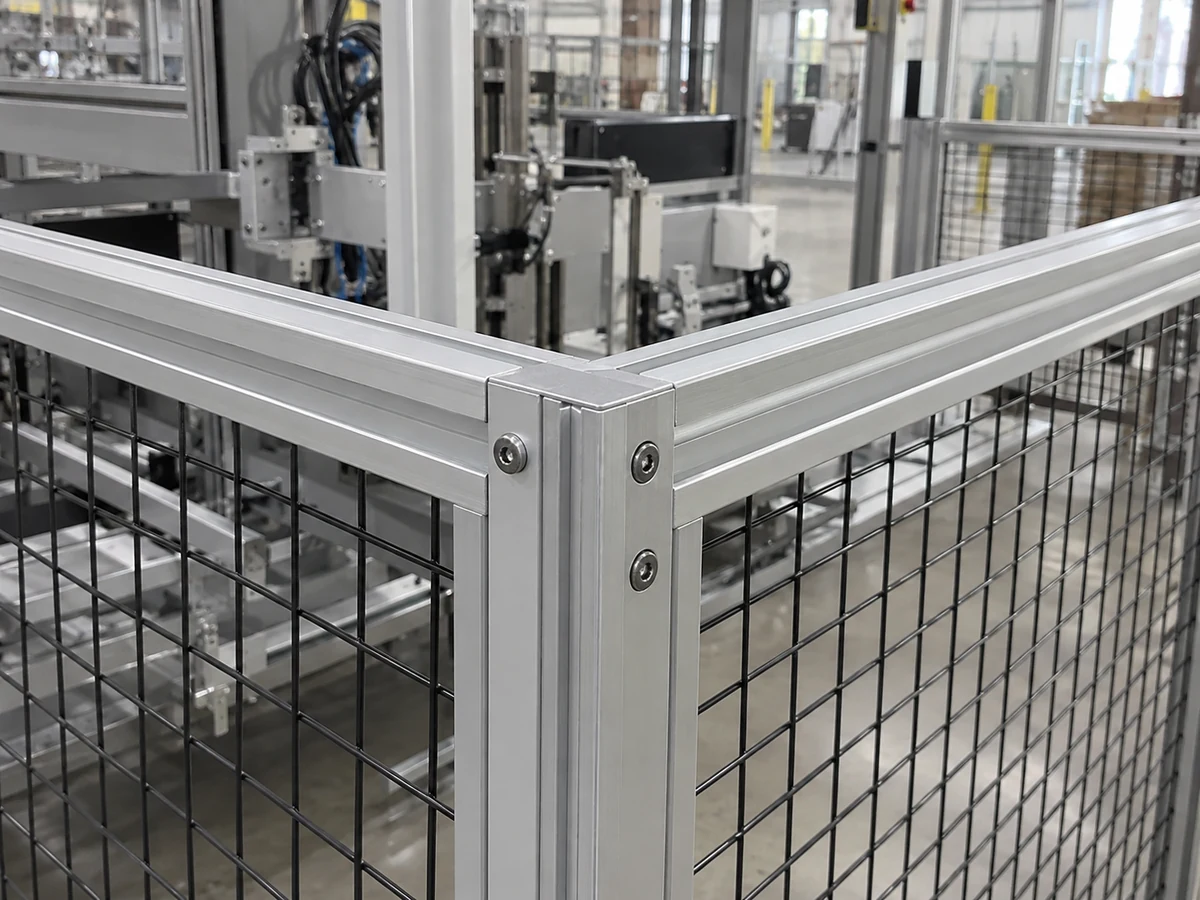
Request the machine and guard identification first. The part package should show the door opening, hinge side, swing clearance, adjacent fixed panels, handle and latch positions, panel material and attachment method, and any switch or actuator interface. Specify who verifies each interface against the installed machine. A drawing for one side of a line may not be interchangeable with the mirrored door on the other side. If a supplier lacks the controlled revision, label the quotation provisional rather than silently adopting a similar-looking layout.
For a cut-member package, define the incoming profile and the accepted handoff: section orientation, length datum, end condition, angle where relevant, identification mark, batch or kit grouping, and the next machining or assembly step. Distinguish the saw’s acceptance dimensions from final door fit and safety validation. Do not use a stock-feeding accuracy figure as a finished guard dimension. Clarify who drills, joins, installs infill, mounts hardware and verifies the interlock or restart behavior.
Separate replacement demand from new-machine production. A single broken door may justify buying a complete module or kit; it does not by itself justify an in-house saw. Repeated OEM production across guard sizes may justify a station if the maker retains enough released aluminum work. Compare the same accepted end state when asking for bought modules, prepared kits and internal cutting quotations.

Check whether the proposed change is actually like-for-like
A replacement may be intended to restore the original guard, or it may alter access and operation. Do not collapse those cases into one price comparison. A wider opening, different panel material, moved hinge, new latch position or changed interlock arrangement can alter the guarding concept and require a new assessment by the responsible party. The UK HSE’s guidance on refurbished and modified machinery distinguishes essentially identical replacement parts from changes that materially affect safety; the applicable legal route depends on jurisdiction and facts. Ask the machine builder or competent integrator to document whether this is a controlled replacement or a design change.
For an interlocked movable guard, the functional question is broader than a door that closes. OSHA’s machine-guarding guide describes how an interlocked guard should stop or disengage hazardous motion and prevent starting while open; replacing the guard should not itself cause restart. These are system-level checks for qualified personnel. A photo of a hinge, a saw-cut sample or a supplier’s profile drawing cannot verify them.
What a representative cut sample can establish
For a released OEM guard-member project, trial the actual section family and document the saw configuration, support, clamping, program, operator method and part identification. Inspect the agreed output at the saw boundary: length datum, angle if specified, cut face, burr handling and kit traceability. Try the range of section orientations or member lengths that drive support and changeover decisions. Record rejects and the next process owner. Our guard-frame saw-trial checklist addresses that production-stage evidence in more detail.
That sample cannot establish the installed door’s reach protection, panel retention, interlock function or safe restart. Keep three acceptance records distinct: saw-stage part acceptance, OEM or integrator assembly acceptance, and the machine owner’s final guarding and restart approval. When comparing a preassembled module with a labeled cut kit, our enclosure-frame supply guide offers a broader handoff framework.
Send two different quotation packages
To the machine builder or guard-system supplier, send machine and guard IDs, drawings or photographs, defect description, door position, adjacent components, original bill of materials, and the request for an authorized complete assembly or controlled replacement kit. Ask what is included, who performs installation, what inspection or functional record is required, and who signs the return-to-service decision. Do not order loose profiles first and solve the safety interfaces afterward.
To a saw supplier for an OEM production project, send only the released aluminum-member scope: drawings and revisions, real sample sections, family and batch volumes, cut lengths and orientation, end and marking criteria, stock and finished-part handling, downstream operations, and factory acceptance evidence. State which guard elements are bought rather than cut in-house. A meaningful machine proposal will identify what it can cut and which acceptance checks remain with the guard manufacturer.
Video: general aluminum-cutting equipment example
The Jiurun Machinery video below shows general enclosed aluminum-cutting equipment and material handling. It is not footage of this guard door, its model, customer, approved configuration, replacement work, trial cut or safety performance. It only illustrates a possible factory cutting-station context for a separately released OEM member package.
Frequently asked questions
Can a matching profile be used as a guard-door spare?
Appearance and cut length alone do not answer that question. The machine builder or responsible guard-system authority must approve the exact part and its interfaces, and the site must complete the required installation and functional checks. If that path is unavailable, ask for the complete specified assembly rather than treating a cut extrusion as a drop-in safety part.
Does a successful saw trial approve an interlocked door?
No. A saw trial addresses only the agreed cut-member outputs. Door fit, interlock integration, hazardous-motion protection and return to service are separate decisions for the responsible parties.
When is an in-house aluminum saw relevant?
When an OEM or integrator repeatedly makes released aluminum guard members and retains the cutting operation across a defined product mix. If the need is occasional service or a complete certified module is purchased, the factory cutting workload may be too small or unnecessary.
Planning a controlled guard-frame production package? Send JiurunCut the released member drawings, real profile samples, batch volumes and saw-stage handoff through our contact form. We can discuss the cutting scope and a representative sample plan. For an installed machine with a damaged guard, seek the original builder or qualified integrator’s replacement and safety decision first.