
A machine guard panel frame saw trial should answer a narrow buying question: can the proposed saw and fixture prepare the approved aluminum members so the frame assembly owner can seat the specified connectors, panels and door hardware without avoidable rework? A clean offcut alone does not answer it. Guard posts, horizontal rails, panel retainers and door members may use different sections, end references and exposed faces. This guide turns those differences into a practical supplier trial and an evidence pack for a machine purchase. The saw trial concerns cut-member preparation and assembly fit; the responsible machine-safety team must separately assess the complete guard and its intended use.
Define the accepted guard package before the saw demonstration
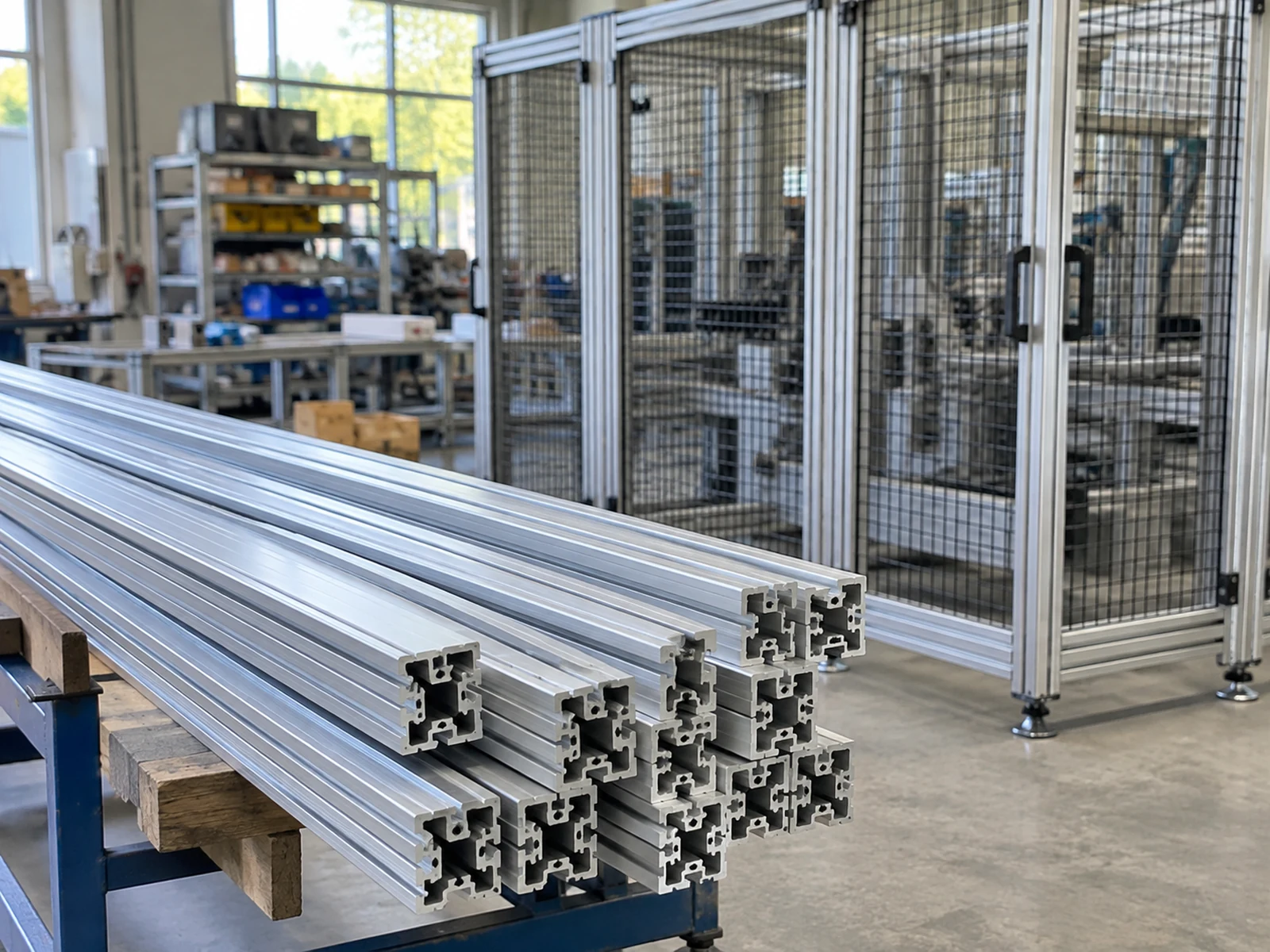
Begin with the released guard drawing, revision and bill of members. Identify each post, rail, door stile, header and intermediate member by section code, stock condition, finish, handedness and intended receiving operation. State whether the buyer needs loose cut lengths, connector-ready members, a panel-frame kit or a fully assembled barrier. The quoted output must match that receiving stage. Do not compare a saw-only price with a preassembled guard price as though both deliver the same work.
Fix the reference for each length and end. A rail located between posts can have a different datum from an overhanging header. An access-door member may need a different end or orientation from a fixed panel rail. Put connector, bracket, mesh-retainer, hinge and latch identities beside the members they affect. If later drilling, tapping or joining is needed, assign that operation to its actual owner. Bosch Rexroth’s FRAMEpro description illustrates why profile parts lists, sawing and drilling work, panel elements and doors belong in the same design handoff. It describes Bosch Rexroth’s system, not a specification or capability claim for a Jiurun saw.
Build a member and acceptance matrix, not a pile of samples
Select trial rows that expose different purchasing risks. Include a common fixed-panel member, a post, a long member that needs support, a short member that challenges retained-piece handling, and a door or opening member if the order includes one. Add a second section only when its wall, groove, finish or locator contact changes the setup. Label every row with drawing revision and its assembly destination so two attractive offcuts cannot be mistaken for a complete family trial.
- Incoming stock: record section identity, stock length, finish or film, visible-face direction and any pre-existing bow or damage.
- Cut request: record the approved length datum, end form, orientation, handedness, quantity and downstream operation.
- Offered setup: identify the quoted saw configuration, blade, supports, locators, clamp contacts and changeover parts actually included.
- Acceptance: name the drawing-based dimensional checks, cut-end condition, protected surfaces, connector seating, panel retention and door-opening checks with an owner for each.
- Evidence: retain labelled first-off and repeat pieces, rejected pieces, setup changes and the assembly owner’s fit decision.
Agree the number and sequence of pieces before the demonstration. Where a buyer expects several panel sizes, choose variants that change the actual saw setup or handling rather than repeating near-identical samples. Record setup, changeover, cutting, inspection and handling separately. An advertised blade cycle cannot stand in for a productive panel kit if the operator spends additional time rotating and sorting handed members.

Check support and clamp contact on the actual section
Ask the supplier to show how each approved section rests, locates and is clamped in the proposed guarded machine setup. Thin walls and open grooves can change the contact risk, while finished faces may remain visible beside the panel or door. Mark the acceptable and prohibited contact zones on the drawing with the product owner. A fixture demonstrated on a solid sample or a different section is useful context, but it cannot release the real guard member without a supported trial.
Observe the complete stock-to-piece route. Does long stock stay supported as it approaches the cut? Is the short retained member identified and handled without striking a visible edge? Does a handed member keep its orientation through cutting and sorting? Compare incoming photographs with stopped, safe-to-inspect outputs so a pre-existing scratch is not charged to the saw and a new witness mark is not overlooked. This is an acceptance discussion, not an instruction to reach into, defeat or work around guarding.
Inspect cut ends against the connector and panel interface
After the machine is stopped and safe for inspection, check the cut face and adjacent profile features that the approved connector uses. Look for a wall that has deformed at the fixture contact, an edge that obstructs bracket seating, a burr at a groove, or an end orientation that puts the panel retainer on the wrong side. Use the drawing’s acceptance limits and measuring method; no universal tolerance can be inferred from a machine display or a photographed end. Feed-position repeatability is not a finished member’s measured accuracy.
Retain the marked sample and assemble it with the approved connector or bracket. Record whether the joint seats, whether the panel opening stays within its controlled dimensions, and whether downstream deburring, drilling or tapping was needed. The assembly result belongs to the assembly owner. When a fit fails, classify the cause before changing the saw: wrong released length, incorrect datum, section variation, cut-end condition, unfinished secondary operation or unsuitable hardware. A neat-looking offcut should not hide a connector that cannot enter the groove.

Fit the panel and door at the intended receiving stage
The part that matters to a buyer may be an assembled panel, not an individual rail. Have the responsible assembler use retained trial members with the approved mesh or solid panel, retainers, corner hardware and any specified door parts. Check panel engagement, corner seating, edge gaps and the clear opening created by the cut members. If a door is included, inspect hinge-side and latch-side fit, the opening route and whether the door clears adjacent fixed panels. Record the drawing and hardware revision used; a fit with substitute hardware does not automatically approve the quoted kit.
Bosch Rexroth’s EcoSafe page describes protective frames, panels and system doors, while item’s industrial partition page shows that panel elements and complete preassembled elements can vary. These manufacturer examples explain why the receiving stage and hardware should be specified. They do not establish the design, load capacity, compliance or performance of this buyer’s guard or any Jiurun machine. The full machine guard requires its own design review, risk assessment and validation by the responsible parties; the saw trial can only supply evidence about its defined cut-member work.

Use the machine guard panel frame saw trial to compare offers
Request a configuration-specific quote for the saw, blade, profile supports, fixtures, protective contact materials, piece handling, changeover components, chip management, guarding and inspection access. List what the offer excludes: secondary drilling or tapping, connector installation, panel fitting, door hardware, final guard assembly and safety validation may sit elsewhere in the route. Ask who supplies each operation and who accepts the result. A cheaper saw-only offer can shift labor and rework to the frame assembler.
Compare three routes at the same accepted receiving point: cutting loose guard members in-house, buying prepared member kits, or buying preassembled panels where appropriate. For each route, include stock length and trim, setup and changeover, rejected and reworked members, downstream preparation, hardware, inspection, packaging and replacement-part support. Use the buyer’s expected mix and actual accepted samples, not a generic cycle-time promise, to make the purchasing decision. The broader machine-guarding frame RFQ checklist helps establish the design and sourcing scope; this trial focuses on whether the quoted cut-member process reaches it. For a refurbishment decision, also review the machine-enclosure retrofit route comparison.
The video below is a general Jiurun Machinery saw-equipment example from the owner’s YouTube channel. It does not show this guard-panel material or approved section, this quoted model or configuration, a customer, a machine-guard trial, a measured cut result or safety performance. Ask for a separate demonstration on the released drawings and actual proposed setup.
RFQ and trial evidence to send the supplier
Send the released guard layout, member drawings and revisions, section and finish identities, the fixed and door-panel mix, approved hardware, cut-list datums, stock condition and expected receiving stage. Provide a row-by-row trial matrix, drawing-based inspection criteria and the assembly owner who will check panel and door fit. Ask each supplier to identify its exact proposed machine configuration and included support and fixtures, then return labelled first-off and repeat samples, rejected samples, setup and changeover notes, measured results against the agreed method, and a list of operations left outside its offer.
Does a clean cut prove a complete machine guard is safe?
No. It provides limited evidence about a defined cut member. Guard layout, panel selection, anchoring, door and access behavior, risk assessment and final validation require separate responsible review.
Can a similar extrusion replace the released guard section in the trial?
It can illustrate general saw motion. It cannot approve a section with different walls, grooves, finish, connector interface or visible-face orientation. Use the released member before committing to the fixture and acceptance plan.
What should happen when a panel corner or door fails to fit?
Keep the failed sample identified and trace the cause through length datum, end form, orientation, section, connector and downstream preparation. Repeat only the affected trial row after the proposed correction is documented and priced.
To plan a saw trial, send your guard member drawings, cut-list revisions, section samples, approved panel and door hardware, and receiving-stage requirements through the JiurunCut contact page. We can discuss the proposed aluminum-cutting machine setup and the evidence needed for your purchase decision; the guard designer and machine-safety owner remain responsible for the complete protective system.