
JR-455Q vs JR-455Y is a useful buying decision only after you define the job that will pass through the saw. Both are presented as semi-automatic aluminum cutting routes in Jiurun’s catalog, but a shared model size does not make their operating sequence, workholding, stock support, or quoted configuration interchangeable. A buyer should compare the exact proposed machines with the same released parts and the same acceptance method, rather than choose from a motor-power row alone.
The practical question is: which route lets your operator load, locate, clamp, cut, remove, inspect, and release your real parts with a repeatable handoff? This guide gives you a five-test comparison and a quotation worksheet. It does not claim that either model achieves a particular tolerance, output rate, blade life, or finished-part quality without a witnessed trial on the agreed stock.
JR-455Q vs JR-455Y: identify the exact machine and cutting sequence
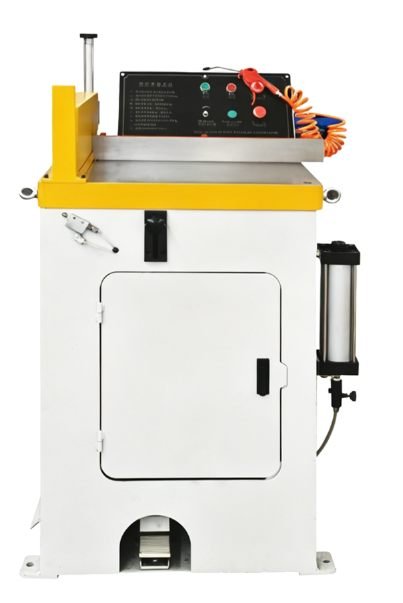
The catalog describes JR-455Q as a semi-automatic aluminum cutting machine. Its description links a foot-pedal action with automatic clamping, oil spray, and cutting. It also discusses a fixture option for angled work. The same catalog page calls JR-455Y a hydraulic crosscutting semi-automatic machine, with electrically controlled clamping and a hydraulically controlled cutting process. These are descriptions of the listed machine families, not proof that every delivered unit includes each option or works identically on your part.
Ask the supplier to annotate the current quotation with the model suffix, blade and fixture package, clamping arrangement, feed or stroke arrangement, stock support, controls, utilities, and any optional angle equipment. Where a catalog table uses slash-separated values for semi-automatic and hydraulic crosscutting variants, require the supplier to identify which value applies to the exact offered build. Do not borrow a dimension from one variant and a function from the other to create a machine that has not been quoted.
Test 1: define the released part family before comparing machines
Build a short part-family sheet with the stock form, alloy and temper when known, outside dimensions, wall or rib features, incoming length, finished length, cut angle, lot size, and cut-end acceptance. Include the smallest and largest recurring parts, plus the awkward part that makes the operator change the setup. Mark whether the material is supplied straight, bowed, bundled, scratched, or protected by a film. A nominal maximum capacity cannot answer how a long, flexible section behaves at the fence or how its visible face is protected during handling.
Separate the normal work from exceptional work. If most orders are square cuts and occasional miters require an optional fixture, quote and trial that fixture explicitly. If the proposed JR-455Y route is meant to cut more than one piece per cycle, identify the specific stock arrangement and verify that each piece remains located and accepted. A claim of multi-piece capability is not an accepted count for your material. Require a sample plan that makes individual pieces traceable to the loading arrangement and inspection record.
Test 2: watch the whole operator cycle
For the JR-455Q route, observe where the operator stands, how the stock meets the stop, how the foot pedal starts the stated clamp-spray-cut sequence, and where the operator puts the finished piece and offcut. For the JR-455Y route, observe the controls for clamping and the hydraulic cutting step as installed on the quoted unit. Record which actions are automatic, which require an operator decision, and which must be repeated after a changeover. Do not infer a production rate from a short video or from a single uninterrupted demonstration.
Use identical start and stop points in the trial: from a released bar at the infeed position to a tagged, inspectable part at the outfeed. Include loading, stop adjustment, cut, removal, inspection, sorting, and routine pauses. Count accepted parts separately from cuts made. If a supplier offers a cycle-time estimate, ask for the part, blade, stock support, operator staffing, observation window, and rejection rule behind it. This makes the comparison about usable output rather than a selective cutting stroke.

Test 3: prove workholding on the difficult section
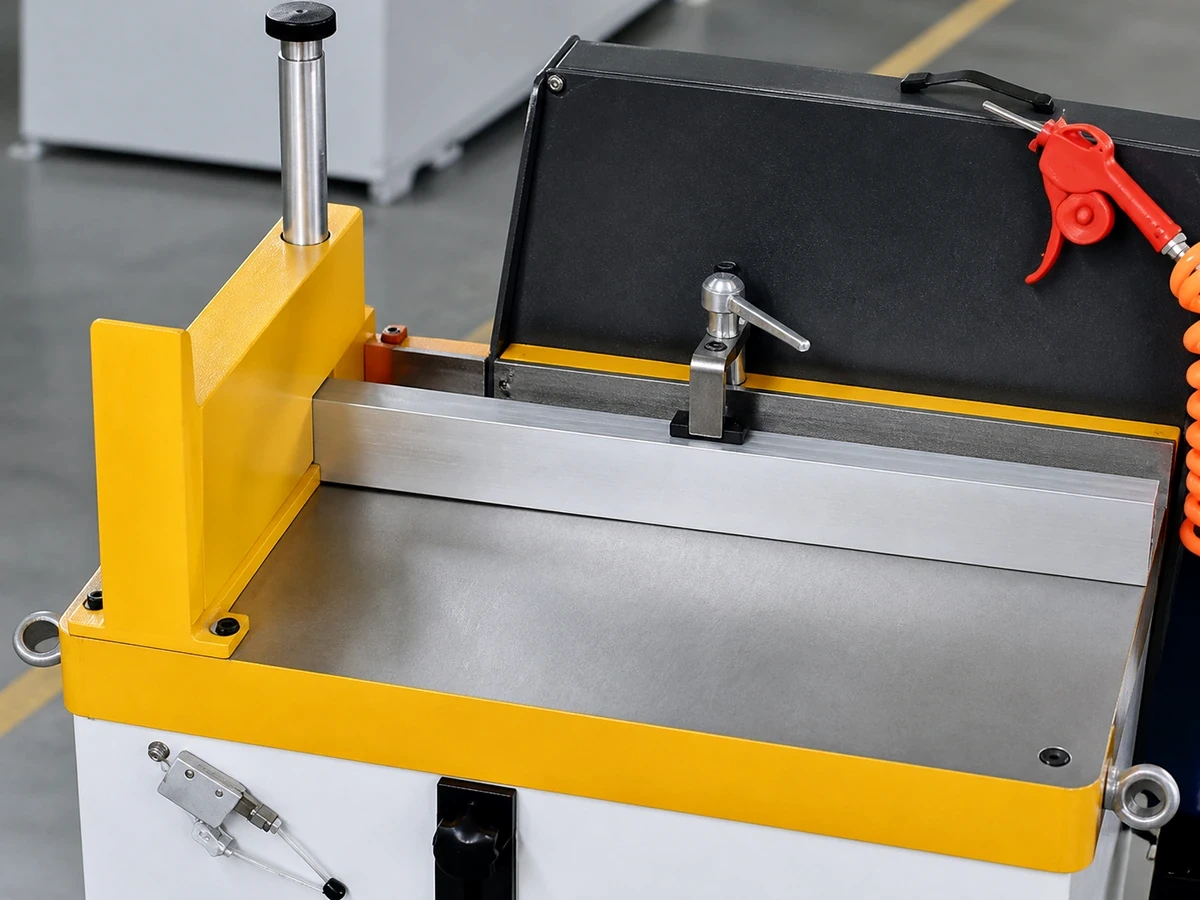
Bring a real hollow, thin-wall, finned, anodized, or otherwise sensitive section if it represents your normal production. Identify the datum face and the area that the clamp may touch. Observe whether the part rocks, deforms, slips, or needs added support before the cut. Examine the cut end and the downstream mating fit under the agreed inspection method. A clamp that closes is only one step in the test; it has not yet proved that the finished part is acceptable.
Write down any pads, stops, nests, fixtures, or special support used during the trial and put them in the quotation scope. If the demonstration relies on a one-off workaround, repeat the cut after a normal changeover. Ask who sets the clamp, who approves the first part, and what condition triggers a stop and readjustment. This is particularly useful when comparing two semi-automatic routes that may put different tasks in the operator’s hands.
Test 4: agree how a sample passes
Before either supplier trial, define what will be measured, where it will be measured, the instrument and fixture, the sample quantity, and the person who will sign the result. Record the first part after setup, a small consecutive group, and a part after a realistic adjustment or restart. If the part joins another extrusion, inspect the assembled interface as well as the isolated cut end. The acceptable method for a visible miter or a tube end may differ from a simple length check.
Do not substitute catalog feed-positioning data for a finished-cut tolerance. Blade condition, stock movement, clamping, datum choice, measurement restraint, and operator handling all affect what the buyer receives. If the two routes use different blade or fixture packages, list those packages next to their sample results. The result supports only the tested material and setup until a change is evaluated. If different operators will judge the same dimension, agree how measurement variation will be checked; the ASQ guide to gage repeatability and reproducibility explains why a stable measurement method matters. For a closer look at model-specific workholding, see the JR-455Q clamp trial guide and the JR-455Y operator-handoff guide.
Test 5: compare the complete installed offer
Ask for two written configurations using the same part-family sheet. Compare the supplied blade, fixture, support tables or rollers, guards, collection and lubrication arrangement, electrical and air requirements, installation work, training, spare parts, documentation, and acceptance support. Confirm which items are included, optional, or supplied by the buyer. If one quote requires a special nest or a longer infeed to reproduce the trial, the quoted price must carry that scope.
Also define what happens after a blade change, fixture change, interrupted cycle, or first-day setup. Who resets the stop? Who checks the first part? Which records are left with the buyer? If the plant has limited space or utility capacity, put actual installation dimensions and service clearances on a layout before paying a deposit. A visually compact machine may still need room for full bar loading and safe part removal. Compare the total operating route, not the cabinet footprint alone.
A five-line comparison sheet for the RFQ
| Decision line | Buyer evidence to attach | Supplier response required |
|---|---|---|
| Part family | Released drawing, stock form, difficult section and lot mix | Exact offered model, fixture and blade package |
| Operator cycle | Defined load-to-accepted-part observation window | Sequence and tasks demonstrated on the offered build |
| Workholding | Datum, contact limits, support and visible-face rules | Clamp and support arrangement included in price |
| Acceptance | Sample quantity, measurement method and mating check | Agreed trial record and changeover or restart condition |
| Site and support | Available space, utilities, staffing and maintenance route | Installation, training, documents, spares and exclusions |
The JR-455Q vs JR-455Y decision is conditional: choose the JR-455Q route if the witnessed operator cycle and quoted fixture package release your recurring parts with manageable work; choose the JR-455Y route if its verified hydraulic crosscutting sequence and full handling package better fit the same parts. If neither completes the defined job, revise the scope or consider another machine family. The catalog names establish which machines to investigate; your accepted sample and signed quotation establish what you are buying.
Video: one equipment-process example
The Jiurun channel video below shows a JR-455Y-labelled semi-automatic machine with an operator handling a round tube at a supported infeed. It is a general equipment and process example. It does not prove the JR-455Q comparison, the material or configuration in your quotation, a customer job, an accepted trial, a tolerance, or a production rate. Use your own witnessed samples and written scope for those decisions.
Request a quote against your real job
Send the released drawing, representative stock, required cut and assembly checks, expected lot pattern, site constraints, and the five-line comparison sheet to Jiurun. Ask the team to identify the exact JR-455Q or JR-455Y configuration and propose a witnessed sample plan before you compare prices. Contact JiurunCut with your part and trial requirements.