
The JR-455Y hydraulic semi-automatic aluminum saw is worth evaluating when a factory wants an operator-controlled cutting station rather than an unattended feeding line. The purchase decision is not settled by a short video of a blade moving through a profile. A useful trial follows a released bar or group of bars from presentation and clamping to the inspected cut parts, then records what the operator must do before the next cycle. This guide turns that complete job into a quotation and acceptance plan.
Jiurun’s catalogue lists the JR-455Y as a hydraulic transverse-cutting semi-automatic machine and describes linked clamping, oil application and cutting functions for the semi-automatic family. That catalogue description does not establish the exact clamp, controls, blade, guard or material envelope of a current quotation. Request a version-specific arrangement and identify each included item before using a demonstration as evidence. The related pneumatic-versus-hydraulic saw comparison discusses the broader power-system choice; the question here is how to accept a quoted JR-455Y station for your own production mix.
1. Define the handoff the operator will actually own
Start with the released part drawing and the incoming stock: section, alloy and temper if relevant, length range, wall or fin features, straightness condition, protected faces, bundle form and identification. State whether the operator receives single bars at the table, opens bundles, positions several pieces for a grouped cut, or collects material from another station. A semi-automatic cutting cycle does not mean that loading, selecting, orienting, inspecting and removing parts are automatic. Put each action in the cycle map and identify who performs it.
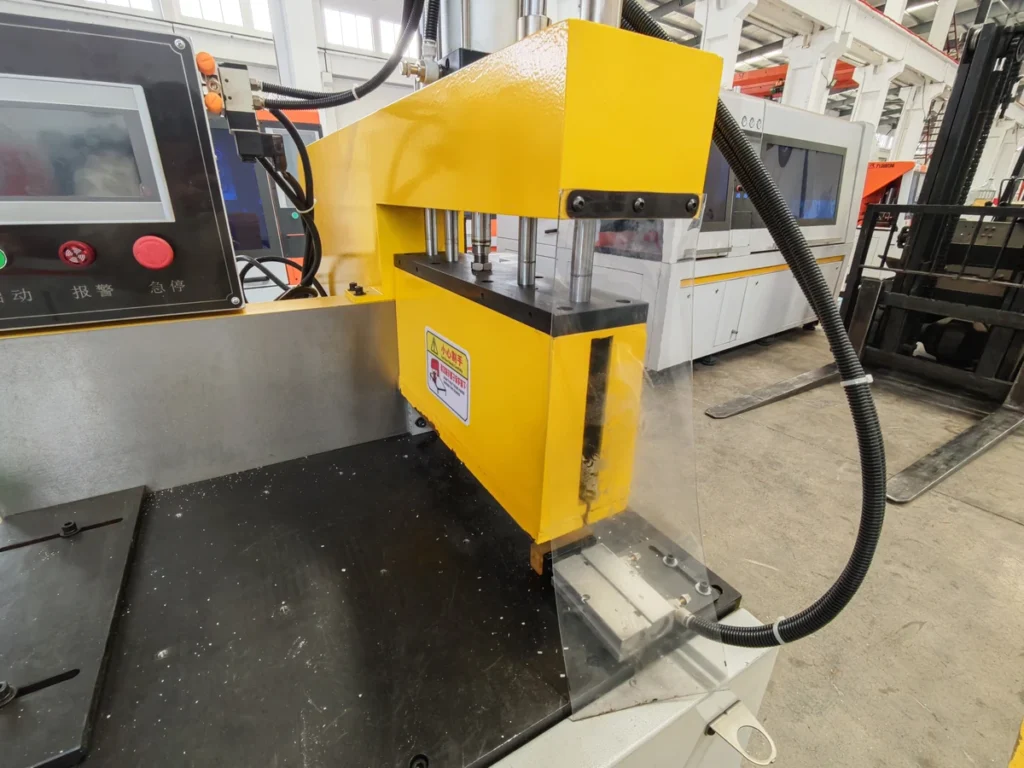
Mark the stock datum against which cut length will be measured and the face that may contact supports or clamps. For a profile with a coating, delicate fin or hollow wall, state allowable contact and whether a sacrificial pad or shaped fixture is required. Do not assume the photographed worktable is the complete support system for your longest or shortest piece. Ask the supplier for a layout showing stock approach, operator standing space, cut zone, accepted-part destination, offcut location and access for cleaning and maintenance. This gives both sides a testable boundary.
2. Separate hydraulic cutting motion from the workholding claim
Ask the supplier to identify which functions on the quoted machine are hydraulic and which are pneumatic, electric or manual. A hydraulic blade drive does not automatically prove that every clamp is hydraulic. The answer belongs on a circuit and component list tied to the quoted serial or configuration. For each stock family, have the supplier show the proposed clamp contact area, support points and how a thin wall or uneven section remains seated before and during the cut. Record the actual fixture used in the trial, including any optional pads or stops.
Watch for a part that moves when the clamp closes, a long section that lifts at the remote end, or a group of bars that can change relative position. Define a hold point after clamping and before cutting, then inspect the cut part against the drawing datum. The trial should compare the first piece after setup, consecutive pieces and the first piece after a profile change. If adjustment is needed, record what changed; do not report only the best later sample as if it represented the initial quoted setup.
3. Make a multi-piece demonstration earn its place in the quote
The company-channel JR-455Y video describes multi-piece cutting, but the buyer should treat that as a possible application to be proven for a specific stock family and fixture. Choose the actual number and shape of pieces that the factory expects to load together. Identify the top, bottom and side contact surfaces, alignment method, permitted variation in extrusion dimensions and the way each piece is identified after cutting. If the supplier recommends a single-piece process for some profiles, record that exception rather than forcing one impressive grouped demonstration to cover the entire order mix.
Run a controlled comparison: first a single representative profile, then the proposed group, then the next production family. For each run record loading and setup time, cut count, individual finished lengths, end-face condition, surface marks, pieces held for inspection and scrap. Agree a sample size and measurement method before the trial. A grouped cycle can appear faster while taking longer to load, separate and inspect; compare accepted pieces per complete staffed cycle, not blade travel alone. Do not infer a throughput or finished-part tolerance from the video or catalogue.
4. Inspect the cut-zone boundary and access plan
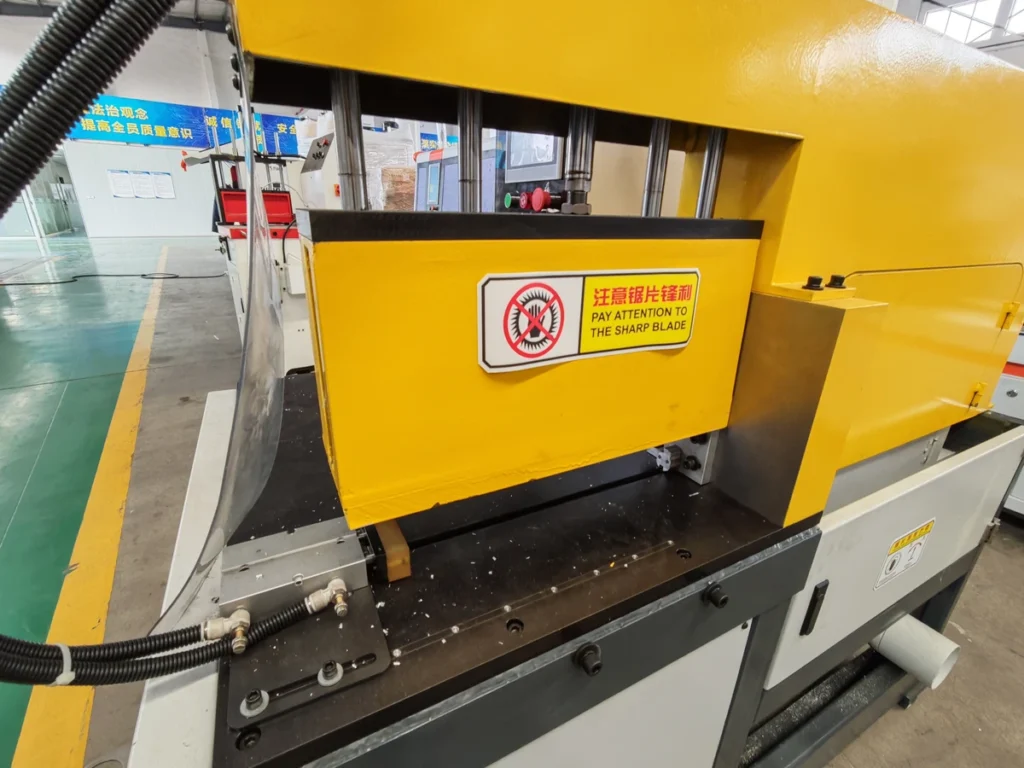
Request the guard and access arrangement for the quoted machine, including the normal loading opening, operator controls, emergency-stop locations, blade-service access and what the operator can see during a cycle. The buyer should observe a supervised demonstration under the supplier’s documented procedure; this article is a procurement checklist, not operating or safety instructions. Do not reach into, defeat, or test a protective function by improvisation. Ask for the machine documentation and have trained personnel confirm the protective measures that apply to the delivered configuration.
A short-cut part, a remnant near the blade and accumulated chips are different access cases. Put the expected way to receive, inspect and clear each category in the quotation discussion. Identify any chute, collection table, extractor connection or tooling needed to support the claimed flow. A guard photograph can locate a visible panel; it cannot establish that a safety circuit, interlock or service procedure is present or effective on another unit.
5. Specify the finished-part inspection and handoff
Define the finished length from the drawing’s actual datum, not from a generic feed-position number. Record squareness or miter condition if relevant, burr and end-face acceptance, surface damage on protected faces, and any downstream machining allowance. State the gauge, calibration status, measurement location, temperature or support condition when those affect the part. For hollow or flexible profiles, decide whether inspection is in free state or in the intended assembly restraint. The buyer and supplier should sign the same acceptance sheet before any performance claim is repeated.
Keep accepted parts, setup pieces, held samples and reusable remnants separate. The station may need only a simple count, but the handoff must reconcile raw bars with inspected outputs. Ask whether the quoted table and collection arrangement prevents cut pieces from mixing with rejects or with another drawing revision. If a later process will mill, drill or assemble the blank, define what the saw must deliver and what remains for that later process. This avoids crediting the cutting station for a finished feature it never creates.
6. Compare the entire staffed cycle and site requirements
When comparing JR-455Y with another semi-automatic or CNC option, use the same released part set and labor boundary. Time the operator’s preparation, stock orientation, clamp setup, cycle initiation, unloading, measurement and remnant handling separately. Note whether a second person or lifting device is needed for heavy or long stock. A fast cutting motion is not a complete productivity case if the station requires extra handling outside the quoted footprint. For a multi-piece order, compare the accepted output after separation and inspection.
Have the quote itemize the machine release, blade and fixture assumptions, table or roller supports, guards, lubricant and chip management, electrical and hydraulic utility requirements, installation and commissioning scope, training, spare and service documents. Ask what the buyer supplies and what the seller will verify on site. Do not treat a photographed adjacent module as included in the price. If the machine uses a hydraulic system, ask for the as-delivered maintenance information, consumable specification and leak-response responsibilities rather than assuming a generic service schedule.
The JR-455Y video from the JiurunMachinery channel below shows general machine and stock footage. It is related equipment context, not proof of this quotation’s clamp circuit, fixture, guard functions, your material, a witnessed multi-piece trial, accepted-part quality or cycle performance.
7. Attach a witness plan to the RFQ
Send the supplier the drawings and revision list, sample stock, expected single-piece and group quantities, protected faces, required output categories and site layout. Ask it to return a version-specific machine and fixture list and a short trial matrix: stock ID, setup, clamp contact, observed cycle, measured part, exception and disposition. Include the first cycle after a profile change and a representative remnant. Decide in advance who may adjust a fixture and when a repeat trial is required. Keep the factory demonstration and post-installation checks distinct.
A suitable JR-455Y purchase is one that can produce your accepted parts through a documented staffed route at the quoted scope. Share your profile drawings, production mix and site constraints with the JiurunCut engineering contact team and request a machine-specific layout and witnessed trial plan. The reply should make the operator handoffs, unproven assumptions and acceptance evidence clear before an order is placed.