
A pressure needle can stay still while a thin extrusion shifts under a saw blade. The display reports pressure at one point in a hydraulic circuit. A buyer still needs to learn what reaches the clamp, how the pad contacts the profile, and whether the part remains located during a representative cut. Treat hydraulic saw clamp force as a workholding claim to verify on the offered setup, not a number inferred from a photograph of a gauge.
Start with the pressure reading’s location
Ask the supplier to mark the gauge, pressure switch, valves and clamp cylinder on the proposed hydraulic schematic. A pump-side reading and a cylinder-side reading answer different questions. Record whether the displayed value is taken while the clamp closes, while it holds a stationary part, or while the saw cuts. A single idle reading cannot show the complete cutting condition.
Pressure alone does not specify cylinder output. Parker’s hydraulic cylinder catalog relates theoretical push and pull force to the pressurized piston area and pressure, and says resistance and piping losses must be considered for actual output. The useful quotation therefore identifies the cylinder bore, rod side used, operating pressure at the relevant point and the mechanism between the cylinder and pad. Those details are configuration dependent; this article assigns no force rating to a Jiurun model.
Hydraulic saw clamp force reaches the profile through the fixture
A cylinder can have adequate theoretical thrust while a narrow pad lands on a web that dents, a curved face that rolls, or a contact point too far from the cut. The purchase decision is about a defined stock section and datum. Send the profile drawing, alloy and temper if known, wall thickness, finish requirements, cut orientation and where marks are prohibited. Ask the supplier to show the proposed support and pad locations on that section.

Use a different test piece for each materially different wall or contact geometry. A successful hold on a solid bar says little about a hollow section with an easily marked visible face. If the quotation offers interchangeable pads, ask which pad belongs to each profile family and how the operator confirms that changeover.
Make the trial observable at the cut
Agree on a practical witness plan before the machine is built or demonstrated. Hydraulic saw clamp force matters only if the chosen section stays located without unacceptable contact marks. Mark a repeatable reference on the stock and fixed fixture, then observe whether it moves between clamping and the completed cut. Inspect the finished face and the pad-contact areas against the drawing’s agreed acceptance criteria. Repeat the cycle with the profile orientation, length and feed support intended for production. The supplier and buyer should agree on a safe observation method that preserves guards and follows the machine instructions.
A pressure trace can help explain a failed hold, but it does not replace the part inspection. Hydraulic saw clamp force at the workpiece still depends on the actual fixture and contact geometry. Record the gauge location and readings at clamp close, cut entry and cut exit if the offered instrumentation can capture them. If the stock slips or deforms, stop the trial, document the condition, and review pad geometry, support, sequence and circuit with the supplier. Do not treat a higher pressure setting as an automatic fix for a thin wall.
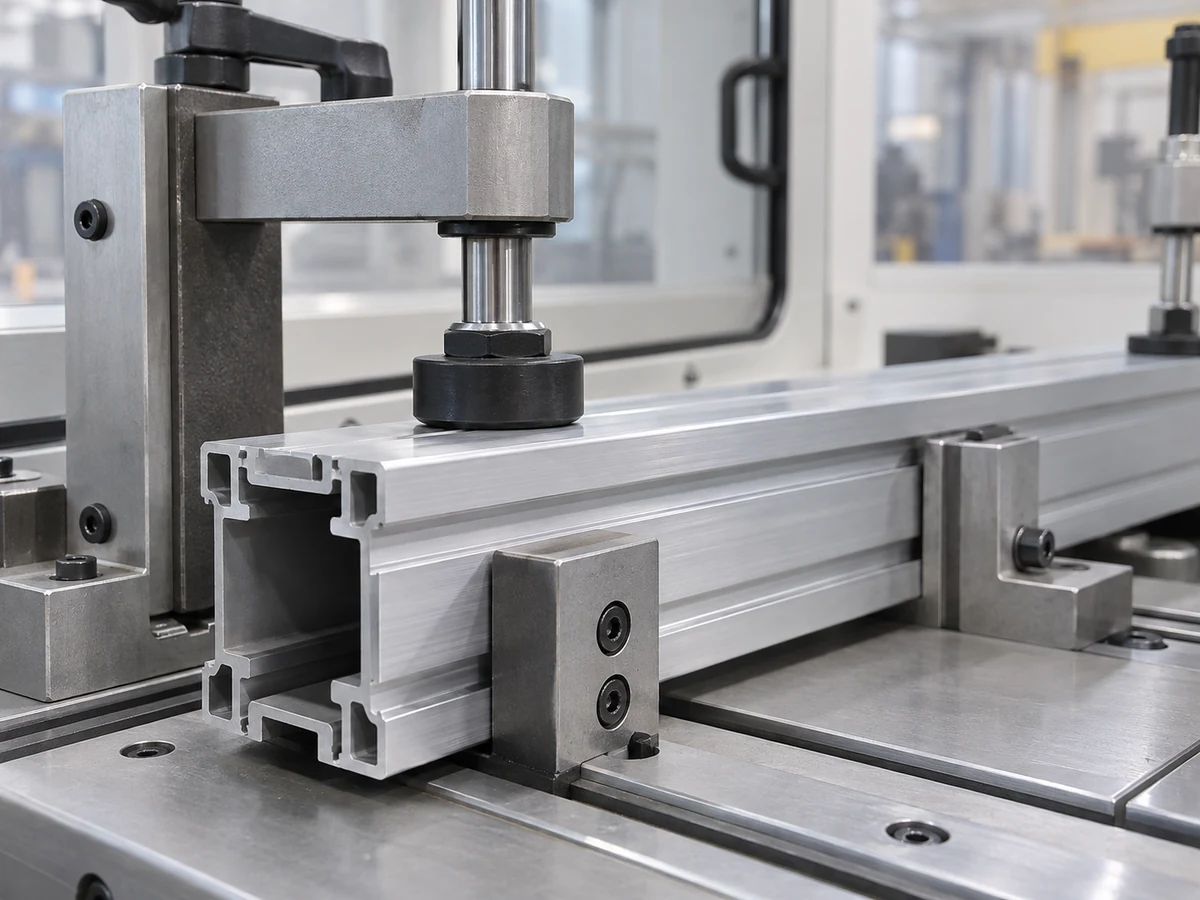
What the quote should commit to
For hydraulic saw clamp force, write one request that can be accepted or revised: identify the offered clamping circuit and gauge point; name the cylinder and pad arrangement; show support locations on the buyer’s section; describe how pressure is set and checked; and attach an agreed trial with movement, visible-surface and cut-part criteria. Ask who supplies any special pads and whether they are included in the quoted machine, tool pack or optional fixture. These answers let two offers be compared without treating unlike pressure displays as equivalent.
The JR-455Y trial guide covers the broader operator and cut handoff. The separate air-pressure sag guide concerns a pneumatic circuit under the cutting cycle. Neither substitutes for the hydraulic circuit and profile-specific contact evidence requested here.
A related clamping video, with a clear boundary
This Jiurun channel video shows a JR-455Q semi-automatic saw and its visible upper and lower work area. It is a related equipment view. It does not show a JR-455Y hydraulic circuit, a gauge measurement, the pad loading on your section, or a verified clamp-force value.
Send a drawing and a test question
For a useful response, send the extrusion section, intended cut orientation, stock and finished lengths, surface limits and the production support arrangement. Ask: “At which point is the quoted pressure read, what pad contacts this section, and what evidence will show that the part stayed located without unacceptable marking during the cut?” Send the drawing to JiurunCut and request a configuration-specific clamping and sample-cut plan before accepting a clamp-force claim.
Source boundary: Parker’s catalog explains general cylinder-force calculation and loss considerations. It does not certify the performance or configuration of any Jiurun saw. Final clamping design, safe trial method and acceptance limits belong in the order-specific engineering review.