
Escalator skirt brush aluminum holder cutting is a narrow manufacturing decision inside a larger safety-related assembly. The question is whether an approved straight aluminum holder may be ordered as a separate cut blank, or whether the escalator owner must buy a complete brush kit from its authorized supplier. A saw-cut rail is not a finished skirt brush, and a visually similar channel does not establish interchangeability.
KONE Spares’ Avert skirt-brush product page describes black anodized aluminum brush holders, curved sections, alignment tabs and end caps as parts of a coordinated kit. KONE’s escalator safety guidance treats the skirt area as a safety concern. These sources establish why component identity and installation authority matter; they do not approve any substitute profile or demonstrate JiurunCut equipment on a KONE part.
This guide is for an OEM, authorized parts supplier or maintenance buyer preparing an RFQ for a supplier-released straight holder extrusion. Ask the escalator manufacturer or authorized kit supplier to confirm whether separate sourcing and cutting are permitted for the exact unit and revision. Keep curved pieces, brush inserts, mounting hardware and installed safety assessment with the parties responsible for them.
Start with the supply boundary, not a saw catalogue
A complete kit price may include brush material, preformed curves, alignment features, caps and installation support. A cut-holder quote covers only the approved aluminum member and any specifically ordered secondary operations. Compare quotes at the same delivered stage. If a complete kit is mandatory, there is no independent straight-rail cutting purchase to optimize.
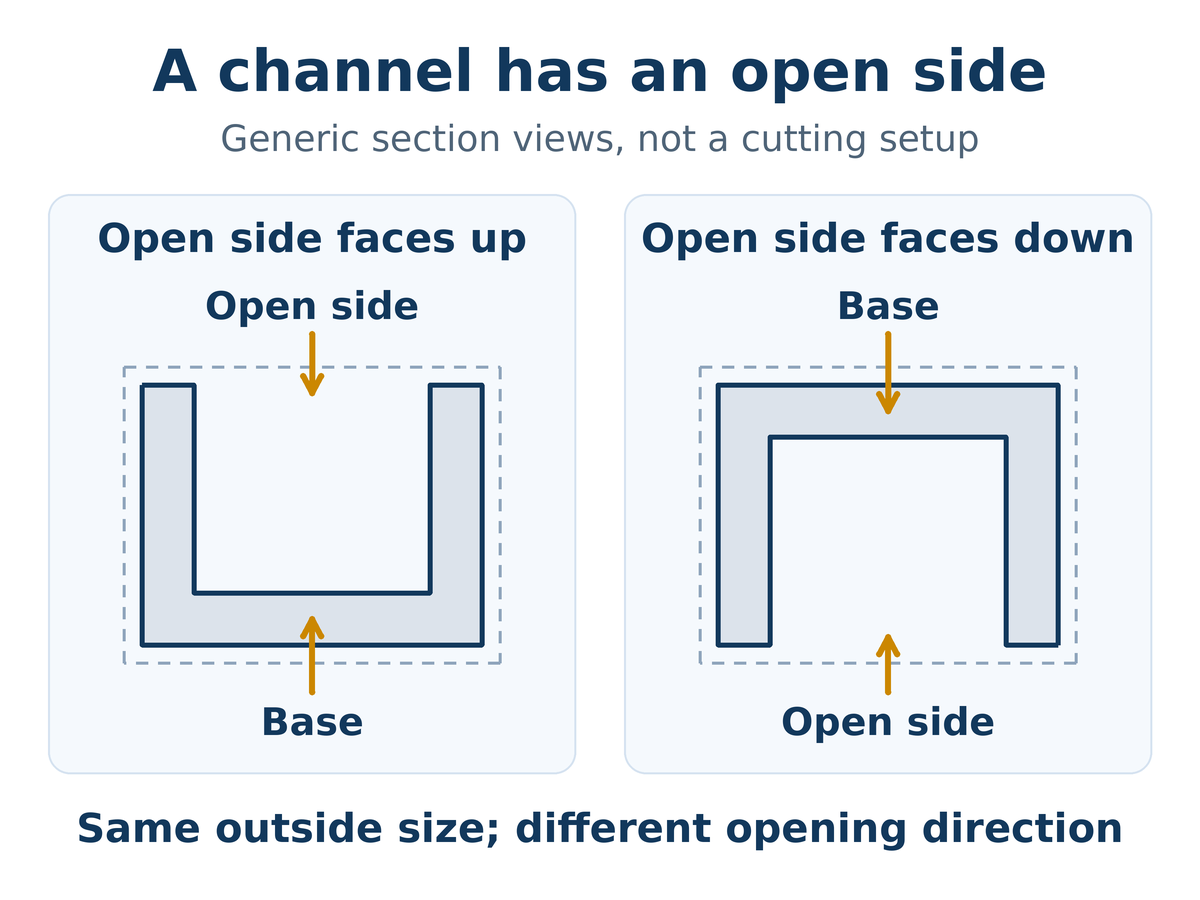
Do not infer the channel size from a photo. Request an approved section drawing with the insertion groove, retaining lips, mounting face, finish and orientation marked. The slot that retains the brush may be more important than the outside width when choosing fixture contact. The channel illustration below only shows how an open side can face different directions.
Escalator skirt brush aluminum holder cutting: seven RFQ checks
1. Identify the exact authorized holder
Record the escalator make and model, unit or project reference, kit or holder part number, drawing revision and the party authorizing a separate extrusion. Obtain the extrusion alloy, temper, surface treatment and controlled section dimensions from that authority. A supplier’s generic aluminum channel cannot be substituted merely because a brush fits into it. Keep the approved curved and straight variants separate in the item list.
2. State which sections are straight and which are curved
KONE Spares describes curved holder sections. A straight-cut aluminum saw cannot form those curves. The RFQ should identify straight stock lengths that may be cut, preformed curved sections supplied elsewhere, and any transition pieces. If a transition requires a special angle or later forming, mark it on a controlled drawing instead of assuming a square end. Confirm whether short remnants are usable or require a different authorized end treatment.
3. Define length from the installed datum
Specify whether length is measured from a mounting hole, a step or skirt reference, a brush-insertion stop, an end-cap seat or the physical cut face. The visible installed brush run can differ from the metal holder length. List the allowed tolerance and inspection method for each straight blank. Include left and right side identity if they differ. Do not quote a nominal escalator span as a saw-cut length without an approved dimension chain.
4. Protect the retention slot during clamping
Thin retaining lips can spring inward or spread when clamped on the opening. A sample fixture plan should show the supported base, acceptable contact faces and prohibited brush-slot surfaces. Test the actual approved section with its intended finish. Check insertion clearance after cutting, not just before it. JiurunCut’s manual versus pneumatic clamping trial discusses how to compare contact and repeatability; its examples are general saw practice, not escalator-part qualification.

5. Specify cut-end and finish acceptance
Define squareness or approved end angle, burr and chip limits, slot-lip damage, anodized-surface scratches and any edge treatment. The receiving inspector should know which end is exposed, covered by an end cap or joined to a curved section. Anodizing may be specified before or after cutting by the design authority; a raw cut face is not automatically acceptable just because the visible body is black anodized. State the required finish stage in the quote.
6. Allocate tabs, holes and caps to the right operation
Alignment tabs and end caps mentioned in the kit description may come as separate parts or be prepared on a holder. Ask for a process drawing that distinguishes simple saw cuts from drilling, punching, milling, deburring, coating, brush insertion and kit assembly. Price each authorized operation explicitly. Do not claim a saw can produce all features of a finished skirt-brush assembly.
7. Agree on first-off evidence and traceability
For the first approved profile batch, record the source extrusion and revision, fixture orientation, cut program or stop setting, measured lengths, end condition and disposition of nonconforming parts. Photograph the actual sample at both ends and at the brush slot. Pair the measurement record with the kit or holder part number. A sample that fits a loose brush on a bench is not evidence of installed escalator clearance or safety performance; the responsible escalator party must assess the complete installation.
A short RFQ the machine supplier can actually answer
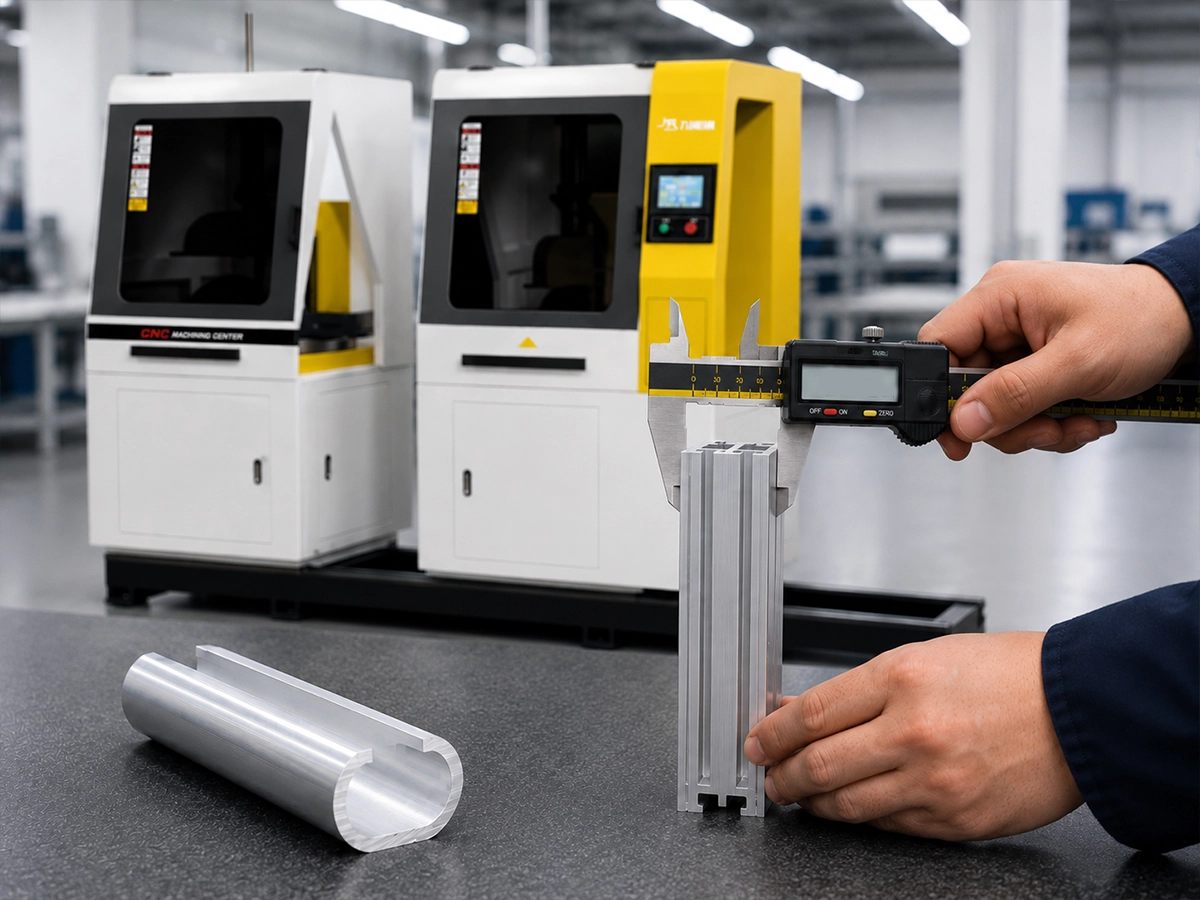
Send one controlled drawing for every straight holder variant, annual and batch quantities, stock length, maximum finished length, end-angle requirements, finish stage, the permitted fixture-contact faces, sample quantity and the buyer’s measured acceptance criteria. Add a written note stating who supplies the brush insert, curved sections, tabs, caps and fasteners. Ask the saw supplier to quote only the released blank and named secondary operations.
Compare a machine trial on the same extrusion, same inspection datums and same accepted output stage. The buyer should confirm material availability and profile authority before treating a cycle-time estimate as production capacity. For a separate escalator aluminum component with a different purchase boundary, see our decking-profile RFQ guide.
What a general saw video can and cannot show
The Jiurun machinery channel video below shows an aluminum-cutting machine in operation. It is a related process demonstration only. It does not show this approved skirt-brush holder, a specific escalator model, a qualified fixture, brush assembly or a measured performance result.
Decision before purchase
Use an independent cutting quote only when the responsible escalator or kit supplier has released the exact straight aluminum holder for separate manufacture. If the design is controlled as a complete kit, buy and validate it through that route. For a released blank, send the drawing, the supply boundary and a first-off acceptance plan together. Contact JiurunCut with the approved extrusion and cut-part requirements to discuss a saw trial; the equipment recommendation follows the sample evidence and the authority’s specifications.