
Cleanroom sliding door track cutting begins with the approved door system, not with a saw setting. A factory may buy a complete automatic or manual sliding door, receive a prepared rail kit, or cut released aluminum members in-house. Those routes need different evidence. A square, attractive cut end cannot establish door motion, interlock behavior, particle control, or suitability for a particular cleanroom. The seven checks below turn a door supplier’s released member information into a useful cutting-equipment RFQ.
Image note: The featured photo shows generic cleanroom-related aluminum frame sections in a staged equipment setting. It is related profile context only; it does not depict a sliding-door track, approved system, customer project, or successful trial.
1. Decide what the factory actually retains
Start with the commercial boundary. If a door supplier provides a complete sliding assembly, the customer may need only receiving and installation checks. If the supplier provides a revision-controlled track and frame kit, a factory saw may not be part of the project. An in-house cut operation makes sense only when the system owner releases identifiable stock profiles and cut-member drawings for that route. Ask who owns the door design, who supplies operators and guides, and who approves the final installed assembly.
This distinction is practical, not semantic. Terra Universal’s published cleanroom-door examples include external-mount aluminum automatic sliding doors, with the track mounted on the wall surface, and recessed aluminum sliding-door assemblies, with the frame and track within the opening or partition. These examples show why a generic “cleanroom door rail” is not a sufficient part identity. They are examples of system arrangements, not Jiurun configurations or endorsement.
2. Identify the released rail and door arrangement
Record the door-system maker, drawing revision, rail/profile number, material and finish, and whether the opening uses a single slide or bi-parting leaves. Record the side of the opening, handing, travel direction, and mounting route in the assembly record. Do not infer a cut length from a catalog opening width. The rail may extend beyond the clear opening to allow door travel or to carry end hardware; only the approved member drawing can settle the length and end condition.
For a retrofit, also identify what is being reused. A new track blank, a complete header module, and a replacement door assembly are different purchase items. If the original system data are unavailable, obtain the approved replacement from the door-system owner before asking a machine vendor to choose a profile or reverse-engineer a safety-critical interface.
3. Name the cut-length datum and end features
Write down exactly where the length is measured: physical outside-to-outside ends, a machined shoulder, a hole-center reference, or a reference point on an assembly drawing. State which end is datum A and which is datum B. A supplier can then distinguish saw-cut length from a downstream drilled or milled interface. If the finished member includes slots, holes, notches, or attached end stops, list them as separate operations unless the proposed machine configuration explicitly covers them.
Specify end squareness or angle from the released drawing rather than from a photograph. For mating parts, ask for a first-off comparison against the actual header or bracket reference. Our separate finished-length datum guide explains why a feed-position number cannot automatically be reported as the finished part length.
4. Test the real section and protect the visible finish
Send a section drawing and an actual stock sample. Identify the faces that the clamp may contact, thin lips or cavities that need support, the anodized or powder-coated surfaces that must remain presentable, and whether film stays on during cutting. A generic jaw that holds a heavy rectangular bar may distort a lighter track. The trial should show stable support and repeatable orientation without silently changing the approved section.
Use a measured representative batch rather than the easiest single blank. Include the shortest and longest required cut lengths, the stock length delivered to the shop, and any left/right or mirrored member variants. In the quote, separate the base saw, feeder, fixtures, work supports, and any special pads. A profile-orientation RFQ can help document which face is down and which side references the fence.
5. Cleanroom sliding door track cutting: feed and clamp checks
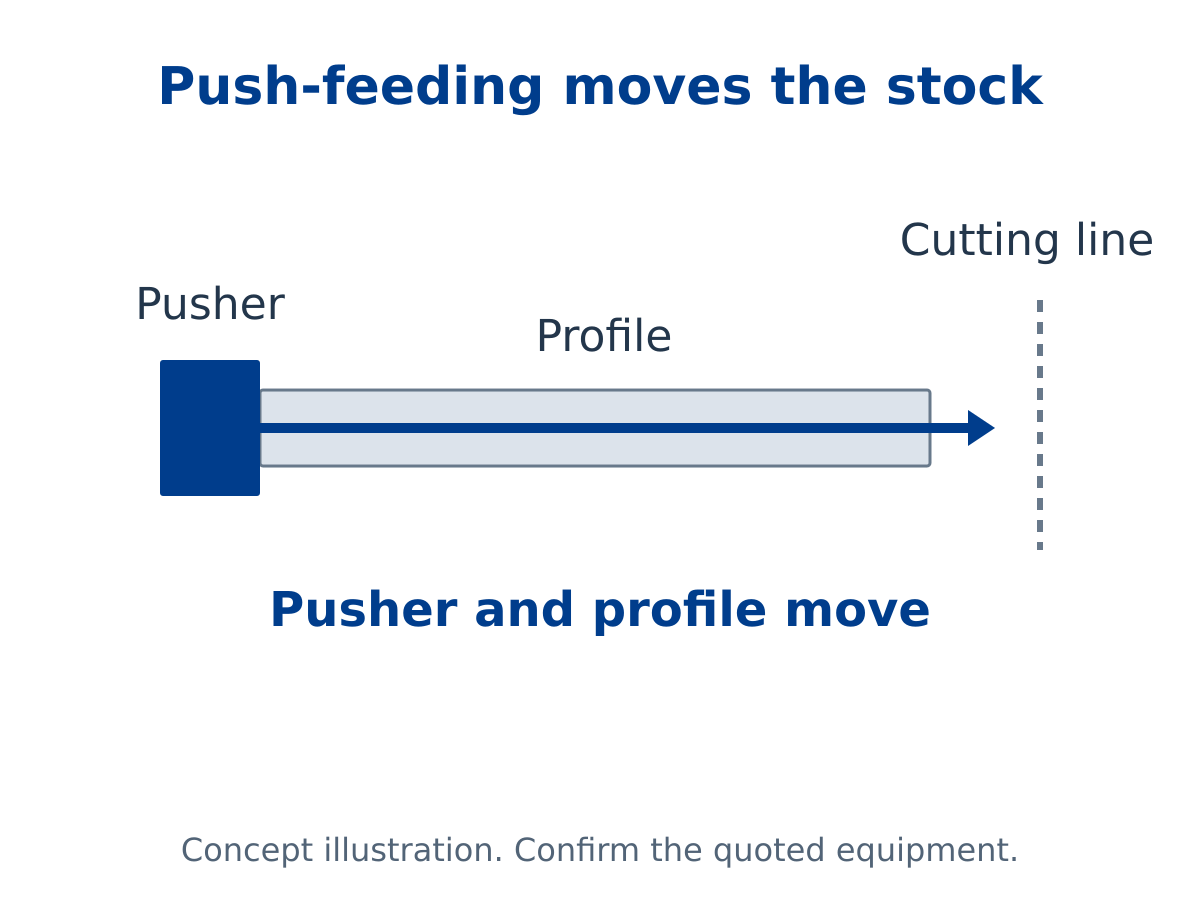
For cleanroom sliding door track cutting, ask the machine supplier to state how long stock reaches the blade, how the first datum is established, how a short remaining length is handled, and where a finished piece lands. Feeding and clamping solve different problems: a pusher positions stock, while a fixture must keep the section stable during the cut. Neither alone demonstrates end quality or system fit. A trial should record the actual profile, fixture contact, blade and speed setting, cut count, and inspection method used for the quoted configuration.
Measure several first-off parts from the same setup, then check the length and end condition against the released tolerance. If the approved drawing calls for a subsequent hole, slot, deburring, or cleaning step, mark the saw output as an intermediate blank. Avoid advertising an unverified finished-door precision, cycle rate, or cleanroom classification from a cut-only trial.
6. Check assembly fit without treating it as a cleanroom test
Where the system owner permits a trial, dry-fit the cut rail with the actual matching header, brackets, stops, or guide references. Note whether fasteners seat correctly and whether the rail’s visible orientation matches the approved drawing. A caliper can help inspect dimensions, but it cannot alone establish smooth door travel, interlock logic, air leakage, or site acceptance. Those checks belong to the door-system and facility teams.

For a factory acceptance run, distinguish four sign-offs: saw-cut blank dimensions, any downstream machining, assembly fit, and installed cleanroom-system release. Record who signs each one. This keeps a capable cutting trial from being mistaken for proof that a door or controlled environment meets its separate requirements.
7. Define the deliverable and compare quotations on the same basis
A useful quotation specifies whether the deliverable is loose cut blanks, a labeled revision-matched member kit, or a completed door assembly. For each door, list rail type, quantity, drawing revision, nominal cut length and tolerance, finish-side protection, any downstream features, and a first-off acceptance method. State the production mix and a realistic representative batch. Ask each vendor to price the same boundaries, including tooling, stock support, inspection time, scrap handling, and operator tasks.
Do not compare a machine quote that excludes fixtures with one that includes a validated profile-specific setup. Likewise, do not compare a cut-blank price with a complete door module price as if both delivered the same result. The best route depends on approved system access, batch mix, available shop steps, and who carries final assembly responsibility.
RFQ handover checklist
- Approved door-system drawing and revision; external or recessed mounting; single or bi-parting arrangement.
- Track/profile ID, physical stock sample, material and finish, protected face, and stock length.
- Cut-list quantity by door and hand; datum, end geometry, tolerance, and downstream features.
- Representative first-off parts, dimensional method, mating assembly references, and sign-off owner.
- Quoted saw, feeder, fixture, support, safety provision and handover scope, each identified separately.
Ask Jiurun to review the cut operation. Send the released aluminum profile section, stock length, cut list, end drawings, batch mix, and an approved sample if available through our contact page. We can discuss a suitable cutting-equipment route and what a representative trial would need to show. The door-system owner remains responsible for system compatibility and cleanroom acceptance.
Related equipment demonstration
The following video from Jiurun’s own channel shows a separate aluminum-profile cutting machine. It illustrates general equipment motion only; it is not a cleanroom door-track test, the quoted configuration, a customer installation, or evidence of door performance.
Sources and scope
Terra Universal, external-mount aluminum automatic sliding doors; Terra Universal, recessed aluminum automatic sliding doors; Terra Universal, sliding-door product data and submittal. These manufacturer references establish that mounting arrangements and door-system details differ. The RFQ method above is a buyer checklist, not a claim that Jiurun manufactured, supplied, tested, or certified those systems.