
Boarding bridge shutter slat cutting begins with the approved slat design, not a saw setting. Passenger boarding bridges can use different closures and materials. A cut-parts request should identify which shutter location and released aluminum profile is involved, what belongs in the blank supply, and who accepts the finished assembly. This guide helps buyers prepare an RFQ for saw-cut aluminum extrusion blanks. It is not a design or certification procedure for a passenger boarding bridge.
The distinction matters because TK Elevator Airport Solutions describes shutter slats made from several possible materials, including aluminum, while ADDA describes a transparent bridge shutter made with anodized extruded aluminum profiles and separate polycarbonate elements. Neither example makes every bridge shutter interchangeable. Start from your own OEM drawing and bill of materials.
1. Define the shutter position and purchased component
A bridgehead front shutter, a lateral curtain and a rotunda closure do different jobs. ADDA describes front and rotunda shutters separately; De Leeuw Protection Systems describes lateral curtains that may be fully transparent or partly made with aluminum slats. Record the exact position, bridge model or project revision, and component number before discussing length. Do not transfer a slat specification from one location to another simply because both parts roll or slide.
The RFQ must say whether the supplier provides raw extrusion, saw-cut blanks, finished slats with later machining, or a complete shutter assembly. These are different scopes. Jiurun supplies industrial aluminum and nonferrous sawing equipment; a saw trial can examine cutting behavior on a supplied profile. It does not establish shutter-system safety, aircraft-side compatibility, or installation approval. Those decisions remain with the design authority and assembly supplier.
2. Release the profile drawing before quoting a cut list
Send a controlled drawing of the actual extrusion section, including its current revision and a physical sample where possible. Mark the visible face, mating edges, any glazing or insert channel, and surfaces that may be contacted during feeding and clamping. Include the material and temper specified by the drawing, incoming profile condition, and whether cutting occurs before or after anodizing or another finish. If geometry is still provisional, request a feasibility discussion rather than an unqualified production price.
- Identify each slat or rail by part number and drawing revision; keep front, lateral and rotunda variants separate.
- Give finished blank length, quantity, permitted length variation and measurement datum exactly as specified by the design owner. Do not invent a standard tolerance for the whole bridge.
- State whether ends are square or require another geometry, whether further punching or machining is performed elsewhere, and who owns that operation.
- Identify finish-sensitive faces and the permitted condition of protective film or packaging at the saw.
- List the matching guide, end connector or insert interface that will be used to check fit after cutting.
If an aluminum component is only one element of a transparent shutter, specify the polycarbonate or other insert as a separate supplied item. A cut aluminum profile is not evidence that the insert, shutter drive, sensors, controls and complete closure will function together.
3. Boarding bridge shutter slat cutting: plan stock support
For boarding bridge shutter slat cutting, long or slender extrusions can present different handling problems from short, rigid blocks. Ask the cutting supplier how the actual stock will be supported before the blade, through the cut, and as the separated blank leaves the station. The answer depends on the real profile, length and finish. A photograph of another extrusion on rollers shows a handling concept only; it cannot prove that a particular shutter section will remain straight or unmarked.

Request a trial that records where the profile touches supports, whether its orientation can be held consistently, and how the cut blank is transferred without striking a finished face. If the profile arrives in mixed lengths, ask for a proposed cut plan with assumptions about saw kerf, unusable ends and remnant handling. Do not turn a theoretical nesting yield into a guaranteed material-utilization claim.
4. Agree on clamping and cut-end acceptance
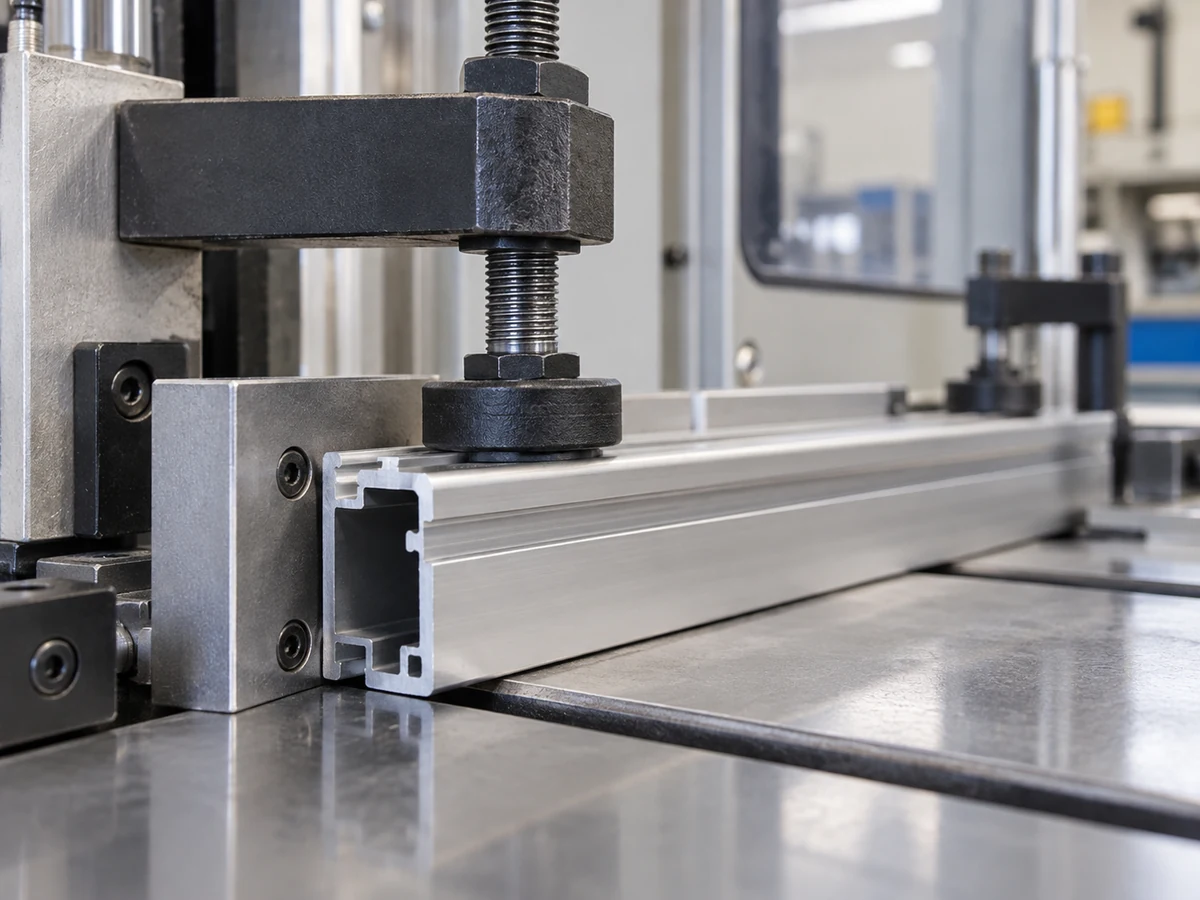
A clamp must locate and hold the actual section without unacceptable marking or distortion. Define the reference face and the surfaces that must stay clear. Where a thin wall or open lip is involved, ask for a trial with the actual profile and finish. Compare the first and last pieces in a sample run rather than approving a single attractive photograph. The picture below shows generic thin-wall profile contact; the shutter design requires its own fixture review.
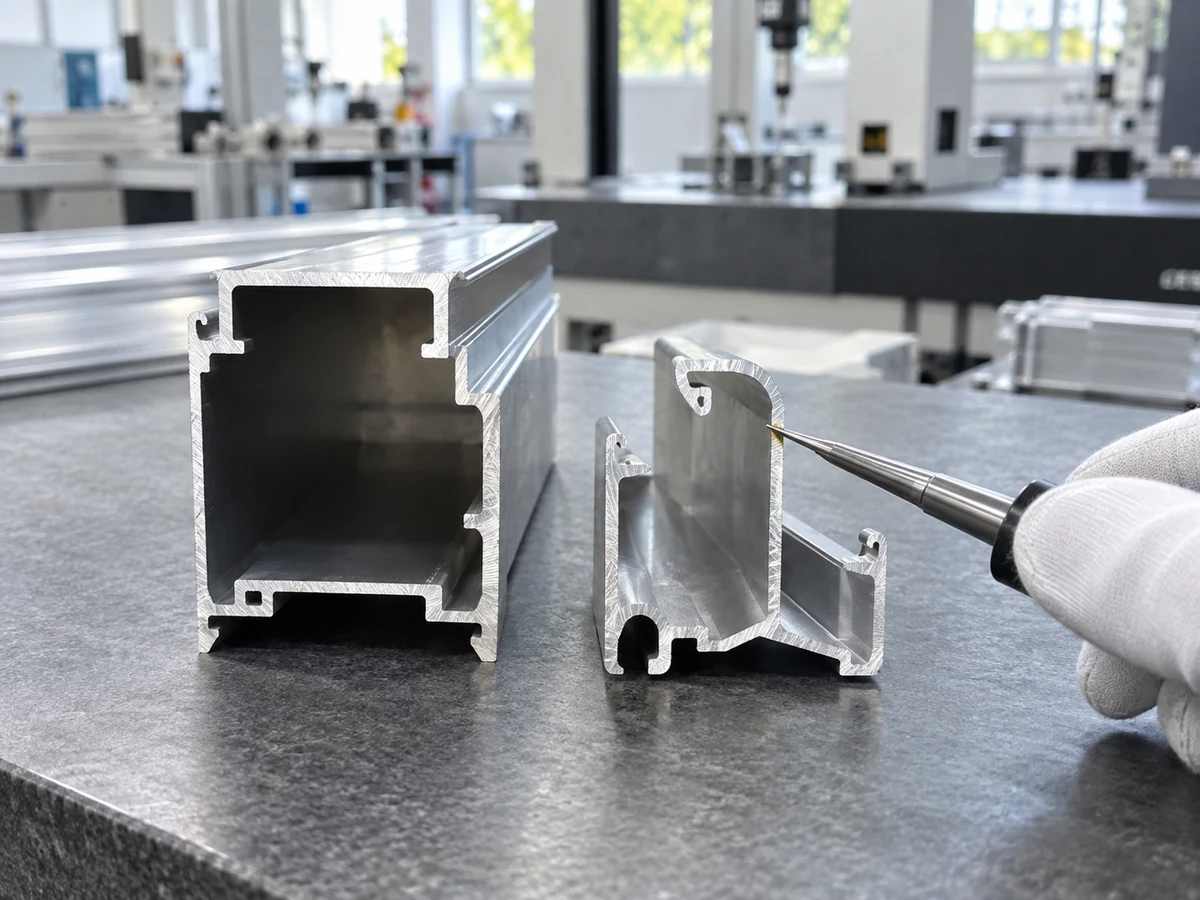
Set acceptance criteria in the RFQ for length, squareness or specified end angle, visible-edge condition, burr removal, deformation, and finish damage. The Aluminum Extruders Council notes that extrusion cutting can be followed by deburring and that requirements depend on alloy, profile and blade selection. The buyer should say where deburring is allowed and whether a burr near an insert groove, hinge or guide is a functional concern. A saw operator should not remove material from a mating feature without the drawing owner approving it.
5. Approve the sample in two stages
First, the cutting supplier can provide a documented sample of the actual released profile: drawing revision, incoming stock identification, cut length measurements, end-face photographs and observations about burrs, contact marks and handling. This is a manufacturing sample. Its purpose is to show whether the proposed sawing method can supply the specified blank consistently enough to justify further review.
Second, the shutter designer or approved assembly supplier checks the blank in the real guide, joint, insert, hinge and closure system as applicable. That team decides whether it may be used in a passenger boarding bridge. The cutting supplier should not treat a good cut face as acceptance of pinch protection, visibility, fire behavior, weather sealing, drive controls or other complete-system obligations. Record who signs each stage before committing to volume.
6. Compare quotes on the same scope
A low price for raw extrusion is not comparable with a price for protected, measured, deburred and identified blanks. Ask each bidder to state which operations are included. The table below is a discussion template; the values and tolerances must come from your released specification.
| RFQ field | Buyer supplies | Supplier returns |
|---|---|---|
| Identity | Bridge and shutter position, part number, drawing revision | Quoted component and revision acknowledged |
| Stock | Section drawing, material, finish, stock length | Supported stock range and source assumption |
| Cut | Length datum, end geometry, quantity, tolerance | Process scope, sample plan and measurement method |
| Edges | Permitted burr, finish and deformation criteria | Deburring and protection steps included |
| Handoff | Part IDs, packing and next assembly interface | Traceability, packing and exclusions |
When comparing quotations, separate machine capability from guaranteed part results. A published saw specification for a different stock section is a starting point for discussion, not a promise about a shutter slat. Ask for a witnessed or documented trial on the exact profile if fit, finish or edge condition is critical.
Video: related Jiurun cutting equipment
The following Jiurun channel clip shows a general aluminum cutting machine process. It is a related equipment illustration only. It does not depict the boarding-bridge shutter in this article, its material, an approved model configuration, a customer trial or certified performance.
Send a useful RFQ packet
To discuss a saw-cut blank supply route, send the approved shutter position and drawing, a representative extrusion sample, material and finish, required cut list, end-condition criteria, annual and batch quantities, and the assembly interface that will be used for acceptance. Jiurun can review the profile and cutting requirements to discuss equipment and a possible sample trial; the bridge OEM or its approved supplier remains responsible for the finished shutter and system release. Contact Jiurun with the drawing and sample details.
If the procurement question is instead about replacing an existing guide, see the separate roller shutter guide rail replacement RFQ. For a broader saw purchase serving multiple shutter components, see the roller shutter manufacturing equipment guide. Those scopes should not be merged into a slat-blank order.
References
- TK Elevator Airport Solutions: Apron Drive passenger boarding bridge (shutter material and closure options).
- ADDA Van Dullemen: Boarding bridges (extruded aluminum profiles, transparent inserts and bridge shutter locations).
- De Leeuw Protection Systems: Lateral PBB shutters (lateral curtain options).
- Aluminum Extruders Council: Cutting/Forming (general extrusion cutting and deburring process).