
An aluminum extrusion can arrive as a long, hollow section and leave the saw as a shorter blank. That does not make the blank a finished RF waveguide assembly. For aluminum waveguide cutting, the useful purchasing question is where the saw supplier’s deliverable ends and where flange machining, assembly, mechanical inspection, and electrical verification begin. Answer that question before setting a cut length or judging a sample.
Waveguide suppliers distinguish unflanged sections from flanged products. Mi-Wave’s Series 691 unflanged waveguide information lists aluminum as a material option and orders sections by a specified length. Flann’s waveguide and flange data treats flange selection as its own decision. These are examples of how specialist suppliers describe their products, not a claim that a Jiurun saw, a particular extrusion, or a pictured part meets either supplier’s specification.
Aluminum waveguide cutting begins with the deliverable
There are at least three different deliverables behind the phrase “cut waveguide.” A saw-cut blank is stock separated to a specified rough length, with an agreed cut-end and cleaning condition. A flange-ready blank has enough stock and an agreed datum for a later operation to prepare the joint. A finished flanged section adds the specified flange, its attachment method, and the inspections required by the assembly drawing. A purchase order that uses one length and one generic “good cut” requirement for all three leaves the most important handoff undefined.
Put the end state on the drawing or order line. Say whether the saw shop delivers an unflanged blank, whether another shop machines the end and installs the flange, and who accepts the finished waveguide. If the final requirement includes RF measurements, assign those to a suitably equipped downstream supplier; a saw cut alone does not establish electrical performance.
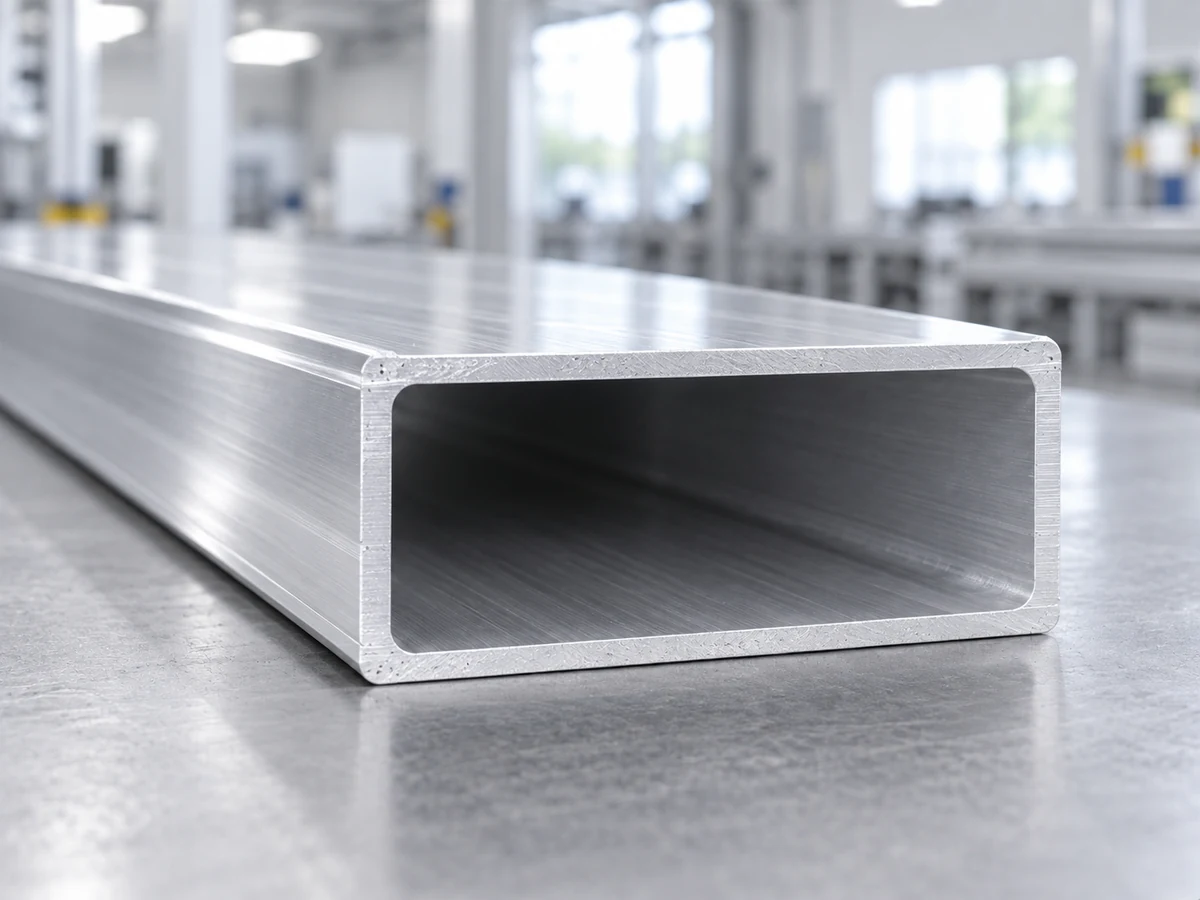
Build the blank length from the finished length backward
For aluminum waveguide cutting, a finished section’s flange-to-flange length and the saw shop’s cut length may be different. Start with the finished assembly drawing, identify the surfaces used as length datums, then ask the flange machining or assembly supplier what stock must remain at each end. One end may have a different treatment from the other. Include any planned facing, end preparation, joining, and trim in the route before issuing the saw length.
A useful order note is: “Cut blank length is controlled from the stated extrusion datum; retain the end allowances supplied by the downstream flange shop. Do not treat the cut end as a finished flange interface.” The actual allowance is a drawing and process decision, not a universal number to copy from another waveguide size. If that allowance is still unknown, request the downstream process plan before releasing a production cut list.
Give the saw shop a section drawing, not only a WR label
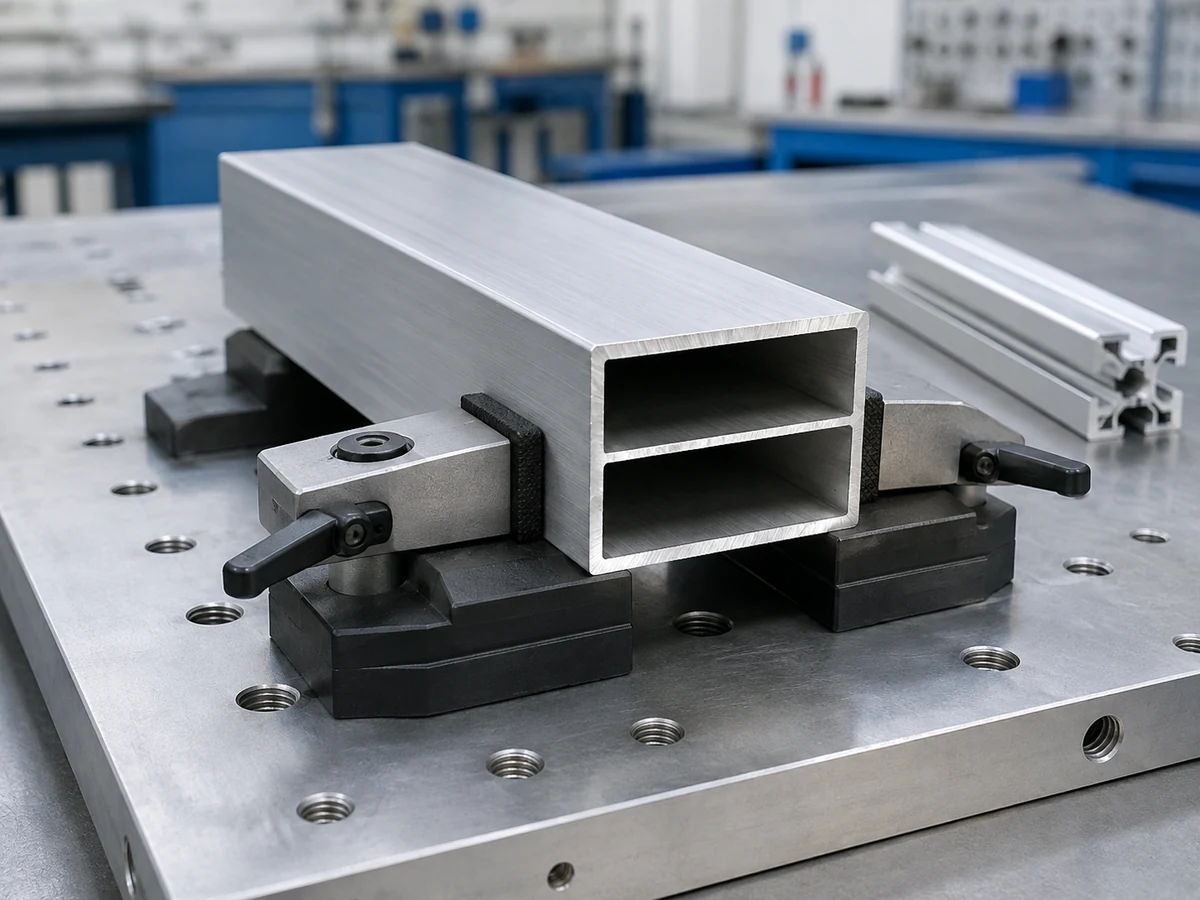
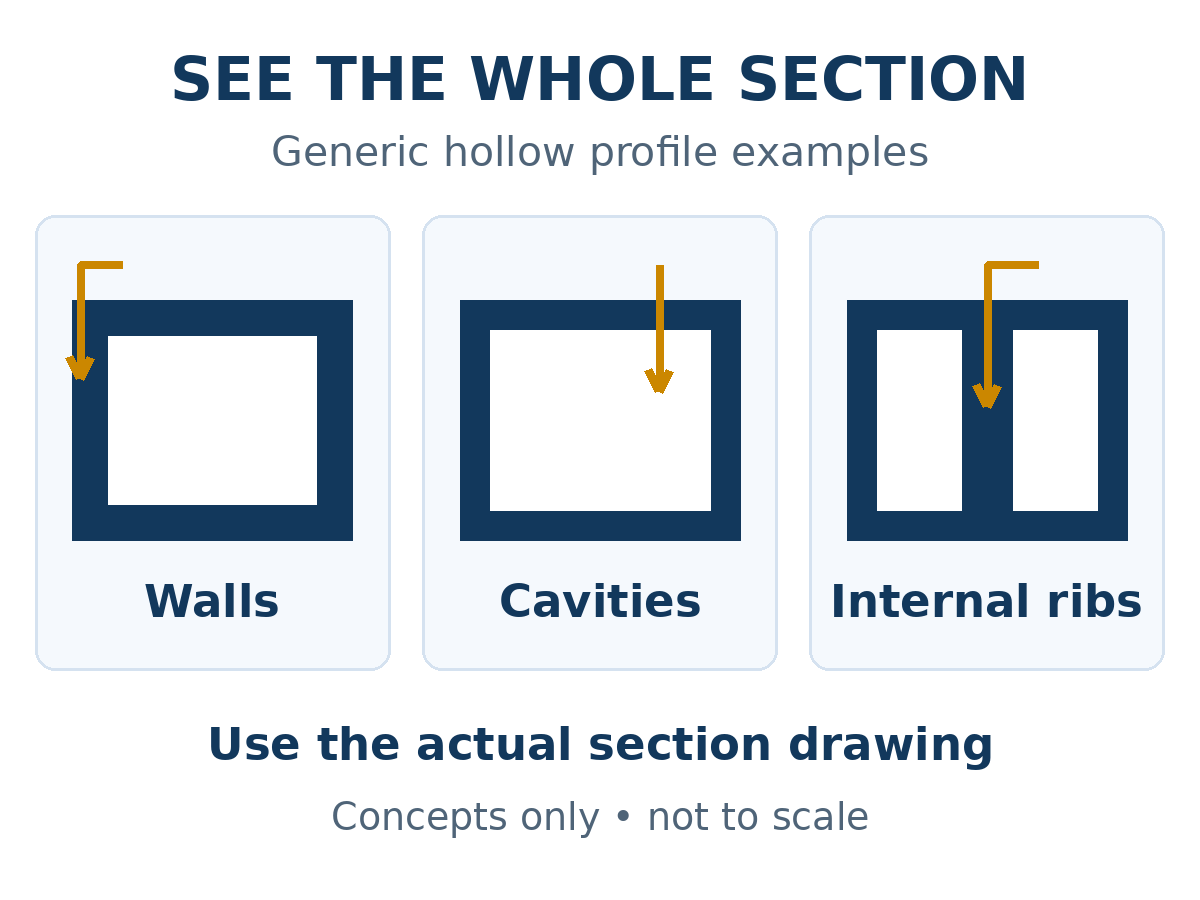
Waveguide designators are useful for product identification, but a saw setup needs the actual supplied extrusion. Provide the section drawing and revision, alloy and temper if specified, actual outside envelope, internal aperture, wall thicknesses, corner details, stock straightness limits, and any protective surface condition. The drawing should mark the surfaces that may contact supports and clamps. A hollow section can present a broad outside face while still having thin walls around the opening; a fixture choice that is harmless on one extrusion is not automatically safe for another.
Ask for a stopped-machine setup review before cutting the first production piece. Check where the stock rests, how it is located, where the clamp contacts it, and whether the end remains accessible for inspection. This review is about the supplied profile and fixture. It is not a substitute for measuring the aperture or qualifying the final assembly. Our clamp contact-zone guide gives a related setup check for ordinary aluminum profiles.
Separate saw acceptance from flange acceptance
For aluminum waveguide cutting at the saw stage, agree on a measurable blank length and datum, an end squareness or angular requirement appropriate to the next operation, visible burr limits, handling damage, and a cleaning method for loose chips. Inspect the first cut at the opening as well as on the outer face. Chips trapped inside a narrow passage and displaced metal at an inside edge can be missed if the inspection only looks at the broad outside surface. For a related inspection method, see our guide to chips inside hollow aluminum cuts.
Keep the next-stage checks separate. Flann’s calibration service identifies mechanical checks such as aperture dimensions, flange flatness, length, internal corner radius, and dowel-hole position, alongside microwave measurements. Those checks describe a specialist acceptance scope; they should not be copied into a saw quote as if the saw alone can deliver or verify them. Name the shop, tools, and drawing revision responsible for each finished-assembly criterion.
For an early sample, record the original stock identity, its orientation at the saw, the blank-length reading, the visible state of both ends, and any chips found after cleaning. Then have the downstream flange shop assess whether the remaining stock and cut-end condition work for its operations. If it rejects the blank, the reason should point to a defined handoff criterion so the saw setup or allowance can be revised before the batch is cut.
When should the order stay with a specialist?
If the order calls for a finished flange interface, certified aperture, specified electrical behavior, or traceable calibration, procure that scope from a waveguide specialist or define a documented multi-shop route. A saw supplier can discuss the feasibility of making a rough blank from a supplied aluminum extrusion. That discussion does not transfer responsibility for flange machining or RF acceptance to the saw supplier.
For a cutting-only inquiry, send the released extrusion section drawing, stock length and condition, target blank lengths and quantities, allowed contact faces, required cut-end condition, cleaning and packaging needs, and the downstream shop’s end allowance. Ask for a representative cut sample from the real stock before committing to volume. For a finished assembly, include the flange drawing, joining route, and inspection owner as separate line items.
A related aluminum saw demonstration
The following video from Jiurun’s own channel shows a JR-455Q family upper-lower compression aluminum cutting machine. It is an equipment overview only. It does not show a waveguide extrusion, a particular flange configuration, a customer part, an accepted trial, or RF performance.
Questions to settle before release
Can a saw-cut blank be called a finished waveguide? Only if the contract’s definition truly stops at a cut unflanged section. A finished flanged and tested assembly needs its own process and acceptance evidence.
How much extra length should be left for the flanges? Obtain the allowance from the actual flange and end-preparation route. It depends on the released drawings and operations at each end; this article gives no universal allowance.
What is the first useful trial? Cut a representative length of the supplied extrusion with the intended support and clamp arrangement, inspect both ends and the opening, and send the result to the downstream flange shop for a documented handoff decision.
If your purchase is for aluminum waveguide cutting blanks, share the actual section drawing and the flange shop’s stock allowance with Jiurun for a cutting feasibility review. Keep finished-flange and RF acceptance requirements assigned to the supplier equipped to perform them.