
A quotation may list an aluminum saw jog mode as if it were a single feature. The label does not tell a buyer which part moves, under what conditions, or what happens when the command is released. One supplier may mean an incremental feed movement; another may mean a controlled axis movement available only to a setup role. Before comparing prices, ask the supplier to describe the actual quoted controls and demonstrate the permitted sequence on the proposed configuration.
Aluminum saw jog mode: name the motion, not just the button
Start with the job your team needs to set up. Is the question about positioning a long profile at the stop, moving a feed carriage, checking a clamp position, or observing a saw-head travel path? These are different mechanical movements with different access and guarding questions. A brochure word such as “manual,” “inch,” or “jog” does not confirm that all of them can be commanded separately. Nor does it confirm a particular speed, travel limit, or control type.
- Identify every movement the supplier says is available in the quoted mode and the axis or device it controls.
- Ask whether the command is a held control, an incremental command, or a selectable function, and what the supplier specifies happens on release.
- Record which operating state, authorization and safeguards the supplier requires before that movement is available.
- Ask how the machine returns to its normal production state without an unintended next cycle.

Request a state-and-action map
The most useful RFQ attachment is a short sequence map for one representative profile and setup task. Have the supplier mark the starting machine state, the authorized person, the selected mode, the intended command, the movement that should be visible, and the expected stop or release response. Then ask what indication shows the machine is ready to resume the approved production cycle. This turns a vague option into a checkable deliverable.
Keep this map tied to the actual machine revision and supplied controls. An image of a different panel can help the discussion but cannot settle how the offered machine behaves. If the supplier proposes a pendant, foot control, HMI function or other option, record whether it is included in the price and who can use it. For a foot-operated command, also review the separate foot-pedal command question; the two functions should not be treated as interchangeable by name.
Witness the demonstration without changing the safety boundary
Ask the supplier to show the specified movement on the quoted machine under its approved operating procedure, with the intended safeguards in place. Observe from the designated safe position. The buyer should be able to see the starting state, the commanded movement, the release or stop response, and the transition back to production mode. If an expected movement cannot be shown on the proposed configuration, record it as an open quotation or acceptance item rather than assuming another model behaves the same way.
Do not use the purchasing demonstration as permission to reach into a moving area, bypass a guard, or improvise a setup procedure. In the United States, OSHA’s general machine-guarding rule addresses point-of-operation and other machine hazards. The applicable site rules and the manufacturer’s instructions still have to be assessed for the actual equipment and jurisdiction. A slow or held command, by itself, is not proof that the task is safe.

Do not treat jog mode as a service method
A setup check performed within an approved guarded workflow is different from maintenance or repair. If a task requires someone to remove or bypass a guard, or enter a danger zone, do not assume a jog button makes that work permissible. For U.S. workplaces, OSHA’s hazardous-energy standard sets requirements for servicing and maintenance in its scope, with a narrow exception for certain routine minor servicing under effective alternative protection. The employer must determine the applicable procedure; the supplier’s feature list cannot make that decision for the site.
Put the boundary into the handover. Which tasks are for a normal operator, which require a trained setup person, and which belong to authorized maintenance personnel? What written instructions and training cover the quoted controls? The separate operator-training handover should teach the actual approved tasks, not turn a generic demonstration into a blanket authorization.
Test the claim against one real profile
Use a representative profile, its drawing revision and an agreed setup question for the supplier demonstration. The aim is to see whether the quoted control helps the team establish the intended position and return to normal production without ambiguity. Record the observed machine state, the supplier’s explanation and any item still needing confirmation. Keep the cut-part acceptance criteria separate: a successful control demonstration does not prove the finished length, angle, burr condition or repeatability of future batches.
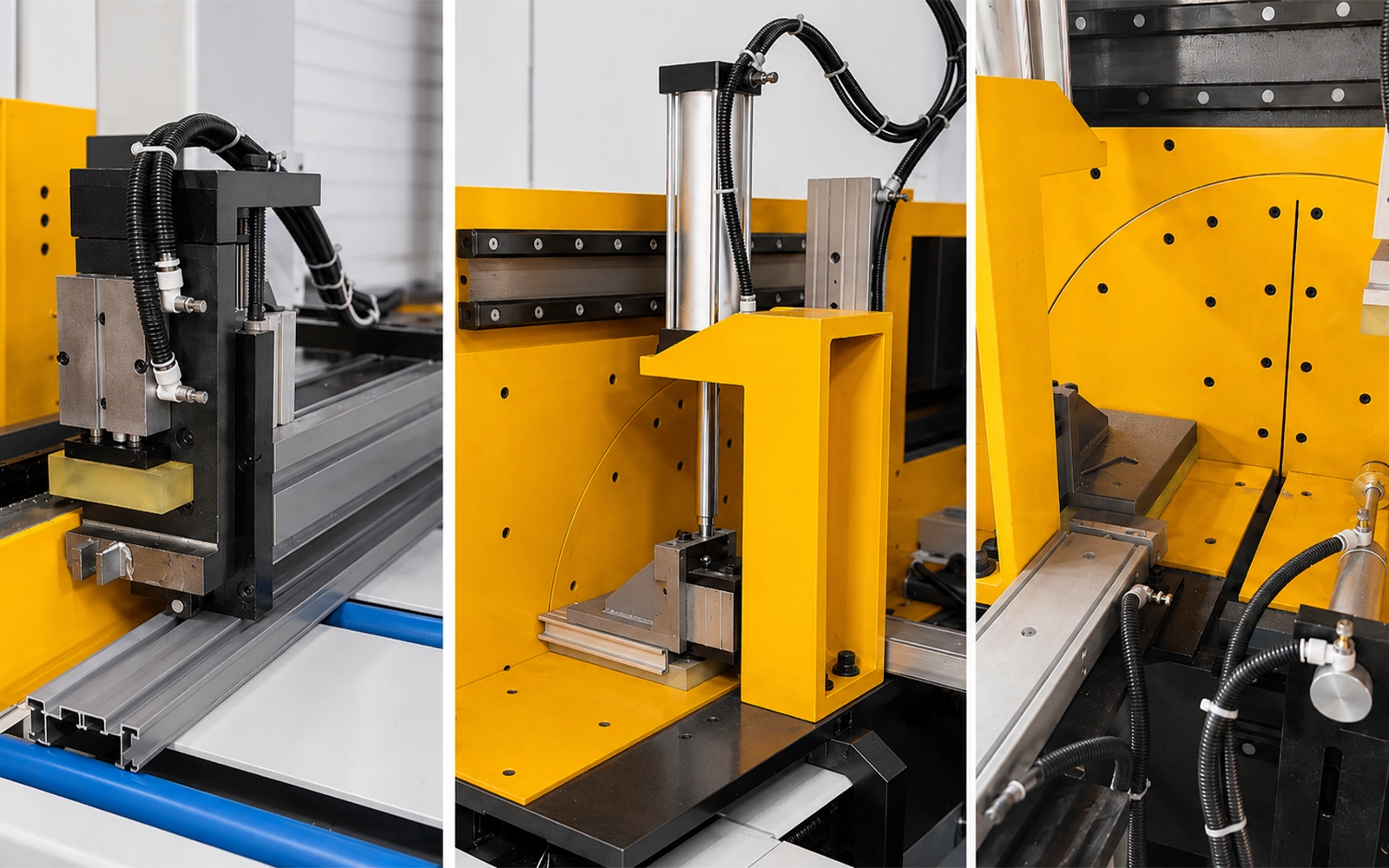
Quote the function as an observable deliverable
Ask for the exact machine and control revision, included jog or manual-motion functions, access roles, safeguards, documentation, demonstration location and unresolved exclusions in writing. If a proposed option changes the interface or commissioning scope, price that difference explicitly. The buyer can then compare two offers by the same representative task and witness criteria rather than by a checkbox.
Related machine footage
The following video is from Jiurun’s own YouTube channel and shows a related JR-455Q saw operating. It provides equipment and cycle context only. It does not show the jog mode, a held-control response, the guarding conditions described here, this buyer’s setup, or an acceptance result.
The purchase decision
Do not approve an aluminum saw jog mode solely because the quotation names it. Approve the specified movement, the people allowed to command it, the guarded demonstration and the handover evidence for your actual setup task. If these points remain uncertain, send JiurunCut your profile drawing and setup question and ask which functions can be shown on the proposed machine before the order is fixed.