
Aluminum saw fixture shims can help only when the locating gap and contact path are defined. When an aluminum shop cuts several extrusion sections on one saw, a shim may look like the quickest way to restore contact under a fixture or profile. It can also hide the real problem: a different locating face, a flexible wall, a bowed bar or a clamp that cannot reach the smallest section. An RFQ should therefore describe the workholding problem before specifying a shim thickness. This guide gives buyers five checks to put in a mixed-profile saw trial. It concerns the cut-blank stage; it does not approve any finished assembly.
When are aluminum saw fixture shims useful?
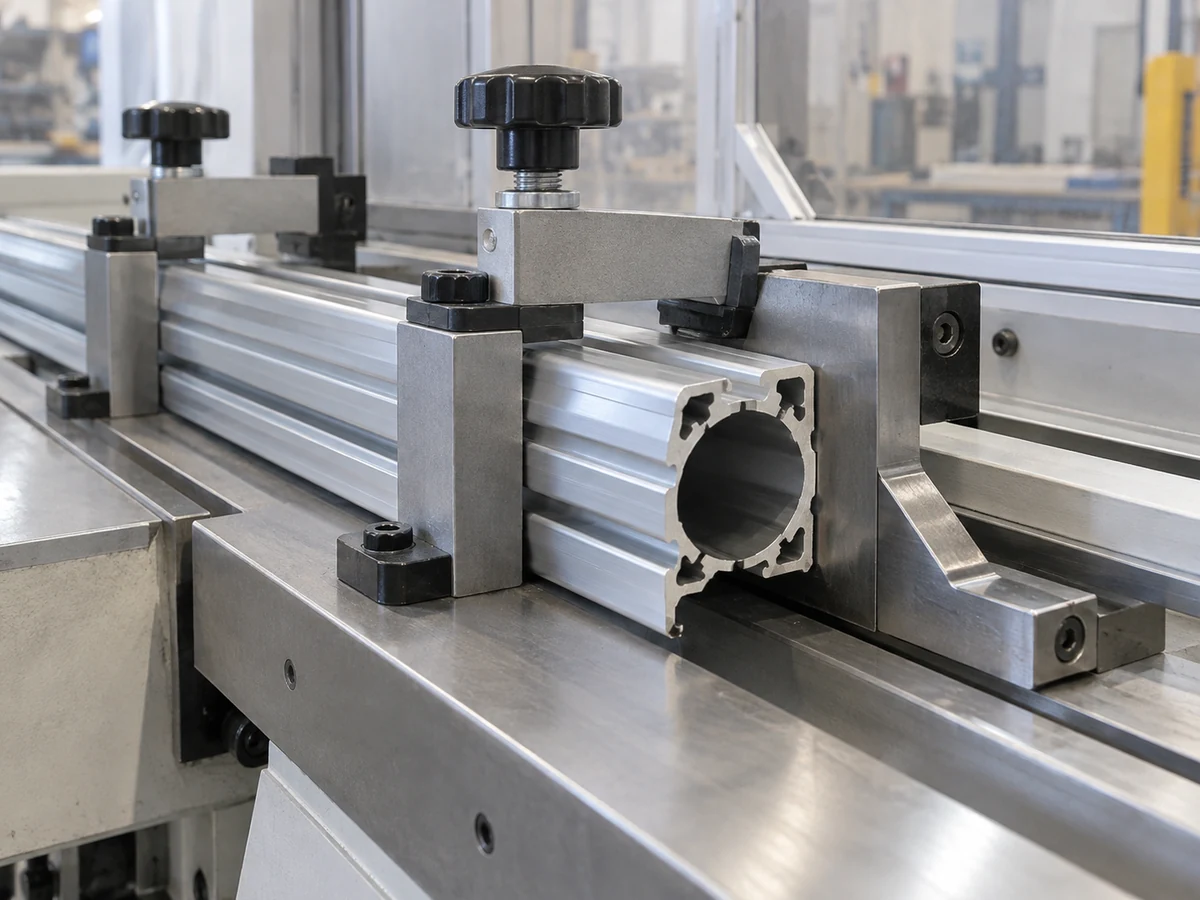
A fixture shim is a controlled spacer used at an identified fixture contact or support location. The proposal should state what gap it corrects, which profile and orientation need it, and how it is retained and removed. A loose packing piece placed wherever a bar happens to rock is not a repeatable setup method. In some cases the right answer is an adjustable support, a different jaw or a dedicated nest, rather than a shim.
Aluminum profiles can differ substantially in section geometry. The Aluminum Association’s extrusion tolerance guide distinguishes dimensional variation, straightness and twist. A local spacer cannot be assumed to correct all three. Before a supplier quotes tooling, give them the actual drawings and representative stock from the profiles that will share the machine.
Check 1: Identify the datum before discussing thickness
Mark the face or feature from which the finished cut length and orientation are judged. Then show how that feature reaches the back fence, side guide and support surface. If one hollow profile locates from its outside wall and another from a narrow rib, the same jaw position may press the second part away from its intended datum. Ask the saw supplier to draw the contact path for each section: stock to support, stock to fence, clamp to stock, and stock to length reference. The drawing should say whether the shim sits under a support, behind a locator, or under a replaceable jaw. Those positions are not interchangeable.
For a broader discussion of locating a profile, see our infeed side-guide RFQ. A supplier’s answer for the cut station should also account for the stock at the infeed and outfeed. An unsupported long bar can change its contact condition as the cut progresses. Emmegi’s published saw descriptions show adjustable vice positions and intermediate support as separate functions; use that distinction when comparing quotations, without assuming the same hardware is fitted to a Jiurun model.

Check 2: Separate stock variation from fixture height
Ask for the section dimensions and tolerances that matter at the locating faces, then measure more than one bar from the intended supply lot. A gap visible on one sample may result from section variation, bend, twist, protective film or finish build rather than a fixed machine error. A shim sized to a single sample can over-compress another. Record the profile number, alloy and temper if known, finish state, orientation, bar length and the measured faces. If the buyer controls the extrusion specification, keep its acceptance decision separate from the saw vendor’s workholding proposal.
There is a practical go/no-go distinction. A repeatable, documented height difference between two approved section families may justify a removable spacer. Random variation within a family calls for a locating or acceptance review. A wall that deforms under clamp load calls for a support-and-force review. The saw trial should make those cases visible instead of allowing a good first piece to stand for the whole batch.
Check 3: Compare shim, adjustable support and dedicated fixture
| Option | Best question for the RFQ | Evidence to request |
|---|---|---|
| Controlled shim or spacer | Is the offset fixed for one approved profile family? | Location, thickness identification, retention, changeover instruction and first-off result |
| Adjustable support or vice | Can an operator reach all sections without improvised packing? | Adjustment range, positive setting method, guard clearance and repeat test |
| Dedicated nest or jaw | Does a fragile or irregular section need shaped support? | Contact drawing, part identification, changeover time and cut-end inspection |
These are comparison options, not claims that a particular machine includes them. Emmegi describes adjustable profile supports and movable vices on its own machines, illustrating why the RFQ should separate stock support from clamping. Quote the exact tooling and change parts that the offered machine would need. Where thin walls or open channels are involved, ask how the tool avoids loading only an unsupported lip. Our clamp-jaw travel checklist covers the smallest and largest section envelope.
Check 4: Put safe changeover in the quote
Ask who is allowed to change the spacer, how it is identified, where it is stored, what prevents it moving toward the blade, and whether any guard or access panel must be opened. A loose shim that can enter the cut zone is not a procurement shortcut. Request the supplier’s documented setup and return-to-service sequence, including a check that the clamp, fence and guard still work as intended. The local operator’s safety procedure and applicable rules govern the actual work. OSHA’s machine-guarding guidance describes energy isolation when servicing requires guard removal; a quote must not imply that a worker may reach into a hazardous area during a normal cycle.
Also decide whether the changeover is genuinely fast enough for the production mix. Count finding the correct spacer, fitting it, setting the reference, running a first-off blank, inspecting it and recording release. If the buyer changes sections every few parts, a purpose-built adjustment may be easier to control than several unmarked shims. Do not accept a changeover-time promise unless the demonstration includes the actual profile and inspection steps.
Check 5: Test worst-case stock and agree acceptance
Bring the smallest and largest approved sections, the most flexible wall, a representative long bar and the shortest required finished blank. Include both the unshimmed and proposed shimmed setups where relevant. Before cutting, document which face is against each locator. During the trial, observe whether the profile stays seated through clamp and cut, whether the spacer remains retained, and whether the outfeed supports the released blank. After cutting, measure length from the agreed datum and inspect the cut end, burr and wall shape using the buyer’s drawing and method. A single attractive cut is not an acceptance plan.
The RFQ should ask for a first-off sheet with profile ID, shim or fixture ID, orientation, stock condition, length setting, measured result, inspector and disposition. If the result fails, identify whether the cause is material, locating, clamp force, support, blade or measurement before changing the spacer. For thin sections, our cut-end approval guide helps keep post-cut shape separate from saw length. Do not convert a machine feed-position figure into a guarantee about accepted finished length.
What to send for a useful quotation
Send the drawing and profile ID for every section, approved stock length and finish, cut list and angles, shortest blank, intended datum, cut-end acceptance method, sample bars, expected changeover frequency and available infeed/outfeed space. Ask the supplier to return a contact sketch, a list of required shims or other tooling, the safe changeover method, trial plan, first-off record and a clear statement of what is included in the offered configuration. If a shim is unnecessary, the supplier should explain how the proposed support and vice settings handle the same mix.
Related equipment video: the following Jiurun Machinery channel clip shows an aluminum saw in operation. It is a general equipment demonstration, not a fixture-shim installation, this article’s stock, a customer trial or performance evidence.
Request a profile-mix review
If your cut list spans several aluminum sections, send JiurunCut the drawings and representative stock details. State which face must locate, which blank is hardest to hold, and how your team will approve the first-off cut. We can discuss the saw and fixture scope against those inputs before a machine recommendation or trial is agreed.
Source context: Hydro’s extrusion process overview describes straightening and cutting as distinct stages. Emmegi’s Norma E description discusses adjustable vice and intermediate support, and its SCA/E 650 description illustrates profile-specific clamping options. Those third-party machines are examples of workholding questions, not specifications of Jiurun products.