
A thin-wall aluminum profile cut end can look clean while the released member remains unsuitable for the next operation. A hollow section may move under a fixture, recover after release, or arrive with a shape variation that the saw did not create. The purchasing decision is therefore more specific than asking whether the blade cuts aluminum: can the proposed stock, support, cutting setup and inspection method deliver the released member required by the drawing?
This guide is for buyers of saw-cut hollow and open-section extrusions, including square tubes and more intricate frame profiles. It lays out a sample and acceptance plan without assuming that any particular Jiurun model, jaw, blade or stock grade has already passed a trial. Use the actual profile drawing and supplier-confirmed machine configuration as the controlling documents.
Define the part that must leave the saw
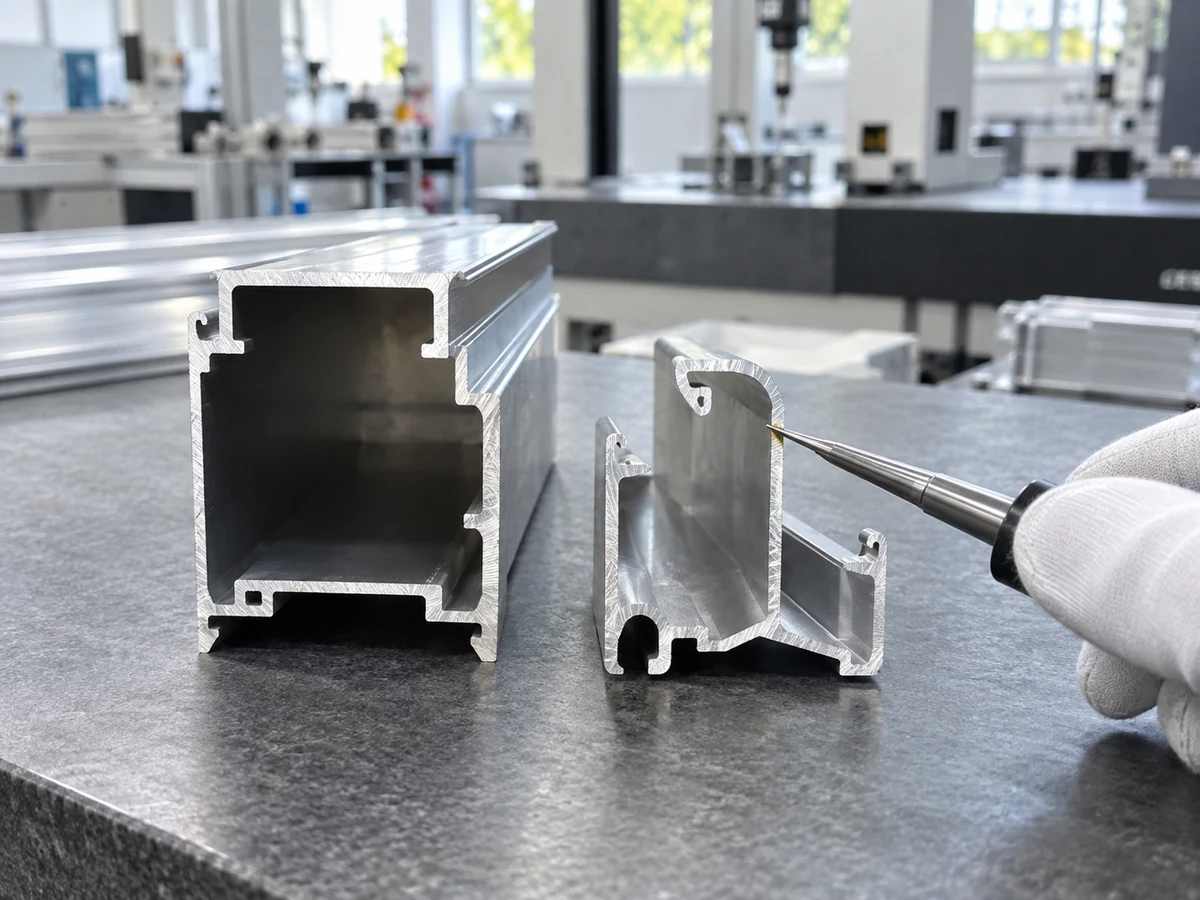
Start with the downstream receiver. Will the piece slide over a connector, accept an end cap, meet another miter, locate against a panel, or go to a later machining operation? Identify the end features that matter to that receiver: overall section width and height, opening or slot width, wall position, end squareness, cut length, local distortion and any edges that will be handled or assembled. A general promise of a “good cut” does not tell a supplier which of these is an acceptance condition.
For each profile family, issue the drawing revision, material designation and condition, nominal section, allowed variation, cut orientation and the measurement datum. If the drawing does not yet distinguish a stock tolerance from a cut-part requirement, settle that distinction before quoting a machine. The Aluminum Association’s extrusion-tolerance guide treats straightness, twist, flatness and other profile dimensions as separate questions. It does not assign acceptance limits to this buyer’s parts; those belong in the agreed drawing and inspection plan.
Record whether dimensions are evaluated while the piece is held, immediately after unclamping, or after an agreed settling and handling step. The production handover is a free part, not a shape that exists only while a jaw is closed. If an assembly needs an opening to remain clear, inspect that opening under a repeatable, documented condition rather than inferring it from an attractive cut face.
Separate incoming shape from cutting effects
Take a small, identified sample from the proposed stock lot before cutting. Measure the same functional section features at a defined location, note visible bow or twist, and photograph the profile orientation. Then retain the lot, bar and sample identity through cutting. If a post-cut piece does not fit, the buyer can compare its incoming condition with its released condition rather than automatically blaming the blade or accepting a stock problem as a machine problem.
Include the actual supply range, not only the easiest bar. A wide hollow section, a narrow thin rib, an open channel and a profile with an asymmetric lip may contact the fixture differently. If the purchase is meant to cover several sections, agree which are representative and which need their own setup. Do not treat one successful square tube as evidence for every hollow or open profile in the catalogue.
Keep the cut-end review separate from cosmetic deburring. A burr or sharp edge may be managed by an agreed downstream process, but a changed opening, rolled wall or displaced internal feature can affect fit even after the edge is dressed. The existing deburring guide addresses edge treatment; this trial asks whether the released section still meets the functional drawing.
Specify support and contact as trial variables
Ask the saw supplier to show how the actual profile sits on the infeed, at the cutting zone and on the outfeed. Mark the reference face, jaw contact regions and the point where the finished piece is supported after separation. A nominal maximum cutting envelope says little about whether a delicate wall or lip remains located through the cycle. The fixture proposal should identify any profile-specific pads or form jaws, their changeover method and what happens when the smallest and largest approved sections are run.
Behringer’s own aluminum-saw description says form jaws are possible for very thin-walled profiles on that manufacturer’s machine. It illustrates why jaw geometry is a procurement question; it is not evidence that a Jiurun machine includes those jaws or delivers the same result. Require the offered configuration and any custom fixture in the written quotation.
During the trial, note contact marks, movement, chatter, wall deflection while held, and shape after release. Change only a documented setup variable at a time where practical. If the supplier proposes a softer pad, a shaped support, another feed setting or a blade change, keep the before-and-after pieces and identify the final accepted combination. The thin-wall clamping guide discusses holding strategy in general; here the buyer needs evidence that the final, unclamped cut member meets its own end-shape criteria.
Approve a thin-wall aluminum profile cut end in a useful trial
Send a sample pack with a part-family list, current drawings, approved stock conditions, expected incoming bar lengths and the downstream receiver. Include both a normal production length and a short cut piece if the job uses both. Specify the required orientation and whether an end is straight, angled or later machined. If the machine will process different profiles during one shift, ask for a changeover demonstration as well as a steady run of a single section.
- Before cutting: identify the lot and drawing revision, document incoming section measurements and support condition.
- During setup: record jaws, pads, blade, feed and reference surfaces actually used; do not infer them from catalogue options.
- After release: measure the specified end and section features using the agreed datum and method, and retain images of both acceptable and rejected examples.
- At the receiver: perform the agreed connector, end-cap, panel or next-operation fit check, keeping that assembly check distinct from the saw’s dimensional evidence.
- At handover: agree the final setup, inspection frequency, hold rule and what change requires another representative check.
A trial that fails is useful when its evidence locates the reason. If the incoming profile was outside the accepted range, revise the stock specification or select approved material for the next run. If the part changed only after a particular clamp or cut sequence, investigate that setup with the supplier. If all drawing measurements pass but assembly still fails, review the receiver and interface definition. Do not collapse those three different outcomes into a single “bad saw” conclusion.
Compare quotes on the accepted route, not a bare cycle
Request a quote that identifies the base machine, the actual profile family and range, any optional jaws or supports, blade and consumables, sample preparation, inspection responsibilities and the final released-part criteria. Ask which work remains outside the saw: deburring, cleaning, further machining, connector fitting or final assembly. A shorter cutting cycle has limited value if the proposed route creates extra sorting, rework or unpriced downstream checks.
Compare each proposal at the same acceptance boundary. One supplier may include a shaped fixture and witnessed sample trial while another quotes only a standard clamp. Normalize those inclusions before comparing price or throughput. Where a downstream operation accepts cut blanks, the saw quote need not promise a finished assembly. Where fit at the next station is the purchase trigger, put that fit check in the agreed trial instead of relying on catalogue cutting-range figures.
Video: general equipment example
The following Jiurun channel video shows general saw equipment operation. It is included as an equipment-view example only. It does not show this article’s thin-wall material, a stated model configuration, this buyer’s fixture, an approved cut sample or measured performance.
What to send with an RFQ
Send Jiurun the drawing revision, actual profile samples or section drawings, incoming-stock range, planned cut lengths and angles, functional end features, acceptable measurement method, expected batch mix and downstream interface. Ask for the offered support and clamping scope and a witnessed trial of representative pieces. A supplier can then explain what its machine can cut, which fixture work must be developed, and what remains to be proven on your material. Contact JiurunCut with the sample and acceptance brief before treating an equipment quote as production approval.