
An aluminum saw clamp cylinder can stop production when it fails, but the spare is not identified by a bore-and-stroke guess. Two units with those numbers in common may put the rod end, ports, mounting face or position sensor in different places. The purchasing decision is whether to order the machine maker’s approved assembly, a documented equivalent, or a supported repair kit. Start with the actual installed unit and the cut job it must return to service.
This guide applies only where the offered or installed saw uses a pneumatic clamp cylinder. It does not establish that a particular Jiurun model has that actuator, and it is not a procedure for removing a pressurized component. Qualified personnel should follow the machine-specific service instructions and site energy-control procedure.
Do not turn a clamp symptom into a parts number
Slow movement, a missed clamp-confirm signal, a leak, or a marked profile can have more than one cause. The cylinder may be sound while the air supply, valve, flow control, tubing, sensor, jaw or fixture has changed. Record what happens at the machine and ask maintenance to establish the failed component before procurement treats a cylinder as the cure. A spare quote cannot diagnose the machine from one symptom.
If pressure falls during the cut, the clamp pressure sag guide shows what evidence to collect at the point of use. If release is slow, the slow clamp release guide separates command timing from the exhaust path. Those checks frame the service question; neither proves that a cylinder must be replaced.
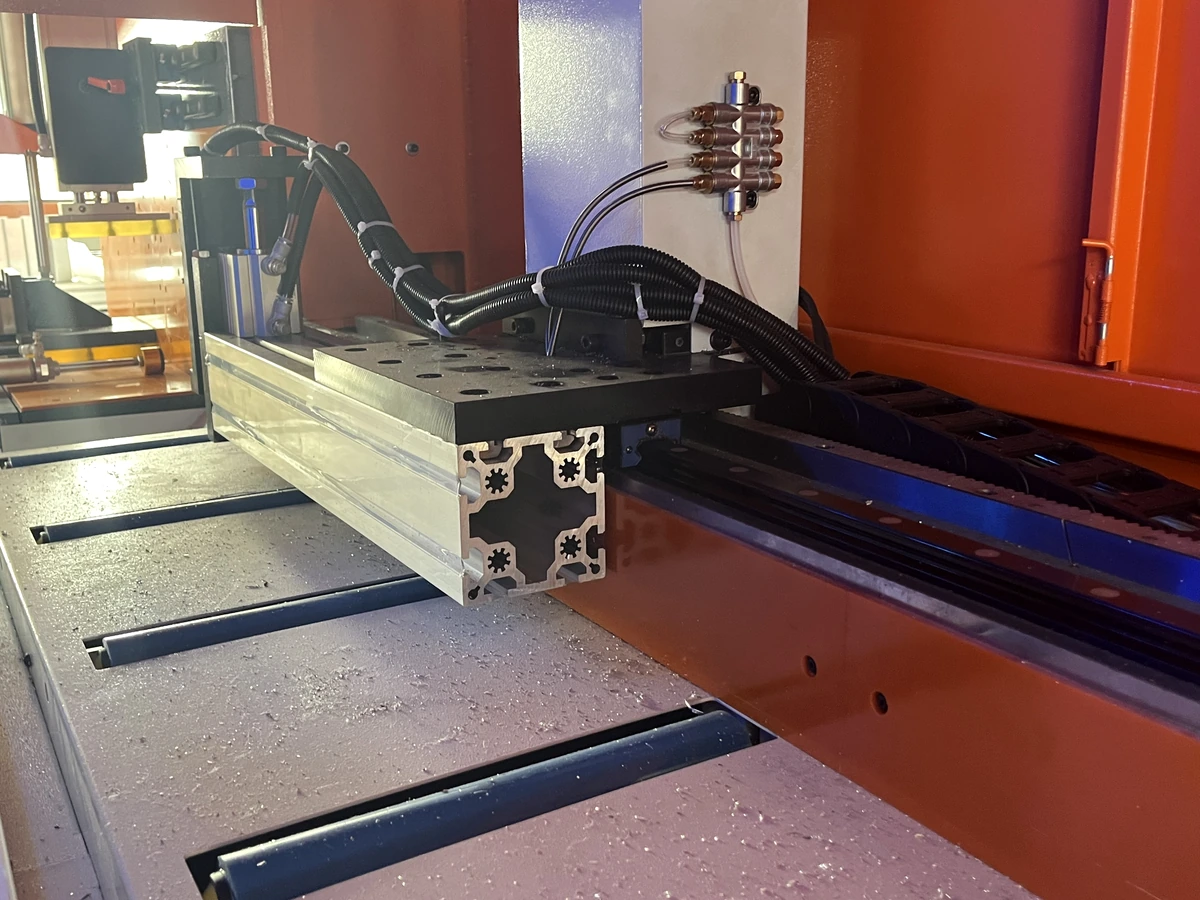
Capture the machine serial number, station and clamp function, the installed cylinder’s full marking, and the relevant drawing or spare-parts list revision. Where the label is unreadable, request the original equipment maker’s cross-reference against that machine record. A photograph can help identify an assembly, but it does not replace the controlled part number or drawing. Keep the rod attachment, sensor bracket, fittings and any special stop in the same record; a catalog cylinder may omit them.
Aluminum saw clamp cylinder: compare the replacement dimensions
Ask the supplier to mark up a side-by-side comparison of the original and proposed units. It should cover action type, piston diameter, stroke, mounting pattern and installed length, rod end and thread, port size and orientation, cushioning or end-stop arrangement, and the operating conditions approved for that model. Request a drawing for the exact suffix and options quoted, not a family photograph.
Standards can help narrow the search but do not approve a substitution for a particular saw. Festo’s ISO 15552 cylinder documentation, for example, distinguishes piston diameter, pneumatic connection, rod thread, cushioning, position sensing and mounting details. Those are useful comparison fields; they are not Jiurun specifications. The machine maker or responsible engineer still has to confirm the complete assembly and its available clearance.
A cylinder with the right nominal stroke can still shift the jaw’s usable contact window if the installed end dimensions, rod coupling or fixture geometry differ. A different port or fitting position may interfere with the guard or a neighboring station. Do not choose a substitute solely because a supplier calls it “drop-in.” Ask which original drawing dimensions and interfaces were actually compared.
Specify the feedback and accessories as part of the spare
Many clamps report an end position to the control system. Check whether the original cylinder uses a magnetic piston, a slotted or external switch mount, and which sensor and cable are already installed. The replacement quote should state whether those parts transfer, require an adapter, or are supplied new. A switch that physically fits a slot still needs the correct sensing position, electrical connection and machine logic confirmed by the responsible technician. Festo’s piston-rod-cylinder guidance explains the role of cylinder sensors in confirming stroke completion; it does not identify the device on this saw.

Ask for a priced bill of materials for the complete spare boundary: cylinder body, rod-end hardware, brackets, sensors and leads, fittings, seals or repair kit where supported, and any installation-specific parts. Label the items that are reused. This prevents a low cylinder-only price from concealing a bracket or sensor that delays the restart. It also lets purchasing compare the machine maker’s approved assembly with a proposed alternative on the same receiving scope.
Choose one of three purchasing routes
Approved original assembly. Request the part number against the machine serial and drawing revision. Confirm whether later revisions change the mounting or feedback arrangement.
Documented substitute. Require the proposed maker and exact order code, a dimensional and functional comparison, any adapters, the party accepting the engineering change, and the test that will release it. A nominal standard or matching bore and stroke alone is insufficient.
Supported repair kit. Consider it only if the cylinder maker and machine supplier support repair of that exact unit and qualified service is available. Compare downtime, parts and requalification scope with a complete assembly. Do not assume every cylinder is serviceable.
If the machine has two or more clamp stations, order against the identified station. A part that fits one clamp on a multi-head saw may not belong at another position. Put the station reference on the purchase order and on the stored spare label.
Release the machine, then verify the cut
The purchase order should define receiving evidence before a technician touches the saw: part marking, matching drawing and accessories, and a record of any approved substitution. Installation and testing belong to qualified personnel under the actual machine manual and site procedure. In the United States, OSHA’s hazardous-energy rule includes pneumatic energy in its scope for covered servicing. Local requirements may differ; neither a disconnected hose nor a stopped blade alone establishes a safe service condition.
After authorized installation, ask for a controlled functional check of travel, clamp release, position feedback, guard and restart behavior, followed by a representative first cut. Record whether the approved profile is held without damage and whether its accepted cut dimensions remain within the job’s own criteria. Do not infer clamping force or cycle reliability from a catalog rating or a single photograph. Keep the original and replacement identification, change approval and first-off result with the maintenance record.
Send the evidence that can answer the spare question
For a Jiurun saw inquiry, send the machine model and serial number, clamp-station identification, photographs of the installed actuator and its marking, the available parts drawing, and the failed-function record. State whether you seek the original assembly, a supported repair path or an engineered substitute. Jiurun can then identify what evidence is still needed for the particular machine. If the saw is from another maker, take the same packet to that machine’s responsible supplier. The aim is a spare that can be received and requalified against the actual clamp, not merely a cylinder that resembles the old one.
Related Jiurun saw footage
The Jiurun video below shows a semi-automatic aluminum saw and its guarded cutting area. It is equipment context only. It does not show this article’s replacement cylinder, confirm a sensor or mounting interface, or document a completed spare-part acceptance test.