
Aluminum saw blade stabilizer is a term that can describe a separate pair of discs fitted to a stationary saw, while a blade supplier may instead offer damping built into the blade body. Those are different purchase scopes. Neither a quiet-running claim nor a product photograph establishes that an accessory fits your existing aluminum saw or improves the accepted cut on your profiles.
Before requesting a retrofit, identify the saw, its currently approved blade and the actual job that prompted the question. Ask the machine and tool suppliers to confirm the proposed combination in writing. This is a buyer’s comparison and trial plan, not instructions to alter guarding, mount a disc or run a saw outside its manufacturer-approved arrangement.
Featured image: related JR-550CNC-CORNER cutting-area photograph. It does not show an installed blade stabilizer, an approved retrofit or this article’s trial result.
Aluminum saw blade stabilizer: name the exact item
Start by asking what the seller is actually quoting. A CMT stabilizer product listing describes a pair of separate stabilizers and explicitly restricts that product to stationary saws. That listing is evidence for CMT’s product, not a statement that a CMT part will fit a JiurunCut machine. A Leitz non-ferrous-metal blade brochure separately lists a blade body with vibration-damping steel foil. That is a blade construction, not the same item as add-on stabilizer discs.
WorkSafe Western Australia’s saw-blade purchasing guidance explains that blade vibration can contribute to noise and distinguishes built-in damping from ordinary expansion slots. It also cautions that different noise figures require comparable test conditions. The published examples do not predict a decibel reduction, blade life or surface result for your machine and stock. Ask for the manufacturer’s exact product record instead of treating “low-noise,” “laser-cut” or “stabilized” as interchangeable specifications.
Our expansion-slot guide addresses what slot labels mean. Here the decision is whether an external accessory belongs in the proposed saw-and-blade assembly at all. Keep that distinction visible in the RFQ.
Freeze the approved blade and saw identity first
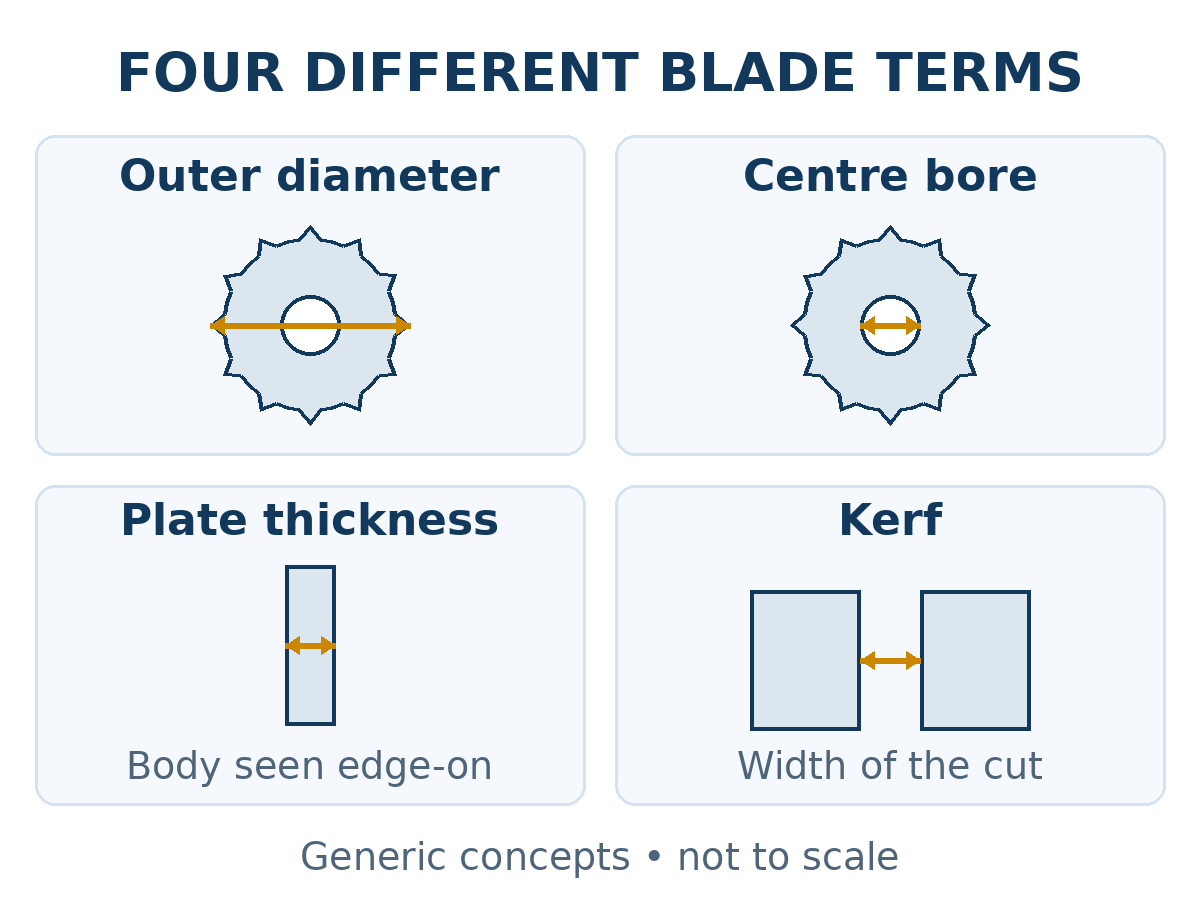
List the installed saw model and serial or revision, the approved blade manufacturer and part number, and the machine’s current mounting and guarding arrangement. Record the complete blade specification from the supplier. Outer diameter, centre bore, plate thickness and kerf are separate terms; matching only one of them cannot prove that an added part has physical clearance or manufacturer approval. The existing flange-pair guide covers the machine-specific mounting parts that should not be silently replaced with a generic accessory.
Ask both the saw OEM and accessory or blade supplier for the permitted product combination, required parts and exclusions. The answer must cover the exact blade, mounting components, guard envelope, available space, permitted operating range, inspection and service responsibility. If either supplier cannot confirm compatibility, do not treat a nominal diameter or catalog photo as permission to install. A proposed change belongs in a supplier-approved engineering review, with qualified personnel following the machine and tooling instructions.
Compare three purchase routes on the same job
A useful RFQ separates the existing approved arrangement, a different blade with documented internal damping, and a separately approved accessory configuration. They should be compared against the same released aluminum profile, drawing revision, material condition, blank lengths, cut-end criteria and output requirement. If one option changes the blade geometry or machine setup as well as damping, record the change; it is no longer a single-variable accessory comparison.
| Route | What must be identified | Purchase question |
|---|---|---|
| Existing approved setup | Saw, blade, mounting and current accepted parts | Is the concern evidenced under normal production conditions? |
| Internally damped blade | Exact blade product code, construction and approved machine fit | Does the delivered blade match the tested tool? |
| Separate stabilizer accessory | Accessory pair, approved machine/blade interface and complete installation scope | Who confirms clearance, guarding, setup and future service? |
A sales claim that “the cut is quieter” is incomplete without the observation method and operating state. Ask whether the comparison covers idle running, actual cutting or both, where sound was observed, the stock and the machine condition. For a quality decision, retain the parts and inspect the actual cut-end and dimensional criteria. A lower sound level alone does not approve a blank, and a smooth photo alone does not measure sound or establish tool life.
Use a representative trial and preserve the baseline
Before changing the setup, document the accepted baseline and the reason a change is considered. Is the problem a measured noise exposure, an observed cut-face defect, a dimensional rejection, or merely a catalog claim? If unusual vibration or suspected damage is present, follow the site’s stop-and-review route and the machine maker’s instructions. Our blade-imbalance review explains why one symptom cannot diagnose a replacement part.
When suppliers approve a comparison, agree the trial’s blade identity, stock lot, profile orientation, clamping and collection arrangement, part count, time window, inspection method and personnel responsibilities. Compare a defined beginning, middle and end, including a representative difficult section or finish where the purchase requires it. Keep rejected as well as accepted pieces and any interruption log. Do not claim an accessory fixed the process if the blade, supports, feed or collection route changed at the same time.
For noise, obtain a method the responsible workplace specialist accepts and preserve the measurement context. For cut quality, identify the drawing features, visible faces, burr criteria and approved gauging method. For productivity, distinguish actual accepted output from a free-running machine cycle. No single photograph in this article substitutes for that recorded trial.
What belongs in the final quotation
- The exact saw and blade identity, and whether the tested blade is included in supply.
- The exact stabilizer item or built-in damping construction, with manufacturer documentation and revision.
- Written approval for the complete machine, mounting, guarding and accessory combination; any required qualified installation and inspection service.
- The buyer’s released profile and accepted-part criteria used in the demonstration.
- Noise and part-quality evidence with comparable conditions, including limitations and rejected results.
- Parts, service, training and future replacement responsibility, with exclusions stated separately.
Hold the accessory decision if a seller cannot name the actual product, the machine owner has not accepted the proposed arrangement, a guard or mounting change remains unresolved, or the demonstration uses an unquoted blade. Request a complete approved alternative instead of improvising an installation. If a suitably documented internally damped blade meets the job without an accessory, compare that option on the same acceptance basis rather than assuming extra hardware is necessary.
Video: a general Jiurun saw example
This Jiurun Machinery video shows a general saw/equipment view. It does not display an installed stabilizer, an approved retrofit, the blade or profile in this article, a noise test or a cut-quality comparison.
Send the current saw and blade records, the approved profile drawing, actual input stock and the rejected or questioned part evidence when you contact JiurunCut. Ask the relevant machine and tooling suppliers to confirm which complete arrangement can be offered and tested. A defensible order names the delivered combination and the evidence by which the buyer will accept it.