
Aluminum saw blade change access is a purchasing question, not just a maintenance detail. Two saws can accept the same nominal blade yet require very different space, tools, people and production interruption to replace it. A quote that lists blade diameter but says nothing about isolation, guard access or return-to-service checks leaves a practical gap in the buyer’s comparison.
Use this checklist to ask for the actual replacement route on the quoted configuration. It is an RFQ and acceptance framework, not an instruction to open a guard or change a blade. The machine supplier and the buyer’s competent maintenance team must provide and approve the machine-specific safe method under the rules that apply at the installation site.
Why blade change access belongs in the purchase decision
Blade life, regrinding and spare-blade prices are only part of the ownership picture. A buyer also needs to know where the machine can be isolated, which covers must move, whether a blade can be handled without interfering with a wall or adjacent line, and what evidence releases the saw back to production. These questions can change the required floor space, maintenance staffing, spares and expected downtime. Do not accept a demonstration on a different saw head as proof for your order.
Ask the supplier to name the exact model, options, guarding and blade specification included in the offer. If a loader, outfeed conveyor, extraction duct or enclosure is optional, show the blade-change route with that option installed. A route that works on a bare showroom machine may not work after line integration.
Define the blade and machine boundary first
Start with the released work: profile families, sections, alloy/temper where relevant, cut direction, blade family and expected change frequency. These are inputs to the discussion, not a claim that one blade suits every job. Ask which replacement blades are approved for the quoted arbor and guard envelope, who verifies compatibility, and whether the quotation includes a starter blade, spare blade, handling aids or dedicated tools.
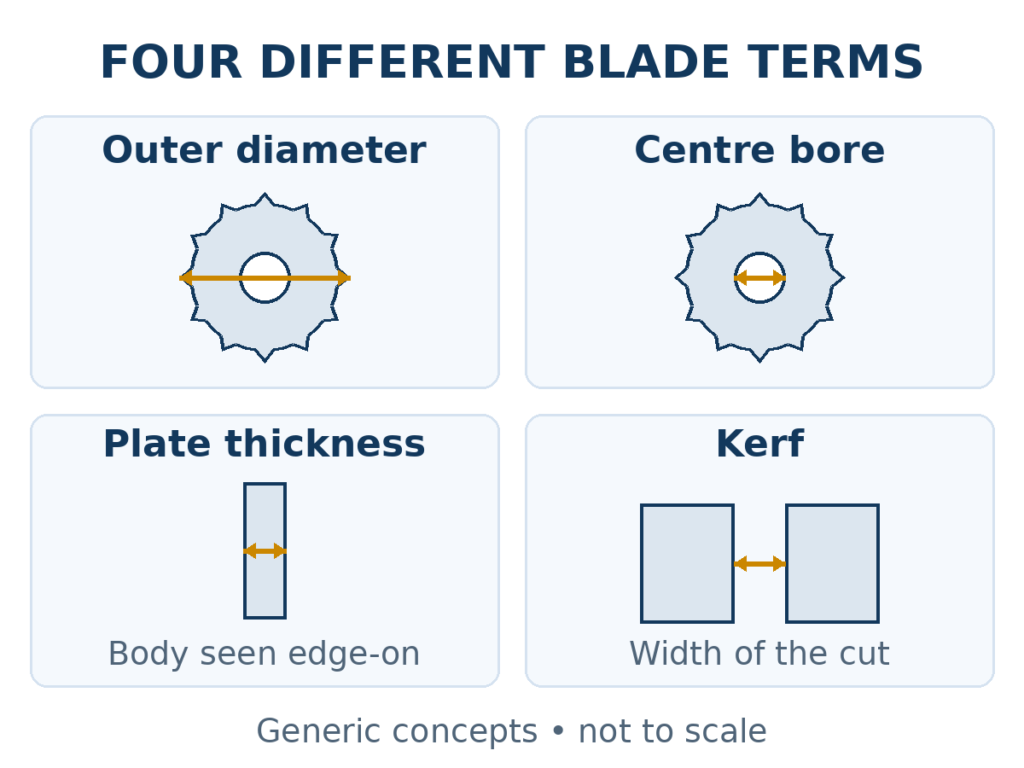
Keep blade identification separate from service access. Outer diameter, centre bore, plate thickness and kerf are different dimensions; a matching nominal diameter alone does not establish fit. Our blade dimension guide explains the terms. Have the supplier supply the approved blade identification and machine documentation for the actual configuration rather than inferring it from a photograph.
Four aluminum saw blade change access interfaces to inspect
1. Energy isolation and ownership
Request the machine-specific energy-control documentation and have the buyer’s safety and maintenance personnel review it. Identify the electrical disconnect and any pneumatic, hydraulic or stored-energy interfaces that apply to the quoted machine. Record who is authorized to isolate, verify, perform the replacement and release the machine. A stop button or a dark screen is not, by itself, evidence that all hazardous energy is controlled.
2. Guard and access route
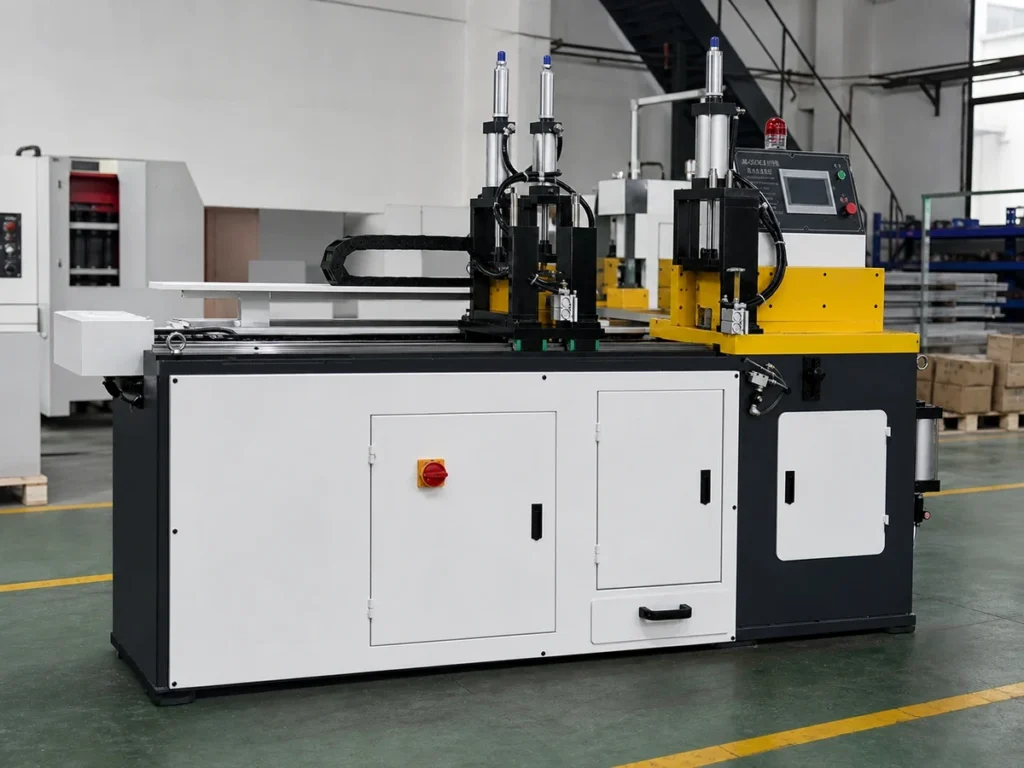
Ask the supplier to point out the actual cover, door or removable guard used for service; the opening direction; the space needed to reach the blade; and how guarding is restored. If an interlock or guard-locking function is part of the offered design, obtain its configuration and test method in writing. Do not infer that any pictured machine has a particular interlock. The buyer should ask what prevents access while dangerous motion remains possible, then witness the applicable demonstration with trained personnel.
3. Blade handling and work area
Show the path from storage to the saw and back for the removed blade. Check the clear floor area, nearby stock racks, adjacent equipment, overhead restrictions and the place for a protected removed blade. Ask who supplies any lifting or holding aid and whether a second person is needed. These are questions for a site-specific assessment; they are not a prescribed manual handling procedure. If the saw arrives within a line, evaluate the route after all surrounding equipment is shown on the layout.
4. Restart and quality release
After the replacement, define who checks that guards and tools are restored, what machine-specific checks precede restart, and how the first representative cut is inspected and released. Agree the record of blade identity, date, operator or maintainer, reason for change and first-piece decision. Do not confuse the blade’s seating or machine display with proof of finished-part accuracy: the accepted measuring method and limits must be specified separately. Our acceptance-measurement guide gives a separate framework for that decision.
Ask for an acceptance demonstration, not a promised change time
A useful factory acceptance test or site acceptance test starts with the same configuration and constraints being quoted. Ask the supplier to show, with authorized staff, the documented isolation boundary, the guard-access path, the approved replacement blade identification, handling clearance, restoration of the guarded state and the recorded return-to-production decision. The buyer can witness and record the sequence without performing it. If a demonstration cannot be done safely or on the actual configuration, list the missing evidence and close it before acceptance.
Time the production interruption only after agreeing where measurement starts and stops: last accepted cut, isolation, access, exchange, restoration, first trial, inspection or first released production part can produce different numbers. Note how many people and which tools were used. One observed trial is a configuration-specific data point, not a guarantee for every blade, operator, profile or site. Ask for a repeatable method and stated exclusions before using the observation in a business case.
Compare the cost of a workable service route
Compare offers over the same planned production period. Include replacement-blade supply, approved blade variants, required tools or handling aids, expected labor, documented training, service support and the space or guarding changes needed after installation. Separate these from sharpening, repair or managed-tool services. A lower blade price may not offset a difficult access route, but neither should an unverified change-time estimate be treated as savings.
For a fleet, ask whether blade IDs, tools and release records can be standardized across actual saw configurations. If not, name the exceptions. Where a third party supplies blades or manages a tool program, define who checks compatibility and who owns the machine release decision. Our tool-management comparison addresses that broader service boundary.
General equipment video: This clip shows a Jiurun saw operating in a guarded cutting workflow. It does not show blade replacement or verify the blade, guard, model configuration, material, customer, trial result, safety function or performance discussed in this guide. Request a separate demonstration on the quoted machine.
Copy this blade-change access RFQ into your supplier inquiry
- Quote reference, model, options, blade guard and line layout under review.
- Approved replacement blade identification and document revision for each intended job family.
- Machine-specific energy sources, isolation points, stored-energy considerations and responsible roles.
- Actual guard or service-door access path, opening clearance and guard-restoration evidence.
- Required tools, blade support or lifting aids, people, storage and removed-blade protection.
- Effect of loading, extraction, conveyors, adjacent machines and site walls on service access.
- Witness demonstration location, configuration, records and unresolved deviations.
- Agreed return-to-service and first-part inspection authority and acceptance method.
- What is included in supply, training and after-sales support, and what remains the buyer’s responsibility.
Request photographs or a marked layout of the specific quoted access route, plus the relevant supplier manual sections. Images in a general brochure are useful for orientation but cannot establish a safe method or prove that the ordered guard, blade and work area are the same.
Evidence and safety boundary
The UK Health and Safety Executive advises buyers to consider maintenance in work-equipment selection and identifies isolation and prevention of inadvertent reconnection as important for higher-risk maintenance. Its work-equipment maintenance guidance and work-equipment overview explain the general principles. OSHA also describes the need to identify and control hazardous energy during servicing in its machine-maintenance guidance. These sources are general safety references, not certification of any Jiurun model or a substitute for the law and competent assessment applicable to the buyer’s site.
Next step: Send Jiurun your current saw or target machine configuration, intended blade families, line layout and maintenance constraints. Ask for a configuration-specific access drawing, blade identification and a witness plan before you compare offers. Use the contact page to request a technical discussion; no blade-change time, safety function or cut result is promised by this article.