
An aluminum heat sink saw purchase only makes sense after the buyer identifies which part of the heat-sink route the factory will actually keep. A supplier may deliver a finished, inspected heat sink; a cut blank that still needs machining and finish; or a long finned extrusion that the factory cuts to length. Those are different receiving states. Quoting the same saw against all three hides the work already purchased elsewhere and the work that remains after the cut.
This guide is for a heat-sink manufacturer or integrator deciding whether to retain extrusion cut-to-length work. It is not a thermal design method or a promise that a Jiurun machine can cut a particular fin geometry. Use the released profile drawings, actual stock and a supplier trial on the quoted configuration to decide that separately.
Start with the accepted handover, not the machine brochure
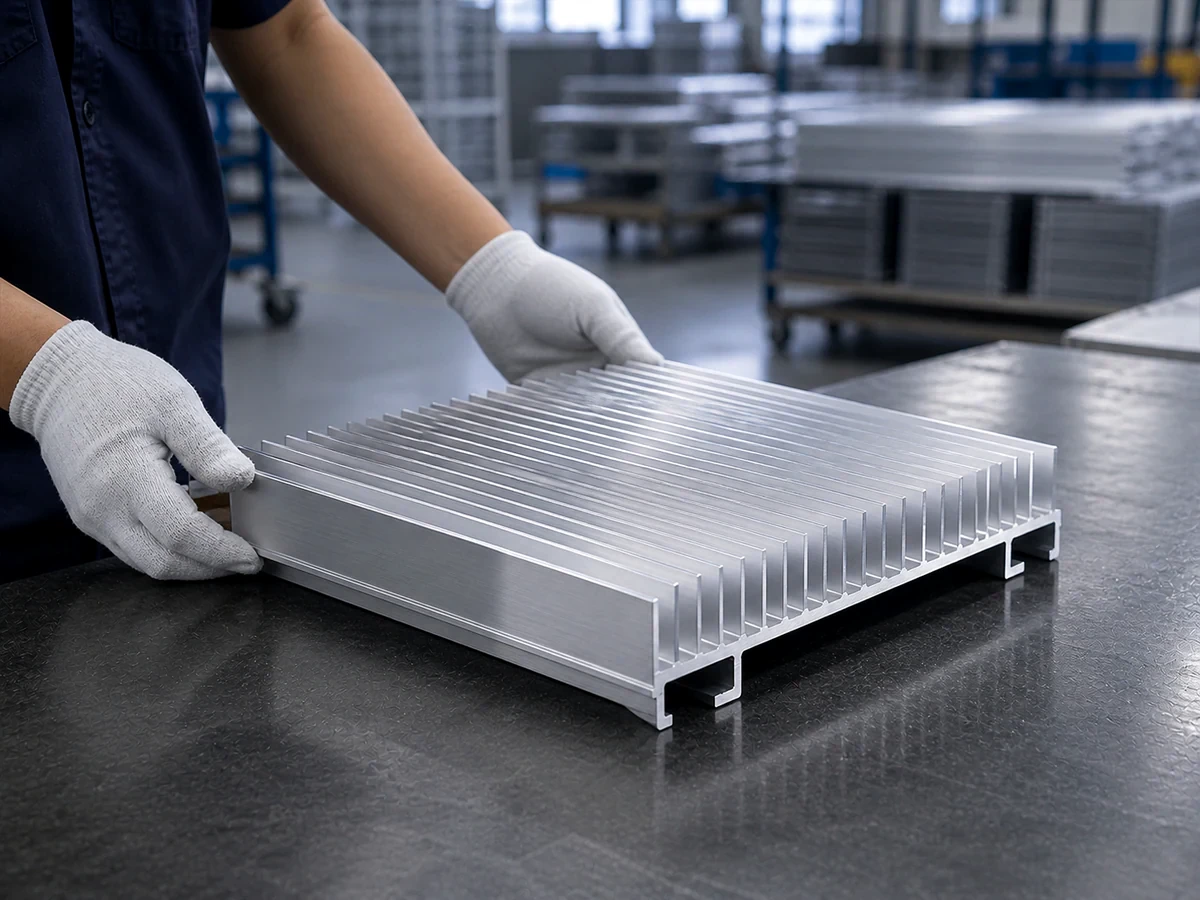
Write one line for each heat-sink family: the item received, the party responsible for its section geometry, the operations still required, and the point at which your downstream team accepts it. A finished sink, a machined extrusion blank and a raw profile bar may share an outline yet place very different demands on a saw. In particular, cutting an already extruded finned bar to length does not create the fins. Our separate guide on stock cutting versus fin creation explains that process boundary; the question here is which supply route merits a machine investment.
Boyd’s Heat Sink Fabrications Guide describes an extruded profile as a long bar formed with its section geometry, subsequently cut into lengths and, where required, machined and finished. That sequence is a useful scope check, not evidence for any Jiurun configuration or cutting result. A catalog profile and a custom section may also impose different purchasing, tooling and revision responsibilities.
Compare three purchase routes at the same receiving point
1. Buy finished heat sinks
The supplier delivers a part that has passed the agreed final operations and inspection. This route can remove profile cutting from your factory for that family, although incoming verification, assembly and inventory control remain. Ask which drawings and revisions govern the finned section, cut length, mounting features, finish and acceptance record. If the seller includes only the extrusion and the cut, it is a prepared blank rather than a finished heat sink. Do not justify a saw with units already arriving complete.
2. Buy cut blanks, retain downstream work
The supplier cuts each extrusion to an agreed blank length; your factory retains any specified machining, surface treatment, assembly or final inspection. This separates bar handling from later work and may simplify launch volumes or a highly variable product mix. Record the blank allowance, reference face, end identification and packaging so the next operation receives a usable part. A blank purchase price alone omits the remaining operations and their rejects. Compare total accepted-output cost at the same stage used for the other routes.
3. Buy profile bars and retain cutting
The factory receives released extruded stock and performs the specified cut-to-length operation itself. This is the only route of the three that directly creates recurring saw demand for the relevant family. It also brings stock storage, infeed support, saw setup, short-piece handling, scrap identification, chip control and cut-stage inspection into the factory’s scope. The supplier must quote and demonstrate the actual profile envelope and part mix, not a nominal heat-sink outline. If some families are bought finished and others are cut in-house, count only the latter in the saw workload.
Build a workload from released families, not a single sample
List the section ID and revision, stock condition, available bar lengths, required blank lengths, release quantities, batch frequency and end-of-line destination for each family the factory will cut. Separate repeat lengths from one-off development pieces. Keep both typical and difficult combinations: a wide finned section, a slender profile, a short remaining piece, a cosmetic face and any asymmetry that changes how the part can be located or clamped. Record whether these are real production requirements or merely possible future designs.
Then make a cut-list sample that reflects the mix in one realistic campaign. How many profile changes and length changes occur? Are the longest bars compatible with the proposed infeed space and support? How will the operator or feeder identify the correct revision when similar profiles look alike? Where do offcuts and short accepted parts go? These questions affect the quotation more than a headline cycle figure from an unrelated profile.
For a mixed family, compare the same accepted cut-blank output under each sourcing route. Include stock purchase and storage, labor, setup and changeover, tool and consumable assumptions, inspection, packaging, rejects and the remaining downstream work. Ask the supplier to identify what its price includes. Do not treat a low machine price, a low blank price and a finished-part price as directly comparable until the handover boundary is the same.
Describe the actual contact and cutting constraints
A finned section may have delicate or visible surfaces and may offer only limited places for secure support. The RFQ should show the incoming section in the intended orientation, the surfaces allowed for contact, the reference face used to locate length, and any protected fin tips or cosmetic faces. Mark mounting features or voids that change support. Do not assume a generic vice drawing proves fit. Require the proposed machine configuration and fixture approach to be reviewed against the actual cross-section.
Specify the cut-stage output separately from final heat-sink performance. Relevant cut-stage checks may include the agreed length reference, end condition, visible damage, burr condition, identification and consistent presentation to the next process. Define the inspection method, sample size and acceptance owner in the purchase documents. Final base flatness after machining, coating quality, thermal resistance and device-level cooling belong to their own qualified processes and tests. Feed positioning repeatability, if quoted, is not automatically finished-part accuracy.

For thin fins, ask the supplier to show how the proposed support avoids contact damage while the actual stock is cut and removed. Our thin-fin cutting review covers that narrower cut-quality question. A different profile or a revised extrusion die can change the support problem, so record the section revision used in any trial.
Trial an aluminum heat sink saw against the proposed quotation
Send representative production stock, not only a convenient small offcut. Before cutting, agree on the bar identity, section revision, incoming condition, permitted contact surfaces, target blank lengths and downstream receiver. Ask the supplier to state the quoted blade, fixture, infeed and outfeed arrangement, guarding and any optional handling equipment. A trial on a different setup is useful exploration, but it does not verify the offered configuration.
Observe loading, locating, clamping, cutting, unloading and identification for more than one relevant length where the released workload requires it. Inspect the agreed output at the cut stage and have the downstream team confirm that the blank can enter its next operation. Record deviations and what remains untested. The result should be a documented fit decision for named sections and conditions, not a blanket guarantee for every heat-sink profile. If the supplier cannot support a critical family, keep it outside the machine business case until a suitable configuration is demonstrated.
Equipment video: The following video from Jiurun Machinery’s YouTube channel shows general cutting-equipment footage. It is included only to illustrate equipment activity. It does not show or prove the heat-sink material, quoted model configuration, any customer order, a trial for this article, or achieved quality or performance.
General equipment example only; not evidence of heat-sink cutting, a specified model or performance.
Copy this aluminum heat sink saw RFQ record
- Buyer and receiving stage: finished sink, supplier-cut blank or factory-cut blank; identify the accepting team.
- Released family: section drawing and revision, actual stock source, condition, material designation supplied by the owner, and permitted substitutions.
- Cut workload: bar and blank lengths, batch mix, forecast period, changeover pattern, short-piece and offcut rules.
- Contact and quality: locating face, protected surfaces, permitted clamping zones, agreed end and burr criteria, inspection method and traceability.
- Quoted scope: base saw, tooling, fixtures, infeed/outfeed, chip handling, controls, installation and training inclusions and exclusions.
- Trial and handover: actual profiles, quoted configuration, sample record, deviations, downstream acceptance owner and unresolved families.
Ask every bidder to return the same record with explicit exclusions. If the factory’s retained cut workload is small or uncertain, obtaining prepared blanks or finished sinks may be the better immediate route; if released recurring work supports in-house cutting, a representative trial and a complete quote allow a defensible machine decision. The selection depends on your own parts, flow and acceptance standard.
Request a configuration review
Send Jiurun your released heat-sink profile drawings, actual stock photos, cut list, required blank acceptance conditions and the supply route you intend to retain. We can review whether an industrial aluminum circular-saw configuration should be evaluated and what must be tested on your real parts. Contact Jiurun with your RFQ package. Do not send a thermal target alone as a substitute for a cutting specification.