
Aluminum extrusion first-end crop is a small line on a cut list with a large effect on the first acceptable part. A supplied bar may arrive with a prior saw end, a visibly damaged corner, a stretcher-contact area, or an end that has never been accepted as a production datum. The buyer must decide whether that end can become the finished face of part one. If it cannot, the quote needs a defined crop, a new reference, and enough stock for the promised quantity.
This guide is for straight aluminum extrusions cut on an industrial circular saw. It does not prescribe a universal trim length. The incoming material condition, drawing, workholding, blade kerf and permitted tail length determine the plan. A crop cut is a separate operation; it should not be silently counted as the first finished part.
1. Define the aluminum extrusion first-end crop decision
Ask the stock supplier what its stated length and end condition mean. Is the bar delivered as an extrusion mill length for later fabrication, or as a finished cut-to-length member? What visible damage, distortion, oxide, finish interruption or transport marks are allowed at the end? Keep an accepted photograph or marked sample if the answer is visual. An end that looks square in a listing photo is not an inspection result for the batch on the saw.
The Aluminum Extruders Council describes precision cutting as a common first fabrication step and notes that cut requirements vary with the profile and following operations. Hydro’s extrusion process overview places a saw cut after straightening. These sources explain why a supplier bar end and a purchaser’s finished end should be treated as separate specifications; they do not establish a crop allowance for your part.
2. Put the crop rule on the drawing or cut list
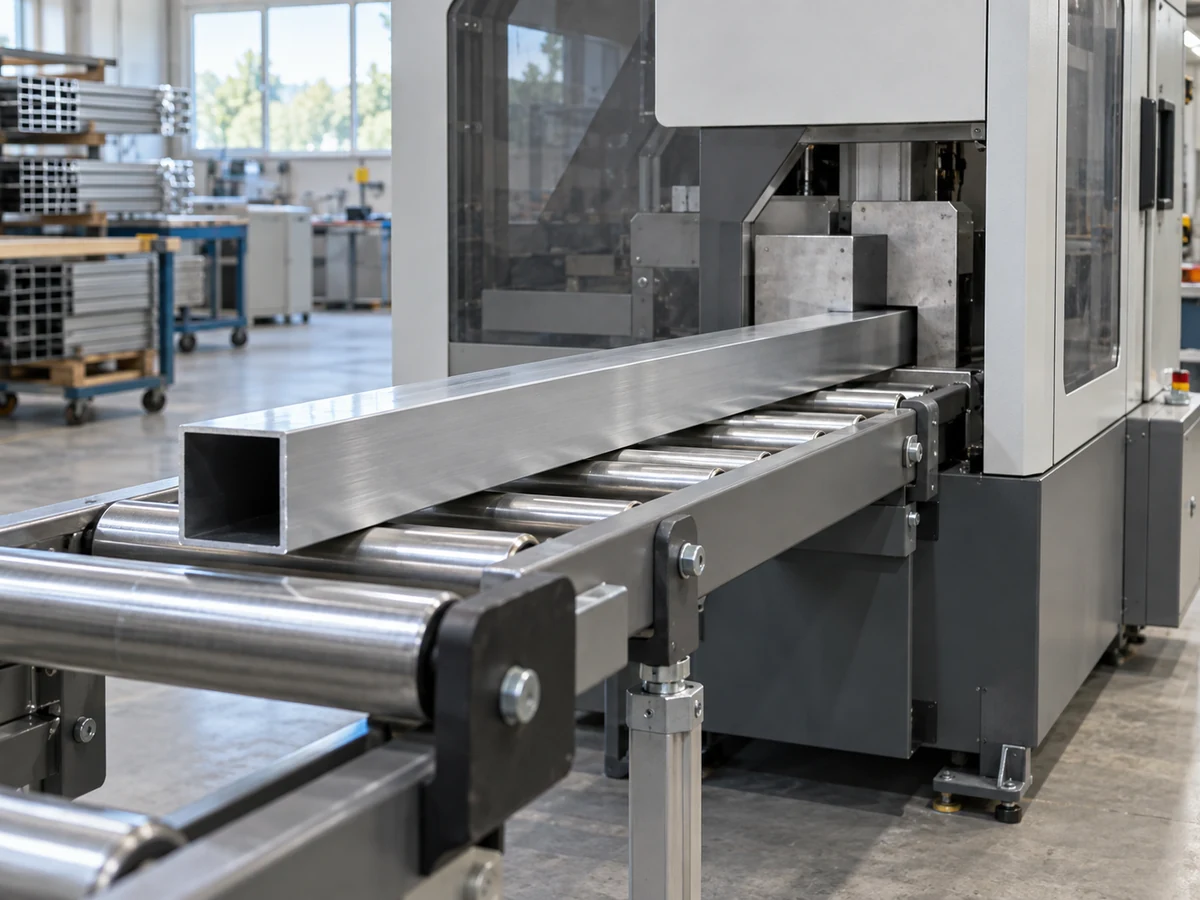
Use an explicit rule such as “remove the minimum length needed to obtain the approved end condition, subject to a buyer-approved maximum crop per bar,” or an agreed fixed allowance after the supplier has shown representative incoming bars. State whether the measured crop is the discarded piece alone or the discarded piece plus its saw kerf. Those are different yield figures. Record whether the rule applies to one end, both ends, or only bars rejected at incoming inspection.
A fixed 20 mm allowance should not be copied from another profile. A large hollow section, a narrow channel and a thin wall can present different end damage and different supported clamp positions. Where a first-cut face must mate with another component, specify the actual fit or face requirement and the inspection method. Do not claim a square end merely because the program requests a 90° cut.
3. Establish the new length reference after trimming
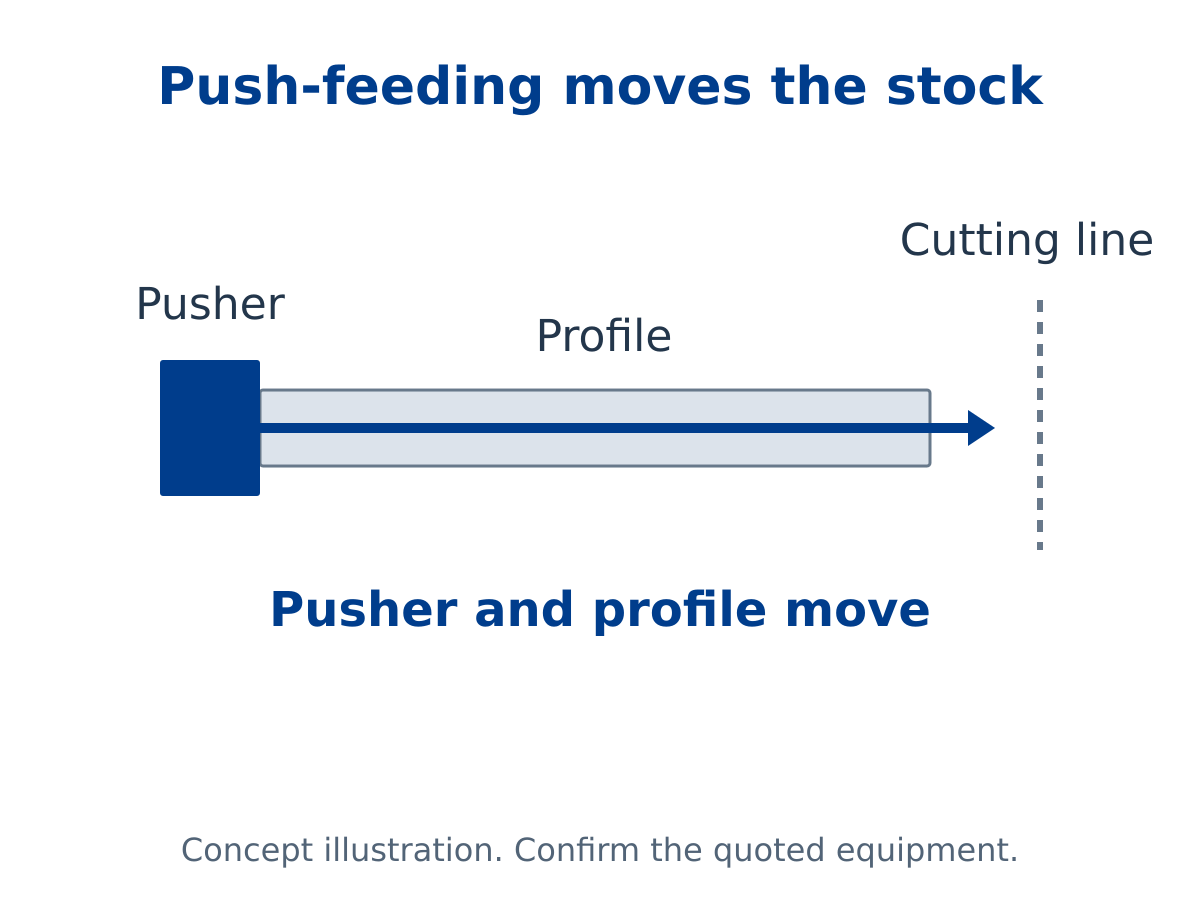
After the crop is separated, identify which surface becomes the length datum for part one. On a stop-based process, the approved trimmed face must reach a clean stop consistently. On a push-fed process, the bar advances to a cutting-line reference under the machine’s actual feed sequence. The two approaches should not be described as identical: a driven stop moves the stop; push-feeding moves the stock. Ask the supplier to show the quoted sequence with the real profile and a representative crop, including any regrip, reversal or manual reset.
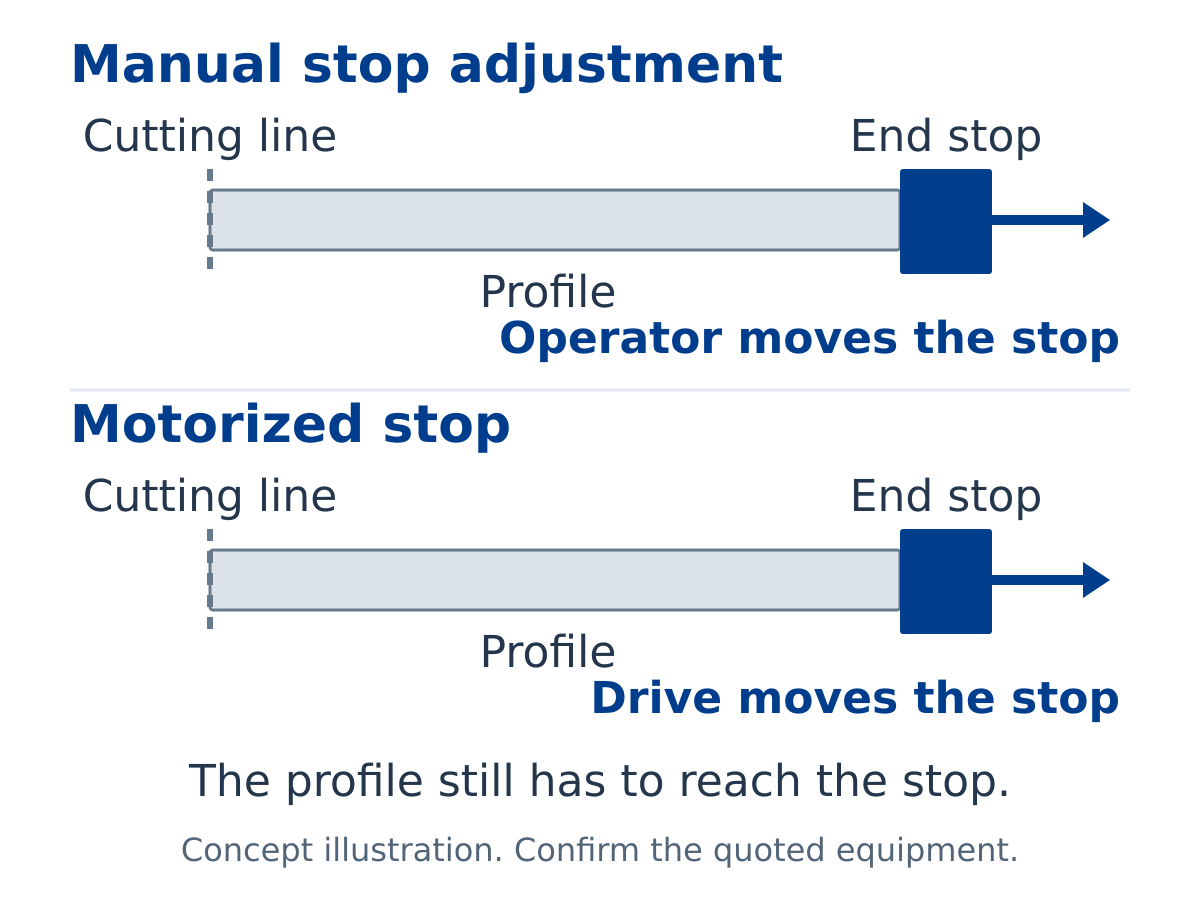
Measure the first finished piece from the drawing’s named faces, not by averaging an unapproved raw end with a new cut. If a burr or protective cap changes the physical contact, include that in the trial and acceptance method. The related length-stop contact checklist addresses stop contact in more detail; the first-end question here is when that reference becomes valid.
4. Check support and safe workholding at the first cut
A crop can be shorter than a production part. The saw supplier must show where the bar is supported and clamped for the crop, where the free crop goes, and how the operator removes it under the machine’s guarded procedure. A crop that is too short for the normal clamp or discharge path needs a different approved method. Do not improvise by holding the short end by hand or defeating a guard to save material.
State the section drawing, wall thickness and orientation in the RFQ. A profile that is stable on a broad flat side may rock when the cut is made in another orientation. Ask for a stopped setup photograph, a sequence description and a sample produced with the proposed fixture. The acceptance decision is whether the proposed process holds this stock without movement or damage, not whether a catalogue photo shows a clamp nearby.
5. Recalculate yield with crop, kerf and tail reserve
Use a per-bar calculation rather than promising a part count from nominal bar length alone. For a simple sequence with one crop cut and a remaining tail, the illustrative arithmetic is:
Margin = supplied bar length − crop piece − crop-cut kerf − (finished part length + production kerf) × number of parts − required tail reserve.
For example, a 6,000 mm bar with an agreed 40 mm discarded crop piece, 4 mm crop kerf, seven 800 mm parts, 4 mm kerf for each of seven separating cuts and an 80 mm tail reserve leaves 248 mm of unassigned margin: 6,000 − 40 − 4 − 7 × (800 + 4) − 80. This is arithmetic for RFQ comparison, not a cutting-capacity or yield claim for any Jiurun model. If the actual cycle uses a different number of separating cuts, a different tail requirement or a second-end trim, recalculate before quotation.
Ask whether the bar length is a guaranteed minimum or only a nominal ordered length. Include tolerance, damaged-end variation and setup samples in the material plan. The blade-kerf buying checklist and trial stock-length guide cover those adjacent inputs. Neither replaces an agreed crop rule.
6. Release the first finished part, not just the crop face
After trimming, cut and inspect the first finished part. Identify the accepted reference face, measured finished length and the drawing’s required end condition. Check burr direction and visible finish where the part will contact a seal, fastener, end cap or mating member. If squareness or perpendicularity is required, provide a datum and measurement method; a general claim of “square” is not enough for acceptance.
Keep the crop piece, first finished part and incoming-bar identification distinct in the trial record. A useful record names the bar lot, profile orientation, crop piece length, blade and kerf used for the calculation, clamp arrangement, part length result and the disposition of the remaining stock. If any part fails, determine whether the raw end, the new stop reference, stock movement or cut quality caused it before changing saw settings. The separate batch-release article covers first-off through last-off checks once a repeatable setup is established.
7. Quote the supply boundary and exceptions
Two quotes may look different because one supplier receives raw mill lengths and crops them, while another receives end-prepared cut lengths from the extruder. Ask each bidder to identify who owns incoming inspection, crop scrap, additional stock, first-off rejection and remnant handling. A “zero-tail” or short-remnant label on a machine is not permission to ignore its actual clamping, tail and guarding limits. Make the proposed stock sequence and part count visible in the quotation.
When material is costly or mixed-length orders are common, ask for a worked cut list using the real order mix. Separate a usable remnant with identified length and condition from a short, ungrippable tail. The remnant-return guide addresses whether a leftover can safely re-enter production. For this RFQ, first establish the crop and production cut sequence so the remnant number means something.
Send an aluminum extrusion first-end crop RFQ
Provide the extrusion cross-section and orientation, material and finish, nominal and minimum supplied bar length, photographs of representative incoming ends, finished-part drawing, cut list, accepted end-face criteria, proposed crop rule, blade kerf assumption and minimum permitted tail. Include a sample bar long enough to perform a crop, first-off and repeat cuts. Ask the saw supplier to identify the proposed datum, fixture contact, guarded crop removal, part-count arithmetic and first-off evidence. Jiurun can review those inputs against a quoted saw configuration and recommend a trial plan; the page does not claim a specific model, material result or accuracy without that review.
Related equipment video: the embedded Jiurun Machinery channel clip shows a general aluminum-profile cutting machine example. It does not demonstrate this article’s particular extrusion, crop length, fixture, customer order or measured result.
Sources and scope
Aluminum Extruders Council: Cutting/Forming; Hydro: Aluminum Extrusion Process; and Bonnell Aluminum: Extrusion Process support the general extrusion and cutting context. The crop rules, arithmetic example and inspection questions above are procurement guidance to validate for the specific drawing and machine.