
Aluminum door sweep retainer cutting looks like a simple length operation until the metal channel, replaceable seal, hole pattern and finished door are treated as one assembly. A quotation based only on nominal door width can deliver straight, clean pieces that still fail to fit. This guide gives door-hardware buyers and fabricators seven checks to settle before releasing the metal retainer for cutting. It concerns the aluminum member; brush, vinyl or rubber inserts and installation remain separate unless an RFQ expressly includes them.
First define the part being bought
A sweep can use a surface plate, an open retainer, a concealed-fastener casing or a door shoe. These are different sections and mounting arrangements. For example, Pemko’s 29326_NB product description identifies an aluminum casing, brush and snap-on cover with slotted mounting holes; its particular geometry and options belong to that product, not to every retainer. An NGP door-shoe installation sheet distinguishes cutting the metal retainer and gasketing insert before fitting them to a door. These examples show why a buyer should name the supplied components and approved drawing instead of assuming every door bottom is a plain U-channel.
State whether the supplier will deliver bare cut aluminum, a cut and drilled retainer, a retainer with a fitted insert, or a complete kit with fasteners. The saw quotation and the finished-hardware quotation should not be blended silently. If your project uses a proprietary section, obtain its manufacturer-controlled profile and permission to use it before asking a saw supplier to assess it.

Aluminum door sweep retainer cutting: seven RFQ checks
1. Freeze the cross-section and insert interface
Provide the section drawing or a traceable physical sample, alloy and temper if specified, wall and lip geometry, slot width, finished surface, and the tolerance system that governs the drawing. Identify the brush or gasket that will occupy the channel, but do not infer insert fit from an unrelated channel photo. A tiny burr at a retaining lip may matter more to assembly than a cosmetic mark on an unseen face. Mark which surfaces contact the insert, fasteners, door and sill. If the channel is supplied by another extrusion vendor, name the revision and the party responsible for extrusion variation.
2. Define the length datum and the door condition
Specify whether length is measured on the bare retainer, a completed sweep, or between finished end caps. Give the released cut length for each door size; do not ask the saw supplier to derive it from nominal leaf width without clearance rules. Record end-cap allowance, reveal, handing if relevant, and whether the end should be square. A field-trimmed replacement job differs from a factory kit: the first may deliberately leave extra stock, while the second may require a ready-to-install length. Put any allowed field trim in the drawing and packaging instructions.

3. Separate metal finish from assembly finish
Tell the supplier whether extrusion arrives mill finished, anodized or coated, and whether cutting occurs before or after finishing. State which face is visible after mounting and whether protective film can remain during cutting. A visible anodized surface calls for a different handling plan from an unfinished back face. Define permissible contact marks and the inspection lighting or reference sample. Do not treat an attractive saw sample as approval for every finish lot; agree on how production pieces are packed so cut ends and surfaces do not rub in transit.
4. Demonstrate support without crushing the channel
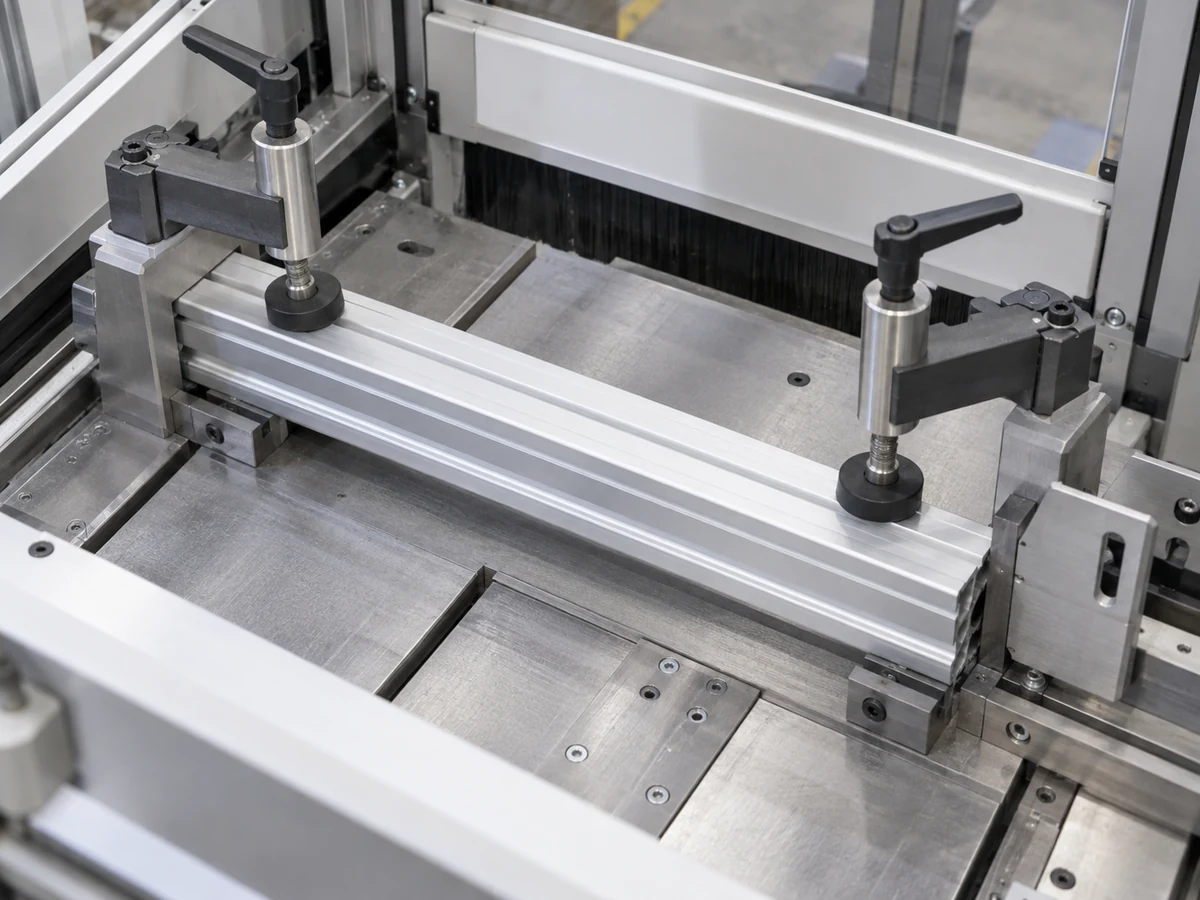
For aluminum door sweep retainer cutting, an open, thin-walled member can move or close under a poorly placed clamp. Ask the machine vendor to show how the actual section will rest, locate and be restrained at the cut. The answer should identify the contact faces, any sacrificial support, the short-piece handling route and how operators keep hands clear. Have the vendor assess the longest and shortest released lengths, not only an easy middle sample. The appropriate fixture and blade depend on the real section and stock condition; a generic saw specification cannot certify this fit.
5. Agree what an acceptable cut end means
Define length tolerance, squareness relative to the drawing datum, visible-face condition and allowed burr or edge break with a signed sample or measurable inspection method. Check both ends if the part may be flipped during assembly. A cut that looks clean from outside may still leave a sharp lip inside the insert track. Specify who removes chips, who deburrs, and whether an insert-fit test is part of acceptance. Keep the trial outcome separate from an equipment maker’s generic capability statement.
6. Assign slots, holes and caps to the right operation
A saw cut does not create mounting slots or verify their distance from the ends. If the sweep design uses adjustable slotted holes, supply the hole or slot drawing, reference edge, orientation and responsibility for punching or drilling. Pemko’s 3151 surface-plate sweep is one documented example with slotted adjustment; it is not a specification for your part. Decide whether end caps, brush insertion, staking or crimping happen before or after metal cutting. A station that cuts only the bar should not be presented as a complete door-hardware production line.
7. Make inspection and traceability proportionate
For the first article, inspect the selected drawing revision, several cut lengths, visible surfaces, insertion function and any hole-to-end relationship that belongs to this supplier. For production, state sampling frequency, measurement device, disposition of out-of-tolerance pieces and lot identification. If parts are kitted by door number, make the label and packing method part of acceptance. Photographing one good cut is useful for communication, but it is not statistical proof of the entire order.
Choose the production route from the order, not the machine label
Low-volume replacement retainers, repetitive factory lengths and mixed-order kits have different handling costs. Compare batch size, number of length changes, stock length and scrap plan, finished-surface care, secondary holes, operator loading and inspection labor. Ask a prospective saw supplier to demonstrate the actual section and representative length range before naming a machine or automation level. If the installed retainer requires a brush, gasket or cap, keep those purchase lines and assembly checks visible in the total-cost comparison.
The video below shows a Jiurun aluminum-profile saw as a general equipment example. It is not a trial of the door-sweep section in this article, and it does not establish a material, model configuration, customer installation or performance result for that section.
What to send for a useful quotation
- Approved section drawing and revision, or a representative physical sample; identify the insert and cap interface.
- Released length table, quantity by length, stock condition and whether cutting precedes or follows finishing.
- Visible faces, acceptable cut-end and retaining-lip criteria, and any protected-surface packaging requirement.
- Hole or slot drawing, insert fitting, caps and fasteners, each with a named responsible supplier.
- Representative shortest and longest pieces for a trial, plus the method for checking length, squareness and insert fit.
- Required output, shift assumptions, material handling and traceability needs for a machine quotation.
For an analogous discussion of supporting a different open extrusion, see our awning-rail cutting RFQ guide. Its channel drawing and examples are not sweep specifications. If a door bottom order also includes exposed corner trim, the corner-guard RFQ guide addresses that separate finished-edge problem.
Common questions
Can I quote from door width alone?
Only when the customer has supplied a rule that converts the measured or nominal door size into the released metal-retainer length, including end clearances and caps. Otherwise request the approved cut list.
Should the insert be cut at the same time as aluminum?
Do not assume so. The insert may have different length, compression and end-retention instructions. Identify the insert supplier’s instructions and assign that operation separately.
Does a clean cut guarantee a working sweep?
No. The finished assembly also depends on section geometry, insert retention, hole placement, mounting height and the sill condition. A cutting trial should verify the metal portion against its defined acceptance criteria.
Ready to assess a saw for your retainer? Send Jiurun the approved section, cut list, finish state and representative stock samples through our contact page. We can discuss the cut-and-support route for the actual extrusion; any production acceptance criteria remain subject to an agreed trial.