
Aluminum cut list nesting can produce the same number of parts from the same number of bars while leaving very different tail lengths. A quote that reports only today’s gross material yield may miss whether the remaining pieces can be identified, safely fed and used on the next approved job. Ask for the actual stock pattern and the disposition of each tail before treating a proposed cutting plan as a saving.
This guide gives a checkable two-bar example and a buyer’s review sheet. Every dimension in the example is invented for planning. It is not a Jiurun machine setting, a tested customer order or a promise that a particular remnant can be cut.
What belongs in an aluminum cut list nesting input?
Start with one released profile drawing and material identity. Record the real incoming bar-length range, each finished-part length and quantity, any end-preparation requirement, the blade and its approved planning kerf, the length datum, and the required cut-face and visible-surface condition. Keep jobs with different sections, materials or finish requirements separate unless the process owner has explicitly approved combining them.
The proposed machine also matters. Ask the supplier for the minimum stock or remnant length that its exact feeder and clamp arrangement can handle in the intended guarded mode. A minimum finished cut piece is a different number from a minimum loadable remnant. The KASTOoptisaw description gives a useful industry example: its optimization considers machine boundaries such as minimum residual length and can weight low scrap against using short bars. Those are KASTO software features, not claims about a Jiurun configuration.
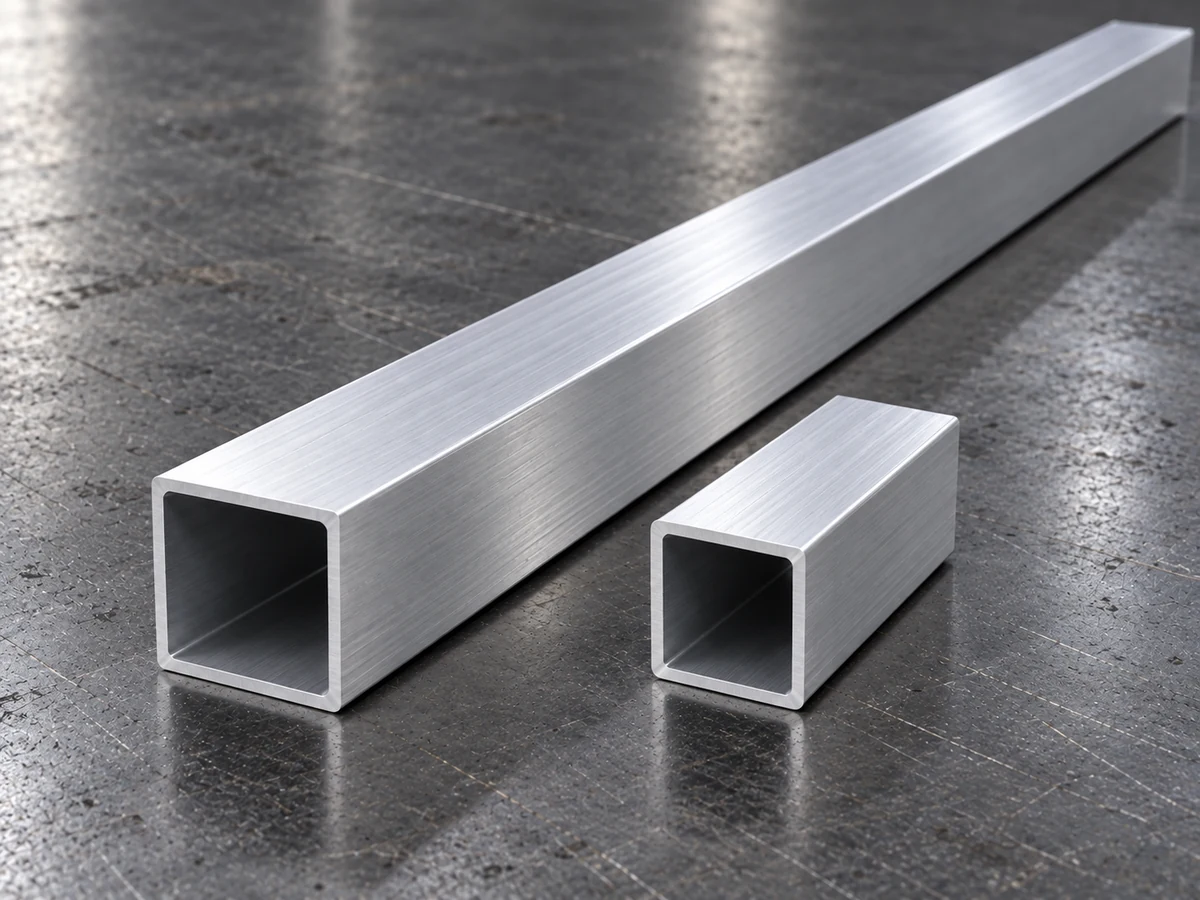
Two patterns, one order, different tails
Assume an invented order for four 1,600 mm parts and four 800 mm parts, all from the same approved section. The shop has two 6,000 mm bars. For illustration, each bar loses 20 mm of front trim and 3 mm in the front preparation cut. Each delivered part then needs one 3 mm separating cut. This example assumes straight cuts and no other processing allowance.
Each bar in either pattern produces four pieces, so its front preparation consumes 23 mm and its four production cuts consume 12 mm. The two patterns allocate the same eight parts differently:
| Pattern | Bar 1 | Bar 2 |
|---|---|---|
| A: balanced | 2 × 1,600 + 2 × 800; tail 1,165 mm | 2 × 1,600 + 2 × 800; tail 1,165 mm |
| B: grouped | 3 × 1,600 + 1 × 800; tail 365 mm | 1 × 1,600 + 3 × 800; tail 1,965 mm |
Check the arithmetic rather than trusting a percentage. For Pattern A, one bar uses 4,800 mm in parts plus 23 mm of preparation and 12 mm of production kerf; 6,000 − 4,800 − 23 − 12 = 1,165 mm. Pattern B’s first bar uses 5,600 mm in parts and leaves 365 mm; its second uses 4,000 mm and leaves 1,965 mm. Both patterns leave 2,330 mm in total. Both deliver 9,600 mm of nominal finished-part length from 12,000 mm of incoming stock.
That equal total does not make the tails interchangeable. If a later released order needs 1,000 mm blanks, Pattern A leaves two 1,165 mm candidates; Pattern B leaves one 1,965 mm candidate and one 365 mm piece. The candidates must still pass the actual machine’s loading, clamping, end-preparation, kerf, drawing and identification checks. Do not count a hypothetical future part as accepted output today.
Keep a tail’s physical length separate from its usable value
For each proposed tail, record the profile and material identity, measured length, end condition, surface condition, storage location and intended next job. A cut plan can mark a tail as a candidate for reuse, but production must decide whether it can enter the approved loading route and still leave enough material for the next cut. A piece that needs an improvised clamp or hand placement near the cutting zone is not a usable saving under that plan.
Ask whether the feeder needs a stock length greater than the drawing length plus kerf and any end preparation. Ask how the last piece is held during the cut and how the remnant is removed. Record the shortest permissible remainder for the actual quoted configuration; never substitute a figure from a different manufacturer’s brochure. The earlier trial stock-length guide explains why a short sample cannot prove the full production feed route.

Compare the whole order, including cut sequence and changeovers
Tail reuse is one objective among several. A grouped pattern may reduce switches between part lengths; a balanced pattern may make later stock use easier. Check whether the intended controller can execute the proposed sequence, whether different programs or stop positions are required, and how the first piece after each change is inspected. A theoretical nesting sheet is not a verified saw program.
Put the real cost boundaries beside the length balance: number of bars opened, setup or changeover time, accepted piece count, rejected pieces, collection and identification effort, and storage of retained tails. Keep material utilization separate from accepted-part yield. The kerf calculation guide shows the length accounting for one straight-cut pattern; the yield guide distinguishes material use from inspection results.
If stock arrives in a length range rather than exactly 6,000 mm, calculate and verify the pattern for the short end of that range. A plan that works only on nominal stock may fail when an accepted incoming bar is shorter. Include the actual bar and part identifiers in the trial record so a favorable result is traceable to the tested material.

Witness the pattern before approving an equipment quote
Give the supplier the released drawings, incoming stock-length range, quantities, proposed patterns, blade reference and the acceptance criteria for cut faces and lengths. Ask for a written response showing the normal guarded feed and clamp sequence, each cut, accepted output and the actual residual lengths. Have the supplier identify any loader, support, outfeed or special fixture needed to run the plan and whether it is included in the price.
For a representative trial, record the starting length of each bar and measure the resulting tails rather than relying on a software prediction. Keep the first piece after setup, the pieces after a length change, and the last part from each bar tied to the same job record. If the proposed pattern cannot run without an unquoted handling step, revise the quote or the plan and retest the affected boundary.
The outcome should say which pattern was tested, which pieces passed the drawing-based checks, which tails are only candidates for reuse, and who owns the next-job release decision. Do not turn an untested nesting proposal into a claimed material-saving rate.
See the equipment context, then request a configuration-specific review
The following video is from Jiurun Machinery’s own YouTube channel. It shows general saw equipment and operation. It does not demonstrate these invented stock patterns, this material, a customer’s order, a minimum remnant length or a measured yield.
General equipment footage only; validate your proposed saw, stock pattern and accepted output separately.
Send your profile drawing, bar-length range, mixed-length cut list and next-job remnant requirements to JiurunCut. Ask for a machine-specific pattern review and a witnessed trial before comparing quoted material savings.