
An aluminum bend test report needs its method, specimen identity, examination record and applicable product requirement. A short entry saying “bend test passed” should remain connected to the document that defines what was tested and evaluated.
Start with the original report and the requirement named in the order. Keep a material ductility evaluation separate from the dimensions required for a production bend.
Four details to locate
1. Identify the aluminum bend test method
The ASTM E290-22 public overview describes ductility evaluation through resistance to cracking or surface irregularities during a continuous bend. It identifies guided, semi-guided, free-bend and bend-and-flatten methods.
The methods apply different constraints to the specimen. Keep the actual method name and edition in the review instead of treating every “bend test” label as the same evidence.
Find the complete reference
Ask the issuer to identify the procedure used and the product requirement it addresses. Retain any referenced attachment or procedure revision with the report.
If the quote abbreviates the method, request the expanded description. A short commercial heading is useful only when the supporting record preserves its meaning.
For a proposed alternative test, retain the alternative as a separate submission. Have the responsible material reviewer resolve its suitability against the original requirement.
Distinguish a test result from a forming proposal
A material report and a production drawing have different review scopes. The drawing defines the part you intend to purchase; the report describes the identified evaluation.
Our profile bending guide discusses the wider forming handoff. Do not copy a test report’s short outcome into a production tooling instruction without the applicable engineering review.
2. Connect the specimen to the supplied aluminum
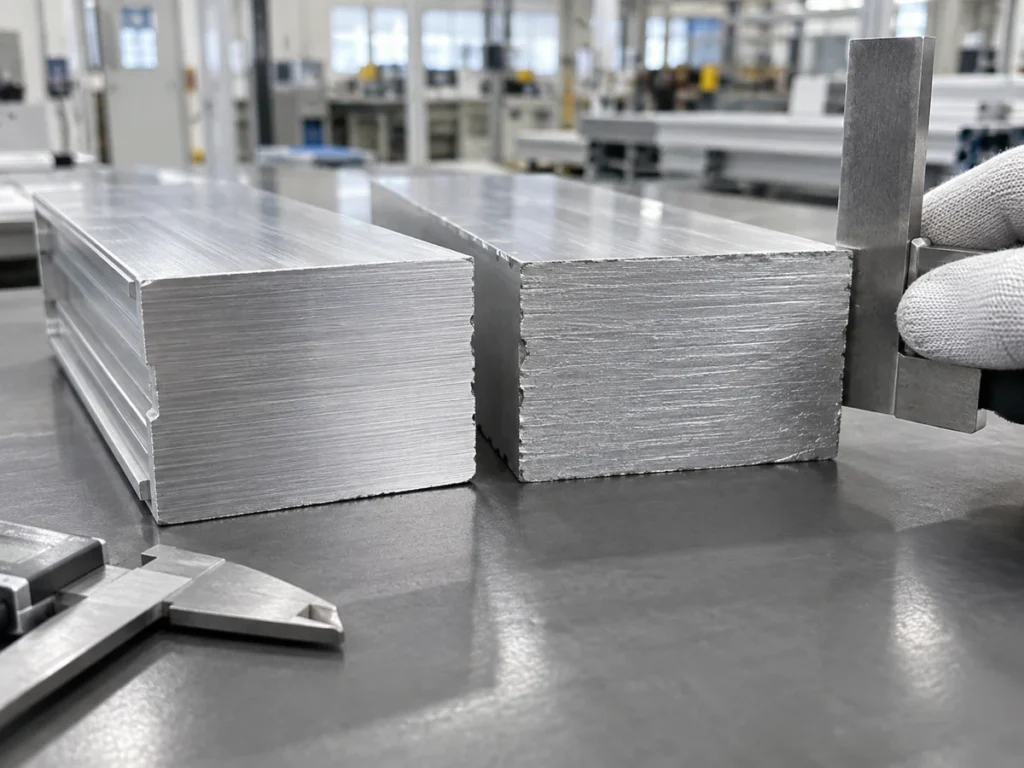
Locate the specimen label and its connection to the material being offered. Keep alloy, supplied condition and product form identifiable alongside the source record.
Ask where the specimen came from and what supplied material the report represents. Retain any reported orientation and source location with the laboratory’s terminology.
Preserve the tested condition
Record the material condition stated by the issuer. If the order concerns a different processing or delivery stage, ask the responsible reviewer to resolve that difference.
Keep specimen preparation and dimensional information with the report where provided. Request an explanation of a missing field rather than filling it from a stock photograph.
The material certificate guide helps connect the report to the supplied order. A familiar alloy designation should still have its required delivery and document connection.
Track reserved starting pieces
If a laboratory requests rough-cut starting pieces, retain its preparation requirements in the cutting brief. Name the reserved quantities and their identification separately from production blanks.
A sawn starting piece may be handed to a laboratory for further preparation. Keep that stage identifiable rather than labeling the rough-cut piece as a completed test specimen.
Ask the receiving team to retain the sample identity through packing and transfer. The report can then refer back to an identifiable piece and material record.
3. Retain the examination record
The E290 overview describes examination of the convex bend surface for cracking or irregularities. Its evaluation connects the relevant observations to the applicable product specification.
Keep the issuer’s actual examination description and result. A report should make clear what its outcome refers to, including any stated qualification or exception.
Read the result beside its notes
Request the complete report pages and any examination attachment. A cropped “passed” line can omit the specimen identity and the limitation that gives the result its scope.
If photographs are supplied, retain their specimen labels and explanatory notes. Images can support the issuer’s documented observation; they should not be relabeled as a different specimen or test.
| Report detail | Question to resolve |
|---|---|
| Method | Which test and edition were applied? |
| Specimen | Which material and piece does it represent? |
| Examination | What observation and outcome were reported? |
| Requirement | Which specification defines the decision? |
Keep angle descriptions understandable
The E290 discussion distinguishes angles measured under bending force from angles measured after force removal, depending on the method. Preserve the report’s stated condition when it includes an angle.
Our springback guide focuses on loaded and released angle descriptions. Here, that field helps identify the reported test condition; it does not provide a production compensation angle.
4. Keep the product requirement with the decision
Retain the released specification and the order’s evidence requirement with the review. Ask the responsible reviewer which report entries address those requirements.
Keep the supplied observations and the acceptance decision separately identifiable. A laboratory’s issued result and a purchasing release should each state their own scope.
A short fictional document comparison
Imagine order B46 requires a defined material evaluation. Report A identifies its method, specimen, examination and product requirement. Report B contains an angle and the word “passed,” with those supporting fields omitted.
The buyer requests the complete basis for B before treating it as equivalent evidence. The buyer does not infer a method from the angle or invent a crack-size criterion.
Please identify the bend-test method, specimen and examination behind the B46 result. Include the applicable product requirement and explain the scope of the reported outcome.
B46 is an invented reporting example. It contains no actual laboratory result, material-performance value or acceptance limit.
Retain an identifiable clarification
Keep the issuer’s response and any corrected document with the original file. Preserve revisions so receiving and quality use the same accepted evidence.
If the offered material changes afterward, carry that change into the review. A document accepted for one identified submission should remain connected to that submission.
Prepare the cutting handoff
Send JiurunCut the identified aluminum stock and representative cutting brief. Include blank drawings, quantities and any agreed sample-identification requirements.
Keep aluminum bend test evidence with the material review. State whether the cutting order covers production blanks, laboratory starting pieces or both.
Does a bend result replace a tensile-property report?
Retain the separate evidence required for each property. The elongation and reduction-of-area guide explains two tensile-report quantities.
Does “passed” define a production forming setup?
Use the actual part drawing and applicable forming review for that decision.