
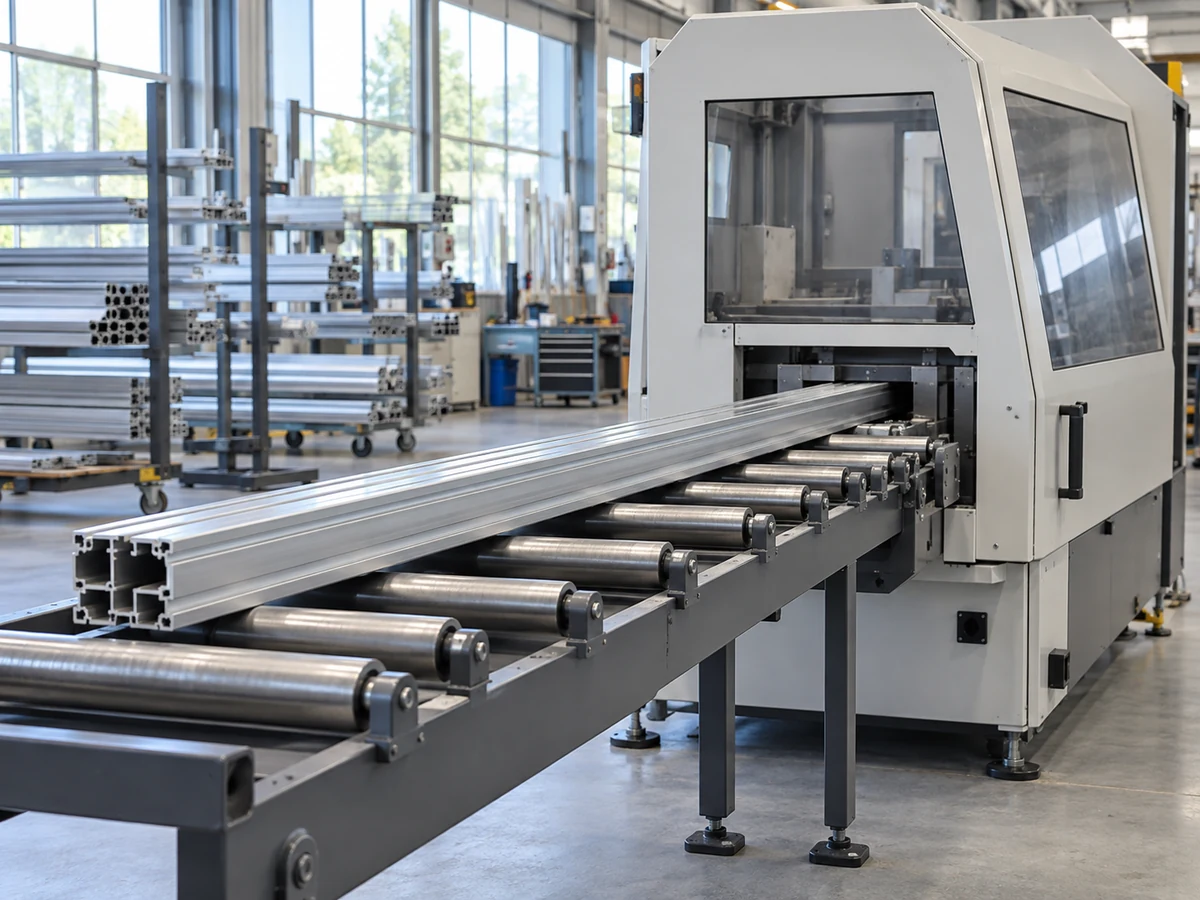
A long aluminum extrusion lies across a row of rollers before it reaches the saw. Those rollers might simply carry its weight, or a motor might turn them to move the stock. The distinction changes the price, controls and acceptance test. Buyers considering powered infeed rollers for an aluminum saw should ask one practical question first: who is responsible for moving the bar at each point from loading to the final feed?
JiurunCut supplies industrial circular-saw cutting equipment for aluminum and other nonferrous materials. This article describes a way to compare proposed infeed arrangements; it does not establish that a particular Jiurun model includes a powered roller table. The supplier must confirm the offered machine, feeder, table and control interface for your stock.
Draw the motion path before pricing a drive
Mark four positions on a simple side-view drawing: where a new bar is placed, where its leading end enters the machine, where the saw feeder grips it, and where the shortened tail leaves the upstream support. At each position, write down what makes the stock move. An operator can push it; a gravity table can let it roll when another device pushes; a powered table can propel it; the machine’s own feeder can take over. These are separate functions even if the equipment looks similar in a photograph.
Include the table-to-machine gap, roller elevation, lateral guides and the contact face of the actual profile. A motor on the table does not prove that the bar stays aligned or that the saw can take it at the right moment. The infeed roller load review addresses support capacity. The present decision concerns drive ownership and the handover between drives.
When powered infeed rollers earn their place
A support-only gravity table may be enough when the planned loading method and saw feeder can move every approved bar through the whole route. The quote should still identify the loading effort, guide arrangement, available floor space and the point where the machine feeder takes control. Gravity rollers reduce sliding contact; they do not create a commanded feed cycle on their own.
Powered infeed rollers become a candidate when a defined movement job remains outside the machine feeder’s reach: bringing stock from a loading position to a pickup point, indexing a heavy or awkward section under controlled conditions, or coordinating a repeatable handover with an upstream station. Ask the supplier to show which rollers are driven, how they are controlled and how the motion stops before the saw grips the bar. Do not infer those details from the word “automatic” in a brochure.
A complete automatic loading rack is a third scope. It may include storage, singulation, presentation and transfer as well as motion. Price it separately from a motorized roller table so that two quotations describe the same loading job. If your line already has a usable table, first document its dimensions and function; the roller-table reuse guide covers that different purchase decision.
Put the handover signals in the quotation
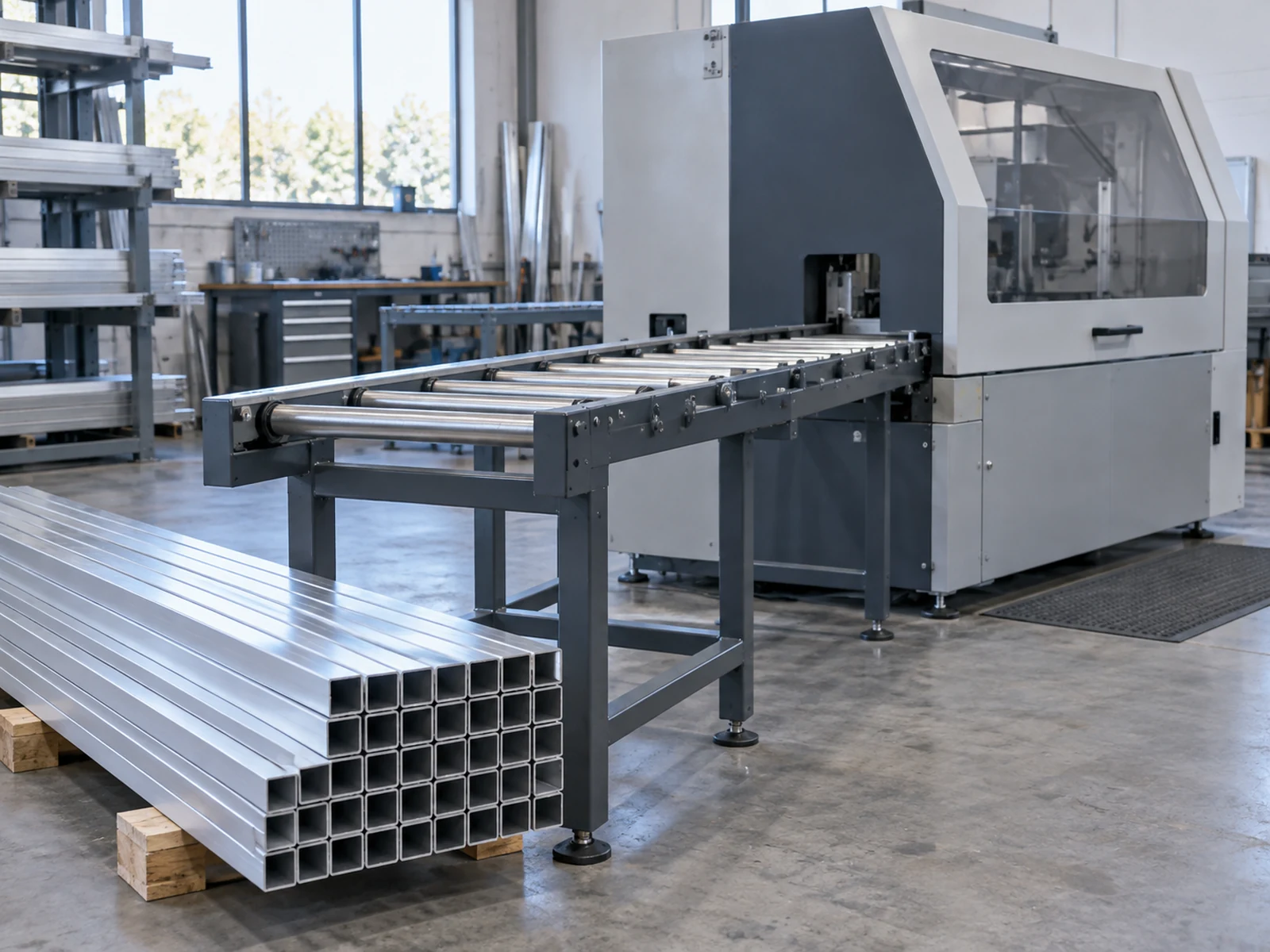
For powered infeed rollers, request an interface description alongside the mechanical drawing. Name the device that requests a move, the device that permits it, the sensor or state that confirms the bar is at the pickup position, and the response if the stock does not arrive. Ask whether the table drive can move while the saw feeder is gripping, whether either drive can reverse, and who supplies the electrical and control connection. These are questions for the machine supplier’s approved design; this article does not prescribe a control sequence.
Record the largest and smallest approved incoming sections, length range, mass and contact orientation. A round tube can behave differently from a flat extrusion on the same rollers. Interroll’s roller planning guidance treats product geometry, contact, roller pitch, load and drive as related inputs. Its general conveyor rules are not a Jiurun saw specification; the proposed supplier must assess the real stock and table.
Witness the movement job you paid for
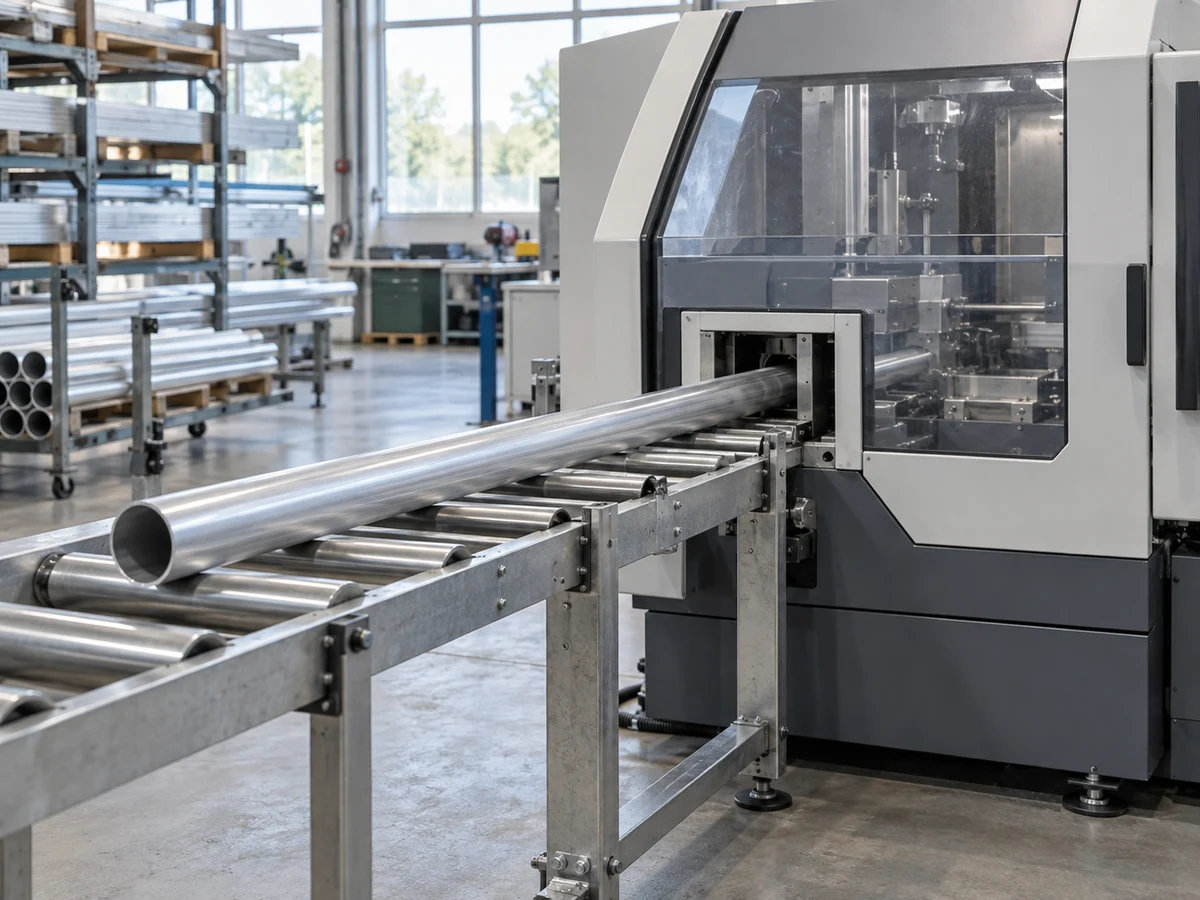
Agree on a trial with the actual representative profile rather than a generic straight bar. At the loading position, observe how the bar first reaches the roller bed. At the machine entry, check whether its leading end reaches the feeder without lifting, rolling sideways or contacting a guide unexpectedly. Then stop the cycle at the agreed handover state and identify which drive holds or moves the material. Repeat with the least favorable approved length and with the feed tail, where support and traction can change.
Record the observed stock movement, the machine and table states, and the accepted cut result. If the offered table is only a support, do not score it as though it had a powered delivery function. If it is powered, a running motor alone does not prove the complete handover. Agree the pass criteria with the supplier before the demonstration, including the production duty and finish condition that matter to your parts.
Video boundary and a useful RFQ
The Jiurun Machinery video below shows an automatic CNC aluminum cutter feeding and cutting stock. It gives a visual reference for the machine-side feed. It does not identify whether the upstream rollers are powered, show the control signals described here, or prove a configuration for your quotation.
Send JiurunCut your profile drawing, finish requirement, incoming lengths and mass, present loading method, available floor plan, and the number of bars presented per cycle. Ask for a layout that labels gravity support, powered movement, saw-feeder movement, the handover signals and the scope of each supplier. Request a witnessed trial plan for the least favorable stock case. Contact JiurunCut with those details so the response can address the actual machine and infeed package.