
An aluminum saw infeed roller load question starts with the stock you actually intend to present to the saw. A catalog rating for one roller does not tell you whether a long extrusion, a round tube, or several profiles will remain supported through the complete feed and cut cycle. Before ordering a saw and its infeed equipment, ask the supplier to assess your heaviest credible stock case at the least favorable position, including the handoff to the machine.
This is a purchasing check for a proposed support arrangement, not a claim that any Jiurun model has a particular roller rating. The outcome should be a named, reviewable configuration and a trial plan. It is different from deciding whether an existing table can be retained or how a worn roller is replaced.
Why a single roller rating is an incomplete answer
A roller’s stated capacity belongs to a defined roller construction, shaft mounting, length and loading condition. The table also has a frame, legs, joints and a connection to the saw. The workpiece may touch only some of the rollers beneath its projected length. At the moment it crosses a table gap or approaches a clamp, the supported span and load distribution may change. A hollow, curved or uneven-bottom profile can make much narrower contact than a flat bar.
Interroll’s technical guidance for conveyor rollers treats load capacity, roller pitch, contact and shaft fixing as related selection inputs. Its guidance is about rollers generally; it is not a specification for a Jiurun saw or a substitute for the proposed machine supplier’s assessment.

Describe the stock case before asking for a rating
Send the supplier a stock-case sheet, not only an extrusion drawing. Record the actual incoming length range and measured mass for the heaviest individual piece, plus the likely batch presented at once. Identify the section that contacts the rollers: a broad flat face, a narrow rib, a curved tube, or an irregular surface. Mark the stock’s center of mass if it is not near the geometric center, and show the longest overhang you expect during loading, feeding and tail-end handoff. State whether operators will place one piece at a time or several parallel pieces, and whether incoming stock can be bent or bowed.
Separate this from finished-part dimensions. A short cut length does not remove the need to support a long incoming bar. Likewise, a nominal extrusion family does not tell the supplier the weight and contact condition of the particular stock you will buy. If those inputs are missing, ask for a conditional quotation with the unresolved cases named; do not accept an unstated generic load assumption.
Evaluate aluminum saw infeed roller load across the complete support path
Have the supplier identify the proposed infeed table, individual roller construction, roller spacing, mounting and total supported arrangement for each stock case. Ask where the stock contacts the first roller, where it loses contact with the last one, and which supports carry it as the saw’s feed mechanism takes over. A drawing should show the table-to-saw height, gaps, lateral guidance and the intended direction of movement. Include the floor support or anchoring assumptions if those are part of the offered package.
The useful answer is a load case at the weakest transition, not a multiplication of a catalog per-roller figure by the number of rollers drawn. The supplier should explain the number of rollers that actually contact the profile in that position and how it assessed the table frame and connection. If a heavier section requires closer spacing, another roller type, a support stand or a different infeed route, put that change into the quoted configuration and bill of materials.
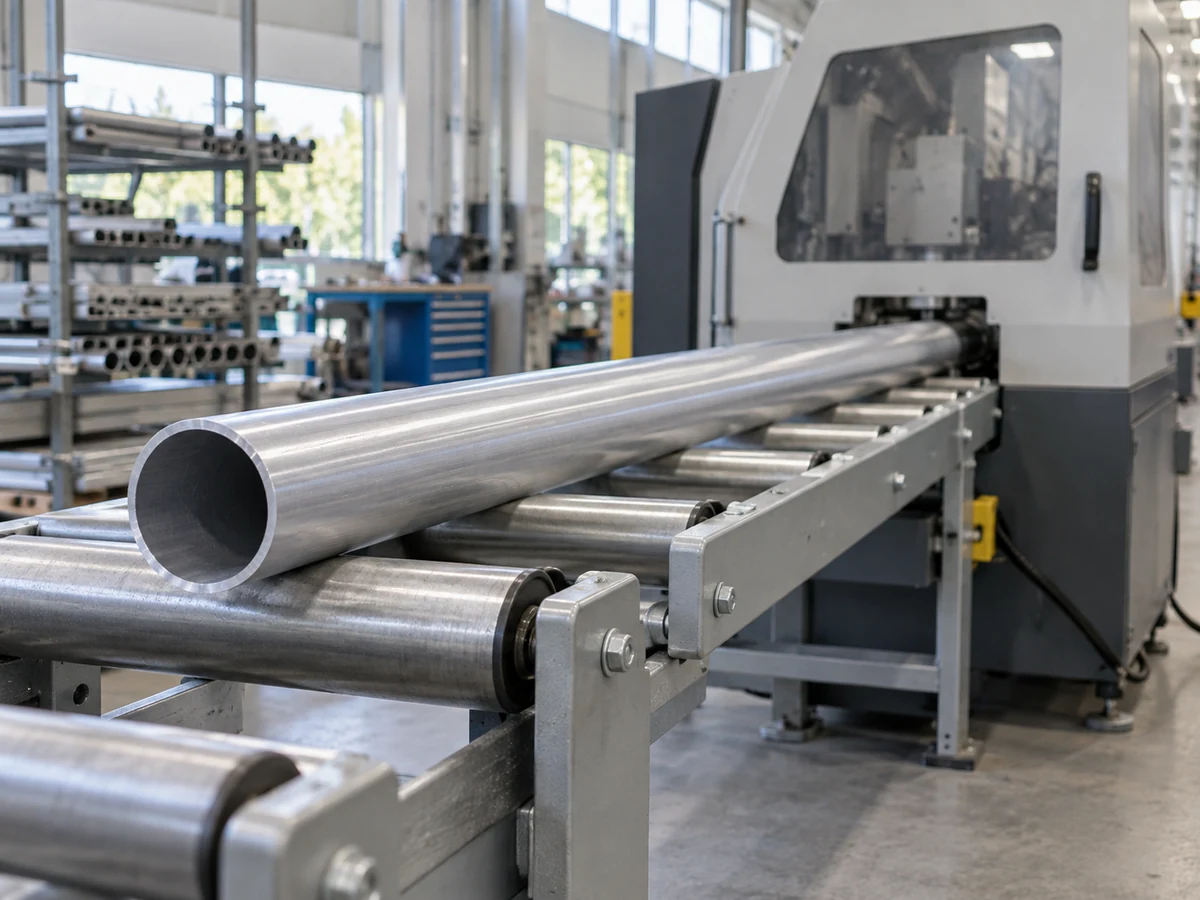
Compare three different loading patterns
One long rectangular profile. Follow the leading end from initial placement to machine handoff and the trailing end as the bar shortens. Ask whether the profile remains aligned without an unsupported span at either transition. Check that the trial stock has the same contact face and comparable measured mass as the case being quoted.
One large round or irregular section. Ask how the tube is kept from rolling sideways and where contact actually occurs. A roller table that supports a flat section may need different side guidance or a cradle for a round one. Request the proposed restraint as part of the machine-side arrangement rather than assuming the operator will improvise it.
Several parallel profiles. Give the supplier the maximum simultaneous count and the placement pattern. A total mass alone can hide a locally concentrated load, and profiles can take unequal shares of the contact. Ask for the proposed lane spacing and how the bundle is kept separated and presented to the feed mechanism.

Put the decision into the RFQ
Use a small acceptance matrix so each supplier answers the same question. The figures must come from your own stock measurements and the supplier’s configured equipment, not from this article.
| Case | Buyer supplies | Supplier returns | Trial observation |
|---|---|---|---|
| Long flat profile | Measured mass, incoming length, contact face and overhang | Support layout and weakest handoff position | Alignment and contact through entry and tail-end feed |
| Round or irregular stock | Section, contact geometry and tendency to roll | Roller and lateral-restraint arrangement | Stable location without improvised restraint |
| Parallel stock | Count, placement, individual masses and total batch | Lane layout and local-load assessment | Separation and reliable presentation at the saw |
Request a configuration drawing or written support explanation, the stated operating assumptions, and a list of exclusions. Agree in advance what the trial will show and who supplies the stock. Observe the loaded entry, handoff, feed and retrieval stages with the actual candidate family. If a case cannot be demonstrated, record it as an open purchasing condition rather than treating a video of another machine as proof.
A general machine view, with a clear limit
The following video is from Jiurun Machinery’s own channel and shows an aluminum cutting machine and profile feed area. It is general equipment footage. It does not establish the roller rating, exact table configuration, material, customer case, trial result or performance discussed above.
What makes the quote ready to compare?
An aluminum saw infeed roller load assessment is ready to compare when the quote names the infeed table and restraint components, the stock cases they cover, the point at which the saw takes over, the operating conditions, and the evidence still required. It should also say whether the table is included in the machine price and who is responsible for matching its height and location during installation. If one proposal answers only with a roller catalog rating while another specifies the complete support path, ask the first supplier to close that gap before comparing price.
For a Jiurun aluminum-saw inquiry, send the contact team your measured stock-case sheet, section drawings and the loading pattern you want evaluated. Ask for a proposed support layout and a trial plan for the actual material. Any load capacity, compatibility or cutting outcome remains subject to the confirmed configuration and observed evidence.