
A frame member may need a 45° miter on one end and a different angle on the other. A double-head saw unequal angles inquiry sounds simple, but the answer depends on the exact saw configuration, the way each head is set, and the drawing’s definition of length and handedness. Two cutting stations alone do not prove that both ends can be set independently for your part. Use one released part as the test case before accepting a machine quotation.
Start with one released part, not two angle labels
Mark the left and right ends on a drawing in the same orientation the operator will see at the saw. Identify the profile’s visible face, its top or datum face, and the direction from which each angle is measured. A 45° end can be mirrored the wrong way while the angle gauge still reads 45°. The required assembly corner is also not automatically the blade setting: confirm whether the drawing calls out an end-face angle, an included angle, or an angle to the profile axis.
Handed parts make this especially important. If a left member and right member are mirror images, show both, or clearly state which part is the master. Add a sketch of the mating pieces if the joint is hard to interpret. For broader drawing conventions, see our guide to profile orientation at the saw.
Double-head saw unequal angles: check each head’s setting
Ask the supplier to identify the specific machine configuration and demonstrate the left-head and right-head settings required by the drawing. Can each cutting unit reach its assigned angle in the needed direction? Are the settings independent, or must the operator rotate or reposition the profile between cuts? What angle stops, displays, or controls are fitted to the quoted machine? Which motions are automatic and which are manual? Record the actual configuration in the offer rather than assuming that every machine called a double-head saw works alike.
This variation is real across the market. Emmegi’s double-mitre-saw range describes manual, assisted, and automatic adjustments depending on the model. The published elumatec DG 79 specification gives an angle range for that particular machine. Neither source establishes the capability or supplied options of a Jiurun saw. Request the range and setting method for the exact unit being quoted.
Unequal ends make the length reference critical
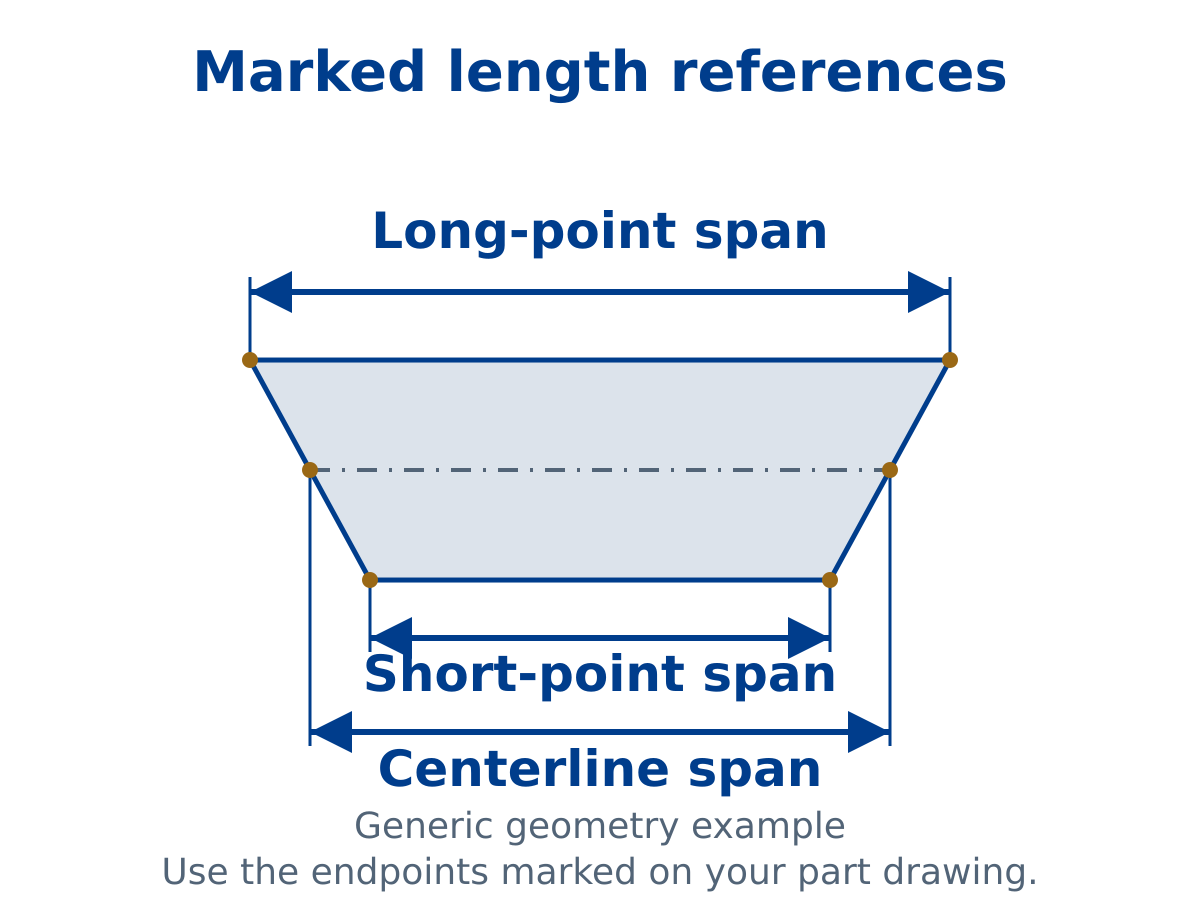
A mitered member has more than one plausible length. The long-point span, short-point span, centerline span, and a dimension between specified datum planes can differ. With unequal ends, the offset at each end may also differ. A quotation that merely repeats “cut length” leaves room for a correct-looking machine setting and a wrong finished part. State the exact endpoints used for the drawing dimension, the required tolerance, and the profile orientation during measurement.
For a representative trial, give the supplier a marked drawing and ask them to report the measured dimension using that same reference. If the profile has a complex section, note which corner or surface defines each endpoint. Also check whether the shortest required part still has adequate support and clamping at both cutting positions. Our single-versus-double-head saw comparison explains other layout questions that affect the choice.
Witness a representative part before accepting the quote
Use the real extrusion section or a documented equivalent with the same support and clamping challenge. Watch the entire two-end sequence: load and orient the stock, set both angles, position the heads, clamp, cut, unload, and inspect. If the proposed process needs a second setup or a flip, make that visible in the trial and in the quoted cycle. A display showing two angles is useful, but the finished piece is the acceptance evidence.
Measure each end against the drawing’s angle definition and check the agreed length reference. Then place the part against its mating component or a suitable fixture to check hand and fit. Note burrs, end-face quality, and whether clamping marks matter on a visible surface. Agree in advance who measures, with what method, and what tolerance constitutes a pass. A single attractive sample without the part drawing and measurements does not settle the purchasing question.
If one two-end cycle cannot make the part
The requirement may still be manufacturable through a different route. One end might be cut, then the profile repositioned for the other; a different saw configuration or a separate operation may be needed. Those choices change handling time, datum control, workholding, and scrap risk. Ask the supplier to describe the actual route, its fixtures, and the expected output for the specified part. Compare that route with your production volume and quality checks instead of treating a double-head label as the decision.
Send a decision-ready inquiry
Send one released drawing, the profile cross-section and alloy, cut-list examples, left and right angle definitions, datum faces, shortest and longest required lengths, and the quantity per batch. State whether the two ends must be produced without reclamping. Ask for the exact quoted machine configuration, a description of the cutting sequence, and a measured representative part against your acceptance criteria. If you have a mating assembly, include its fit requirement.
For a double-head saw unequal angles decision, Jiurun can discuss a specific process against a specific part. Contact the team with the drawing and the checks above to determine whether a proposed saw and workflow fit your unequal-angle job.