
Aluminum saw first-pass yield can sound like a straightforward percentage in a machine quotation. It is only useful to a buyer after both sides agree which cut parts entered the count, what “accepted” means, and when inspection ends. A fast cycle can still leave a cell sorting, remeasuring, recutting, or waiting for a decision. Ask for a count that follows the accepted part, not just the saw stroke.
This guide sets out a practical trial definition for a profile-cutting purchase. It is a proposed measurement method, not a performance claim for any Jiurun machine or a substitute for your own drawing tolerances and inspection plan.
Define aluminum saw first-pass yield at one process boundary
The American Society for Quality describes first-pass yield as the share of units that complete a process and satisfy its quality rules without scrap, rerun, retest, return, or offline repair. That definition is a useful starting point, but an aluminum-cutting line still needs a local boundary: one saw, the saw plus deburring, or the entire cut-part release process. A saw supplier should not be credited or blamed for a later operation unless it is explicitly inside the agreed trial.
For an aluminum saw first-pass yield comparison, mark the start when a profile or blank is committed to the agreed cut program. Mark the end when the resulting part receives its first specified inspection decision. State whether setup pieces, changeover checks, planned destructive samples, and remnants enter the denominator. If they do not, list them separately; do not erase them from the material reconciliation.
Write the numerator and denominator before the demonstration
Use one unique part or cut-piece ID, or a reconciled batch count, so an item cannot be counted twice. A workable calculation is first-pass accepted pieces ÷ pieces entering the agreed process. “Accepted” means the first inspection decision meets the pre-agreed drawing and visual criteria without rework or retest. A corrected part may ultimately be saleable, but it was not first-pass accepted.
Decide these cases in writing before a trial:
- Setup cuts: include them in a full-shift production view, or report a separate stable-run rate if the purchase comparison needs both.
- Held parts: keep them in the denominator and outside the accepted numerator until the first disposition is known. Report the hold count; do not quietly remove it.
- Reworked or recut parts: record final recovery separately from first-pass acceptance.
- Planned samples: state whether a destructive inspection sample is a deliberate production cost or outside the trial boundary.
- Upstream defects: record pre-existing stock defects and the agreed attribution rule, while retaining a transparent input-to-output reconciliation.
For example, suppose a hypothetical run has 120 pieces enter the agreed boundary. At first decision, 106 pass, 6 require rework, 5 are rejected, and 3 remain on hold. The reported first-pass yield is 106/120, or about 88.3%. This is arithmetic for an example only; it is not a Jiurun test result or a target. If two held parts later pass after retest, the final usable output changes, but the original first-pass count does not.
Make inspection rules visible
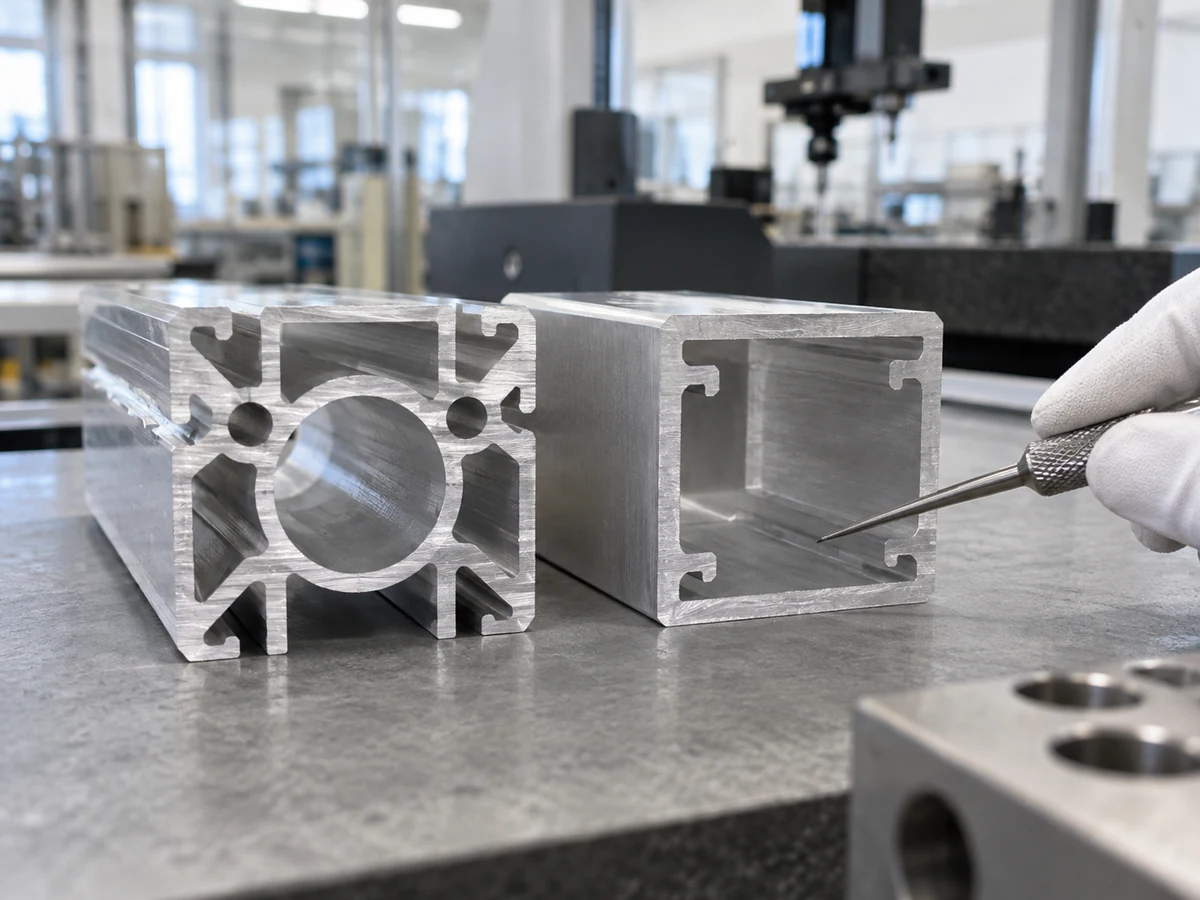
“Good cut” is too vague for an acceptance trial. Bring the actual profile drawings, length datum, permitted burr condition, face quality, squareness or angular requirement where relevant, and any packaging or traceability rule that determines release. Identify the gauge, sampling frequency, operator, and rule for borderline readings. Do not confuse a machine’s programmed feed-position specification with finished-part accuracy; finished results depend on the whole cut and measurement process.
First-piece approval and periodic checks matter because a single end-of-run sample may miss drift, clamp issues, blade wear, or stock variation. Record the first result after each profile or blade change and then a time- or piece-based sample agreed before the run. If every piece is inspected, say so. If sampling is used, a claim about all pieces must be qualified by that sampling plan.
Separate the equipment signal from the release decision
A saw controller may expose a cycle count, alarm, or program completion signal. None of those automatically proves that a cut piece passed drawing inspection. In the request for quotation, ask which signals the proposed configuration can supply, how piece IDs or batches would be linked, and which data still require an operator or your quality system. Have the supplier identify optional interfaces and quoted scope instead of assuming a dashboard, automatic inspection, or particular connectivity feature is included.
The U.S. National Institute of Standards and Technology notes that manufacturing metrics and data collection need a defined use case and context. For this purchase, collect the minimum data that lets the team reconcile attempted pieces, first-pass acceptances, rework, rejects, and holds. Timestamped events help explain stoppages, but the accepted-part decision still needs a named inspection rule and owner.
Run a trial that resembles the purchasing problem
Use a representative mix of your profiles and cut lengths, including the difficult cases that motivate the purchase. Agree the stock condition, blade and tooling specification, clamping setup, operator role, and planned changeovers. Run long enough to observe ordinary feeding, first-piece checks, changeover, and the inspection handoff. A short demonstration of repeat cycles may be useful, but it cannot establish a full-shift first-pass figure.
Record the drawing revision and inspection method alongside counts. Keep the raw count sheet, exceptions, photographs of disputed defects where permitted, and disposition notes. When a supplier compares two machines, use the same boundary and acceptance criteria for both. If a customer’s upstream stock is out of specification, document the effect and present the count with that caveat rather than silently rewriting the denominator.
Questions to put in the RFQ
- What exact cut-part types and drawing revisions will be in the trial?
- Where does the measured process start and end?
- How will setup, destructive samples, remnants, and profile changes be counted?
- Who makes the first acceptance decision, with which gauges and criteria?
- How are hold, retest, rework, recut, and scrap recorded separately?
- Which counts come from the quoted machine configuration, and which require manual entry or another system?
- What evidence will be handed over: raw logs, count reconciliation, sample measurements, and exception notes?
- Will any reported figure cover a stable run, a mixed shift, or both?
Use the answers with a broader saw-cell buying study. If the accepted pieces must be grouped for downstream orders, define the handoff in the cut-part kitting plan. Include blade-change and consumable assumptions in the consumables supply plan, since they affect the real operating trial.
Equipment view
The following Jiurun Machinery channel video shows general aluminum-cutting equipment operation. It is a visual example only. It does not verify the material, machine configuration, customer application, trial conditions, first-pass yield, or performance discussed above.
Ask for a count you can audit
Send your drawing, profile mix, expected batch pattern, and proposed inspection boundary when requesting a machine recommendation. Ask Jiurun to identify the quoted configuration and which trial observations can be captured by the equipment versus your own quality process. Contact JiurunCut with your cutting requirements to discuss a documented trial plan.
Definition and measurement context: ASQ Quality Glossary; NIST manufacturing metrics publication. These sources inform the measurement framework; they do not certify or rate any machine in this article.