
An aluminum cut-part kitting cell should be bought against a defined handover, not a photograph of sorted pieces. The purchasing question is whether the proposed route can turn released cut parts into the correct, identifiable assembly kit at the required point of use. A saw can make parts; a kit process must also identify, count, contain and release the right parts for a specific order or build sequence. This guide compares manual kitting, assistance at the saw and a separate cell on that same output basis. It does not assume that any listed Jiurun saw includes a kitting cell.
Aluminum cut-part kitting: define the accepted kit
Write one acceptance definition that production, assembly, quality and the supplier can all read. Identify the order or assembly, kit variant, bill-of-material revision, part identities, quantities, orientation or surface-protection needs, container, label, destination and due sequence. State whether purchased hardware belongs in this scope or arrives by another route. A trolley containing all available cut pieces is not a complete kit if the receiving station still has to sort variants, count components or resolve substitutions.
Make the acceptance unit explicit. It might be one assembly set, one trolley for a timed build window, or a batch of separately labeled kits. State who signs off a complete kit, what evidence accompanies it and where the handover occurs. Decide what a partial kit means before a shortage happens: some plants prohibit release, while others release a clearly marked incomplete kit under a controlled exception. The supplier cannot design a credible flow around an undefined rule.
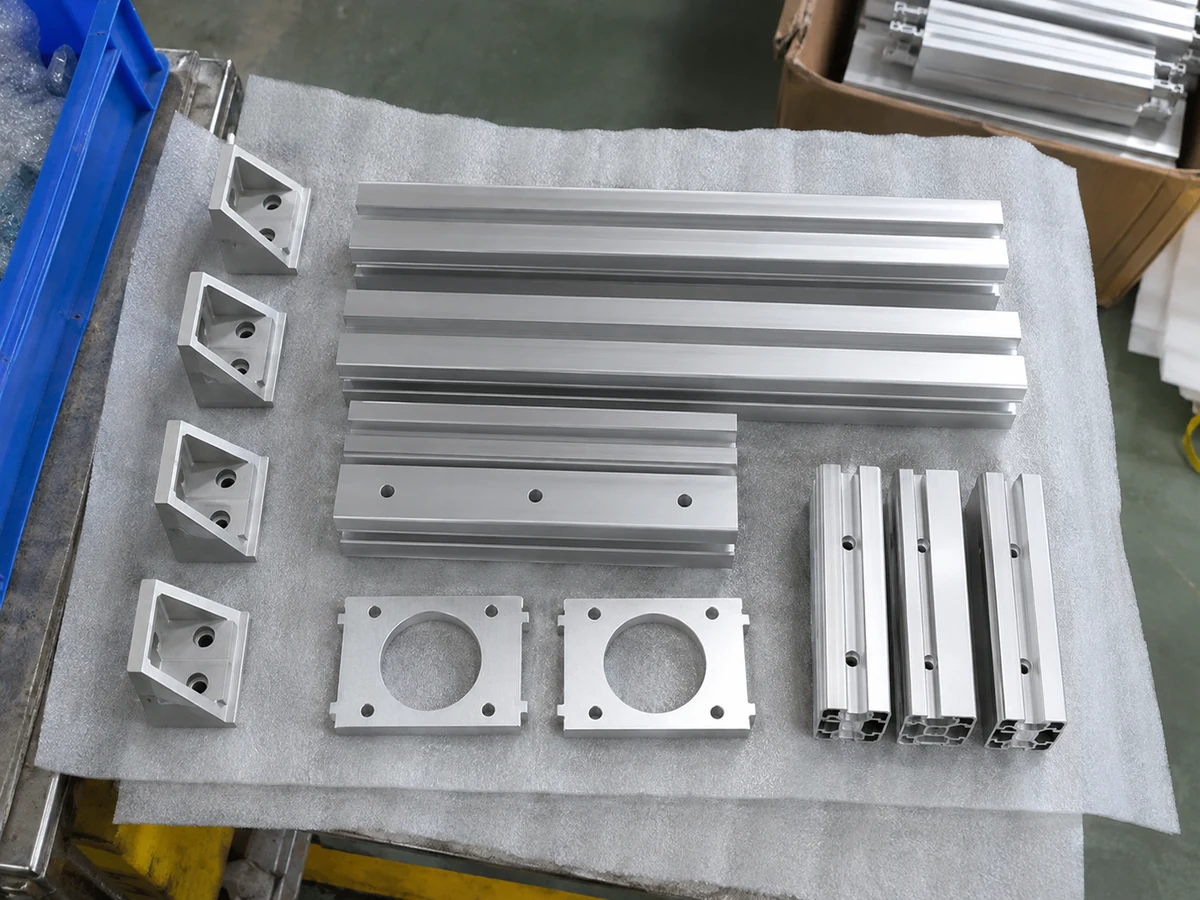
Compare three routes at the same handover point
Retained manual or offline kitting. Operators collect released parts from saw output or a supermarket and build kits at a bench. This can be sensible when mix, volume or revision frequency does not justify a dedicated cell. Include walking, search, counting, space, protective handling, labels and exception resolution in the comparison. Manual work is not automatically a defect; an unclear verification and release method is.
Assisted kitting beside the saw. An identification, scan or directed placement step near the cut operation can reduce later ambiguity if the order and part data are reliable. Check whether the saw’s cycle, changeovers and output buffering allow the operator to kit without interrupting cutting. If different orders share a run, the plan must keep them physically and digitally distinguishable. Verify what is included by the saw vendor versus a separate integrator; do not infer integration from a demonstration of a standalone saw.
Dedicated kitting cell. A separate work area may provide controlled accumulation, part identification, kit verification and handover across several saws or shifts. It also adds floor area, containers, software interfaces, maintenance and a clear owner for shortages or rejected pieces. It is justified only when its demonstrable handover performance and operating burden compare favorably with the other two routes for the buyer’s actual mix. Ask for the boundary drawing and responsibility matrix before comparing prices.
Keep released parts separate from every exception
A kitting cell needs a trustworthy input. Define when a cut piece becomes released: after the applicable identity, quantity and inspection checks, not merely when it leaves a conveyor. Setup samples, offcuts, suspected defects, rework and quality holds need distinct destinations and records. If a missing member is recut, the original hold and replacement must not silently count as two acceptable members. Specify who authorizes a substitution and how the kit label and record change.

Do not confuse destination sorting with kit formation. Sending pieces to two bins is useful but does not prove that one bin contains the exact assembly set, in the correct revision and count. Our two-destination saw sorting discussion covers that narrower routing decision. A kit cell has the additional job of creating and releasing a defined set.
Design staging around the real part family
Long profiles, short cut lengths, small brackets and cosmetically sensitive faces cannot all be handled as identical loose items. Record maximum and minimum part envelopes, weight and safe lift method, surface-protection requirements, rack or tote footprint and the number of concurrent orders. Map where material waits before cutting, after release, during kit assembly and after kit closure. If the plant changes priority, show how an in-process kit is parked without mixing it with the next order.

Measure the required buffer by actual arrivals and departures, not by the saw’s nominal cutting rate alone. A fast saw may feed several assemblies while the receiving station asks for one complete kit in a fixed sequence. Conversely, a large accumulation rack can conceal a slow identification step. Test the longest, shortest and most easily confused members in the same trial. If the line will feed assembly rather than shipment, distinguish this decision from a cut-part packaging line, which has different protection and dispatch goals.
Specify the information handoff and its owner
The physical kit needs an information counterpart. List the fields supplied to the kitting operation: order, build sequence, part number, revision, required quantity, cut-program or batch reference, and release status where relevant. State the authoritative source for each field and who corrects a mismatch. Then define the output: kit ID, contents checked, shortages or holds, closure time, destination and receiving acknowledgment. A scan can record an action; it cannot by itself prove the scanned item is the intended part.
Ask the supplier to show the response to changed revisions, canceled orders, a duplicate scan, power loss and a part returned from quality hold. Which system owns the order and which owns kit release? What happens if the network is unavailable? Keep an auditable path for the exception rather than erasing it when production restarts. NIST’s research on kit-building applications describes parts being assembled into kits for downstream assembly; its separate manufacturing-data traceability work is a useful reminder to specify how data can be trusted. These are general research references, not proof that a proposed machine has those functions.
Run a representative acceptance trial
Use a trial matrix that the buyer can witness and repeat. Include one ordinary kit, two visually similar variants, a mixed-order cutting run, a long member that needs protection, a deliberately missing part, a rejected or held part, a revision change and an interrupted-and-resumed kit. For each case, record the required input, expected operator action, expected kit label and record, accepted physical output and permitted exception path. Time the whole interval from released pieces to accepted handover, including investigation and rework, rather than quoting only the fastest placement cycle.
Ask for photos or records of the finished trial kit, its label, the exception log and the receiving check. Repeatability matters more than a single clean demonstration. Document the staffing assumption, number of parallel kits, upstream saw conditions, consumables and data interfaces used during the trial. A video of a cutting machine is not an acceptance test for kitting.
Video context: This Jiurun Machinery channel video shows general equipment footage. It does not show or verify the kitting cell, kit contents, material, model configuration, customer job, trial results or performance discussed in this article.
Put a complete comparison in the RFQ
- Accepted output: define the complete kit, label, receiving point, due sequence and partial-kit rule.
- Input boundary: identify who supplies released cut parts, purchased items, order data, containers and quality decisions.
- Physical flow: show saw output, buffers, long-part handling, protective contact points and kit pickup.
- Exception flow: demonstrate shortage, hold, recut, duplicate, revision change and recovery after interruption.
- Evidence: request the witnessed trial matrix, kit record, receiving signoff and actual staffing and floor-space assumptions.
- Responsibility: name the party that owns the saw interface, software mapping, installation, training, maintenance and acceptance.
Rockwell Automation’s automotive manufacturing discussion illustrates that kitting can be organized to order, stock or sequence; choose the mode that matches your receiving process rather than treating one layout as universal. If inspection release is the unresolved upstream issue, assess it separately with our aluminum saw inspection-cell guide. The equipment and integration scope should follow the accepted kit definition.
Decision rule
Choose the least complex aluminum cut-part kitting route that reliably delivers the defined kit with a visible exception path. Retain manual work when it is controllable and economical; add at-saw assistance when it improves identification without disrupting cutting; specify a dedicated cell when the accepted-kit workload and interfaces justify it. Compare all three using the same trial and full operating assumptions. To discuss saw output, part families and the boundary of a proposed project, contact JiurunCut with your kit definition and representative drawings. Confirm any kitting functions explicitly in the supplier’s written scope.