
A long-bed aluminum saw can look like the obvious answer when stock bars are difficult to handle. The extra machine length, however, earns its floor space only if the complete route—from released stock to accepted parts—works better for your real orders than a compact saw with separately specified support and handling. Compare the two proposals against the same profile families, cut list and operating day. A longer bed alone does not prove greater cut accuracy, faster accepted output or safer access.
This guide is for a buyer choosing a configured cutting station, not for selecting a nominal model from a photograph. The decision changes when the stock is long but finished parts are short, when several sections share one station, or when loading and unloading occupy more time and space than the saw stroke. Keep each proposed machine, support and operator task explicit in the RFQ.

What is the long-bed aluminum saw decision?
Define the alternatives at the same receiving point. One route may place more of the stock support and positioning inside a long-bed machine. Another may use a shorter machine with an engineered external infeed, support and part-transfer arrangement. A third may keep a current station for the short routine jobs and source or route exceptional long members separately. None is automatically best; the accepted job portfolio and included scope decide.
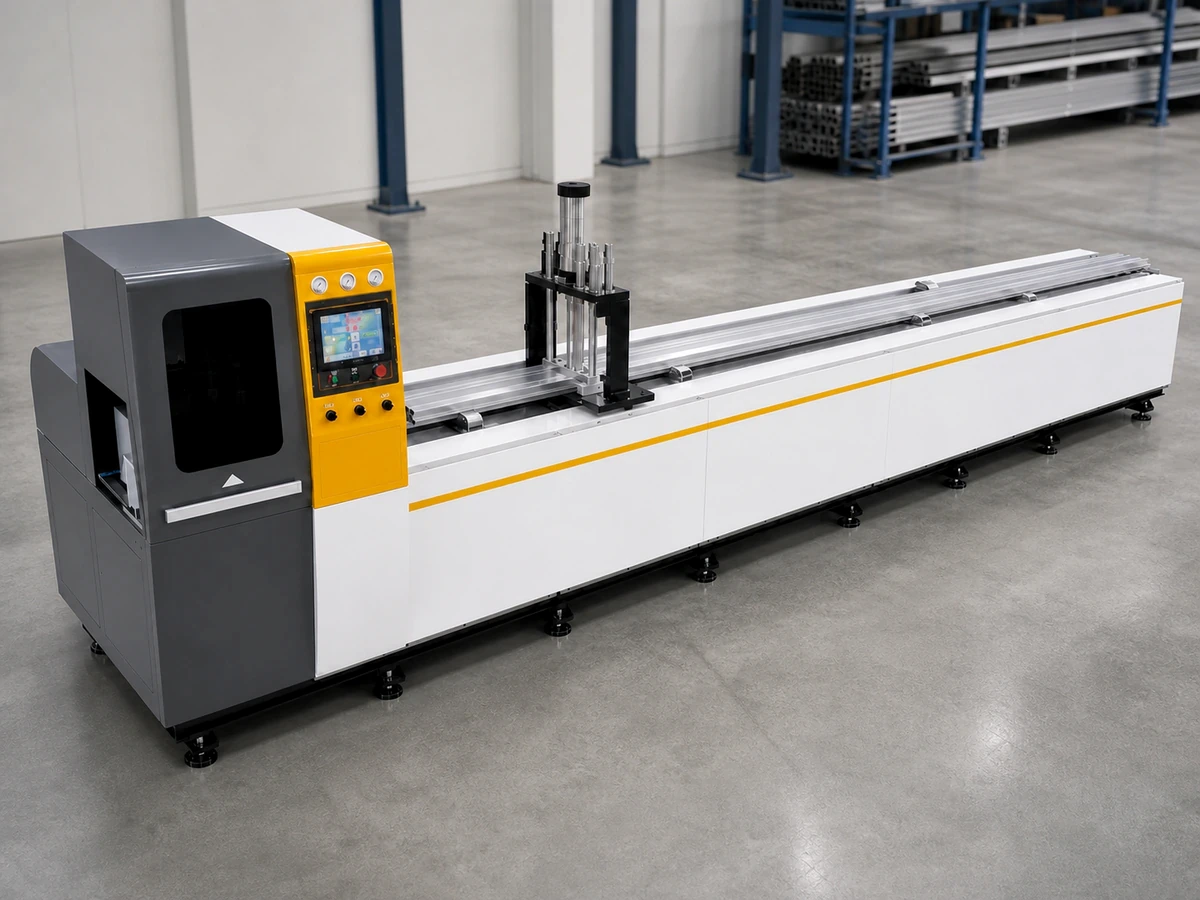
A machine bed, single feed stroke, raw-stock length, maximum finished-part length and supported discharge length are different measurements. Request a dimensioned configuration drawing that labels each one. Check where a full bar arrives, where it rests before and after the cut, what section of it is positively positioned, and where a finished piece can be removed without disturbing the next cut. Do not turn an advertised feed-travel number into a finished-part tolerance. JiurunCut’s CNC cutting-machine overview similarly asks buyers to confirm the final capacity, fixture and process against the real profile and drawing.
Build a job portfolio before judging the bed
For each recurring job family, record the released cross-section, material and surface condition, incoming bar length range, approved orientation, finished lengths, quantities, angle requirements and drawing-critical cut features. Separate a rare maximum-size part from the orders that actually occupy the saw. Include rejected or bowed stock rules and the disposition of remainders. A quote sized only around the largest nominal bar may still leave the common mixed-order workflow awkward.
Identify the datum used to position each profile and to measure the accepted part. Record whether fragile faces can touch guides, rollers or clamps. A long support surface does not establish that a hollow or asymmetric profile remains stable at the blade. The Aluminum Extruders Council notes that extrusion cutting needs to accommodate different cuts, lengths and tolerances, and that deburring or other fabrication may remain downstream (cutting and forming overview). Use the released part requirements to define those boundaries rather than assuming the saw completes the customer component.
Trace one full bar through both proposed routes
Walk the actual material movement from storage to the machine. Who brings the bar, how is it presented, and where can a waiting bar stand while the previous order is removed? Show the feed approach on a site plan with columns, crossings, aisles, neighboring equipment and the operator’s working position. Include the longest normally accepted input as well as a short remnant. The infeed-layout guide covers the shared-aisle check in more detail; this purchase comparison needs the resulting layout for both alternatives.
At the machine, identify support contact, guides, clamps, guard openings, the cutting zone and any controlled transition between them. Ask the supplier to identify which components are included in the quoted configuration and which your site must provide. Confirm access for loading, jam response, adjustment and routine service through the responsible safety review. OSHA’s machine-guarding overview distinguishes the point of operation, power transmission and controls; a layout review should cover the actual guarded machine and material route, not infer safety from bed length.
Follow the cut part and remainder out
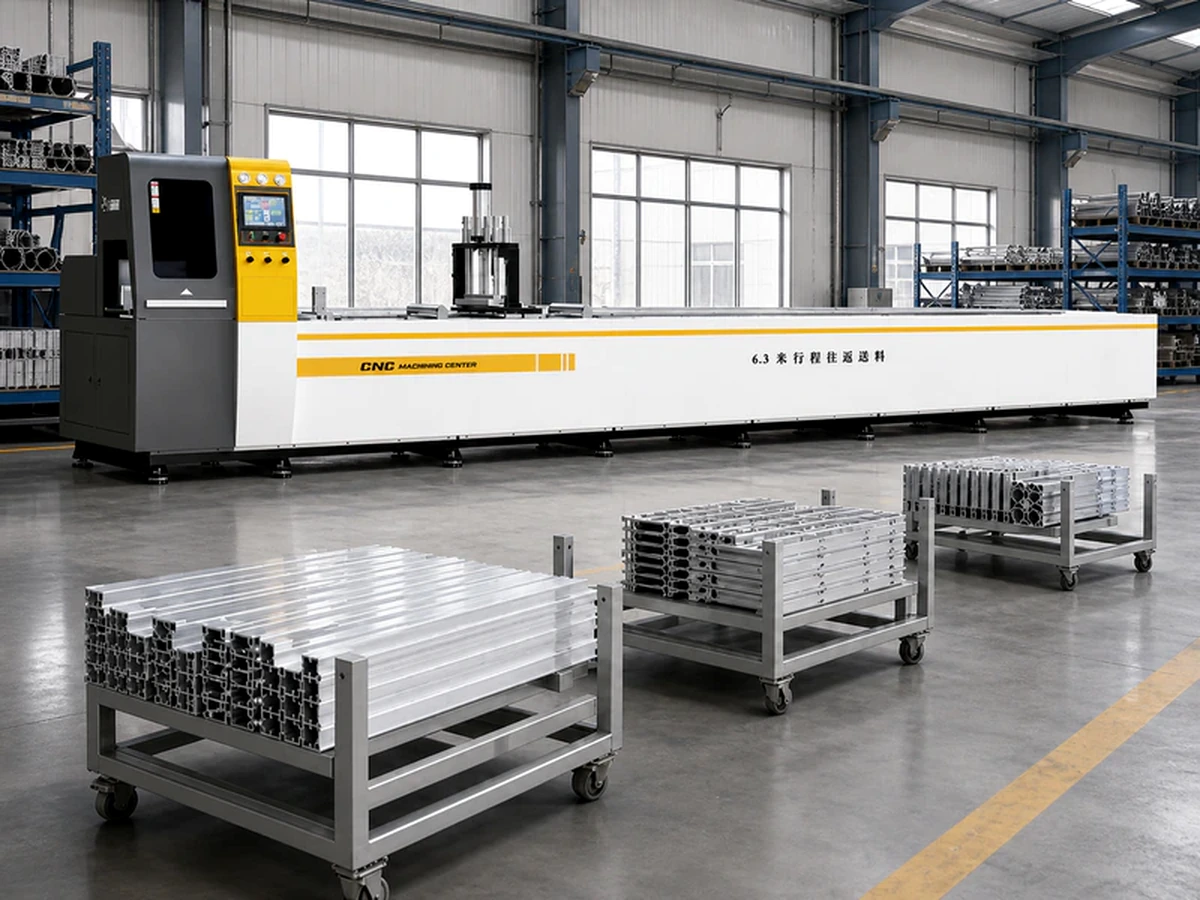
A long bed can simplify one part of bar presentation while leaving collection to an operator or separate receiver. Specify the shortest and longest accepted parts, where they land, how cut pieces are identified, and who removes them. Record the remaining stock after each cut: can it be held for another programmed part, is it returned to storage, or is it segregated as an offcut? Ask for the physical route and ownership of any rack, conveyor or buffer rather than treating a nearby cart in a photo as included equipment.
For a compact saw, include every external support and transfer device needed to meet the same receiving condition. For a long-bed saw, include the space and labor needed to replenish and clear it. Compare both at the point where correctly identified parts are ready for the next operation, not at the instant the blade leaves the material. If the next operation requires a clean or protected surface, define that handoff separately.
Test accepted output, not an isolated stroke
Agree a representative trial for each alternative before accepting a performance claim. Use the same released profile families and drawing revisions. Include a routine job, a difficult contact or support case, a long input and a realistic change between two cut lists. Record the installed fixture, blade, guarding state, operator tasks and all support equipment. If one proposal is tested with extra handling that is absent from its price, correct the comparison before deciding.
Count only parts that pass the agreed inspection. Measure finished lengths from the approved datum and inspect cut faces, visible contact marks and fit features where specified. Record setup pieces and rejected cuts separately. Observe the elapsed route: retrieving and loading stock, setting and verifying the job, cutting, clearing pieces, checking samples and moving accepted output. This is an observed trial, not a promise of continuous production rate. The full-stock trial discussion explains why a short offcut cannot alone demonstrate full-bar handling.
Where a supplier can only provide a partial demonstration, mark each untested boundary. A successful cut of a short sample may support blade-path feasibility but leave bar presentation, long-stock control, operator involvement and downstream removal unresolved. Define a later site acceptance test for those items rather than silently converting a partial result into a full-machine approval.
Compare installed cost and operating burden at one boundary
Request separate price lines for the saw, infeed and outfeed equipment, guards, fixtures, extraction connections, controls, site utilities, freight, installation, training, spares and acceptance work. Add the site work needed for each option: floor allocation, aisle changes, material staging and maintenance access. Ask who designs and verifies every interface. A compact saw plus a fully engineered handling route may cost more than the saw’s list price suggests; a long-bed offer may also exclude the very loading or receiving task that drives the purchase.
Use a common order mix and planning period to compare operator time, changeovers, handling trips, accepted parts and space consumed. Keep measured trial observations distinct from estimates. Include a fallback for jobs that either option cannot cover. A decision table with three columns—quoted scope, site-supplied work and remaining qualification—often exposes a more important difference than nominal bed length.
Video: general equipment footage only
The video below is from Jiurun Machinery’s YouTube channel and shows general aluminum-cutting equipment and a long infeed arrangement. It is illustrative equipment footage. It does not prove the long-bed machine pictured above, an offered model or option set, your material, a customer trial, safety approval or performance. Confirm each of those points in the actual quotation and witnessed test.
Send a long-bed aluminum saw RFQ that can be answered
Send your profile drawings, real stock-length distribution, approved cut list, part inspection method, expected order mix and a marked site plan. Ask each supplier to return a dimensioned installed layout, an included-equipment list, a material-and-part flow drawing, operator responsibilities and a trial plan for the same accepted output. Request explicit exceptions to every required job family. Contact JiurunCut with that package for a configuration review; the final selection should follow the witnessed route and written scope, not the apparent length of a catalogue machine.