
An aluminum saw infeed layout is a site decision, not just a line on a machine drawing. A long extrusion may fit the quoted roller bed and still require a replenishment move through an aisle used by other material handlers or pedestrians. If a buyer approves the saw from its footprint alone, the first production shift can expose a conflict between the stock rack, the bar’s approach to the feed, the people who replenish it and the route that must stay available for other work. The purchase question is whether a defined, reviewable loading route exists for the actual stock and operating pattern.
This guide helps a buyer prepare a saw request for quotation and site review. It does not prescribe a compliant traffic plan, aisle width, lifting method or machine guard. The plant’s qualified safety and material-handling owners must assess the proposed arrangement under applicable rules and the site’s own procedures. Ask the machine supplier to document its proposed equipment and interface; do not ask it to certify an unseen factory aisle from a brochure photo.
Aluminum saw infeed layout: separate the machine footprint from the loading route
Start with the entire cutting cell: machine, infeed and outfeed, stock rack, cut-piece receiver, chip or service access and the places where an operator actually stands. Then draw the movement of one representative bar from its arrival point into the selected infeed position. Those two drawings answer different questions. A static footprint shows where equipment sits. A loading-route drawing shows where stock, handling equipment and people move while the saw is supplied. A path that looks clear with an empty bed may become occupied while a long profile is turned or transferred.
Mark the actual stock families and their supplied lengths, not only the maximum cut length in a product brochure. Include the longest and most awkward section you expect to receive, the way it arrives, and the quantity that will be staged for a normal run. If several profiles need different support or orientation, draw each route separately. Keep unknown aisle, turning, rack and lifting dimensions open for the site team to measure. A supplier’s nominal feed stroke or cutting capacity does not establish the floor area needed to deliver the stock to that feed.

Follow one bar from receipt to the first cut
Write the physical route in order: delivery or internal supply point, temporary holding, identified stock rack, transfer to the infeed, support on the rollers, entry into the cutting zone and disposition of the first cut piece. Name the person or team responsible at each handoff. A buyer should be able to point to where stock waits when the saw is busy and what distinguishes that waiting stock from material already released to the current job. The route should still make sense when the bar is at its full supplied length, rather than only after a short offcut is removed.
Ask how a profile is presented to the infeed. Does the proposed configuration include a loading rack, transfer device or only a roller bed? What establishes section orientation and the first stable contact before automated feed begins? Which handling devices and supports are part of the quotation, and which are supplied by the plant? Record the actual answer for the chosen machine and the buyer’s profiles. A photograph of a long bar entering a saw helps explain the interface, but it cannot prove that the bar was delivered across your aisle without conflict.
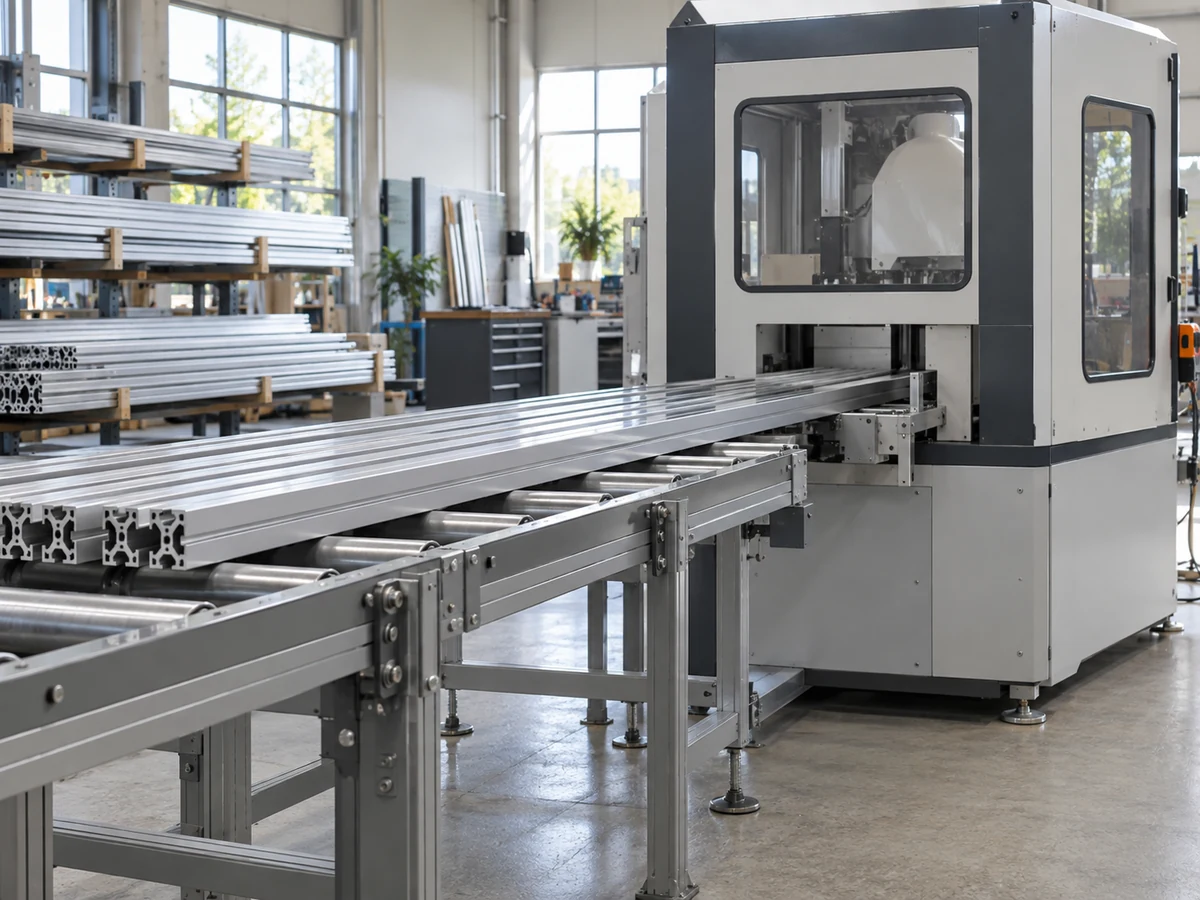
For a multi-profile job, show the change from one section family to another. If stock racks are on the opposite side of a shared aisle, the replenishment frequency matters as much as the one-time installation plan. A route that works for a single demonstration bar may be impractical when operators must replenish a rack repeatedly while other traffic continues. Do not assume that an automatic feed eliminates material-delivery work; ask exactly where the supplier’s responsibility starts and ends.
Check the aisle in three operating states
Routine replenishment. Identify when stock is brought to the saw, how much is moved at once and where the receiving team can pause without blocking an established circulation route. Record the actual handling equipment and its operator’s view, rather than assuming that every delivery is made by hand or every shift uses the same vehicle. The plant’s traffic plan determines the allowed movement and controls.
Changeover. A different profile, stock length or order sequence may change where a bar is staged and how it approaches the feed. Trace the old material out and the new material in. If the infeed’s approach crosses a shared aisle, decide who owns the crossing decision before the saw supplier is asked to promise a cycle time. Include identification of the new stock and the destination of unused old stock so that a changeover is not reduced to a machine-setting demonstration.
Interruption and recovery. A stopped saw, full outfeed or held quality lot may leave long stock on the infeed or in a temporary position. Ask what space and access remain while the cell is paused, who may move the material and who authorizes restart. Do not count a stopped machine as an empty aisle. Likewise, an emergency or maintenance route is a separate site requirement that must be reviewed by the appropriate owner, not inferred from an equipment rendering.
Give the traffic and guarding decisions to the right owners
The U.S. OSHA pedestrian-traffic guidance for powered industrial trucks identifies obstructions, visibility, aisle marking and separation of vehicle and pedestrian movements as workplace issues. OSHA’s machine-guarding considerations also include the way material is fed and ejected. These sources explain why the site’s route and machine interface both matter; they do not supply a universal dimension or approve this proposed layout. A plant outside the United States should apply its own jurisdiction and site requirements.
Ask the site safety lead and material-handling owner to review the proposed stock movement, interfaces with other traffic, access at the machine and any proposed physical or procedural controls. Ask the saw supplier for the actual machine layout, loading sequence, relevant guarding information and the parts of the feed it supplies. Record unresolved interfaces in the RFQ instead of silently assigning them to the machine vendor or the plant. Do not bypass or assume a guard condition to make a stock route appear feasible.
Witness the route without turning a demonstration into a safety claim
Before placing the order, use a scaled site sketch with measured equipment and stock envelopes, then review it with the people who operate the aisle. Where the site permits a demonstration, have the qualified team plan a controlled walkthrough using representative stock or a suitable mock-up. The purpose is to discover physical conflicts and unclear responsibilities, not to create an unsafe crossing for the sake of a sales video. Photograph or record the agreed locations, bar orientation, support points and handoffs. Tie each observation to a drawing revision and the stock length used.
Separate three outcomes on the trial sheet: the bar can be delivered to the proposed infeed; the saw can support and cut the representative part to the agreed inspection criteria; and the site team has approved the overall movement under its own process. Passing one does not automatically pass the others. The first can fail even if a short sample cuts well. The second can fail even if the traffic route is clear. The third cannot be certified by the vendor’s generic photograph or by a single uncontrolled demonstration.

Request a test with the longest representative bar as well as a shorter common job. Our stock-length trial guide explains why a short offcut cannot stand in for full-bar feeding. For this article, add the upstream question: how does the full bar reach the infeed in the first place? Record the answer before using the saw trial to compare supplier quotations.
Compare complete alternatives at the same production boundary
If the proposed location causes a conflict, compare real alternatives rather than forcing one drawing to work. The plant might change the saw location, change the material-delivery point, alter the staging method, modify the infeed arrangement within a supplier-approved configuration, or purchase prepared cut parts instead of cutting on that site. Each option has different equipment, floor, handling, staffing and acceptance costs. Do not assume that a conveyor or automatic loader solves a traffic problem merely because it reduces one manual transfer; ask where stock arrives and how the added equipment changes the footprint.
Quote each feasible route to the same accepted output and operating pattern. Include the machine and infeed actually supplied, stock rack or transfer equipment, site work, handling labor, changeover, inspection, traffic controls determined by the site team, and any outsourcing or transport. Keep undecided scope in an open-item column. A cheaper saw quotation can be the more expensive production route if essential material movement is excluded. Conversely, a fully automatic infeed may be unnecessary where a controlled, low-frequency delivery route already satisfies the real job.
Send an RFQ that exposes the missing interface
- Stock and orders: drawings, supplied profile lengths and forms, longest representative bar, order mix, replenishment frequency and changeover pattern.
- Site drawing: measured saw location, proposed infeed and outfeed, stock racks, delivery point, established aisle and access routes, with revision and owner.
- Supplier scope: machine, feed rollers, loading rack or transfer device, support, guards, controls and the exact handoff where plant-provided equipment begins.
- Movement record: who supplies and receives each bar, where it pauses, how a changed job is identified, and what happens on interruption.
- Acceptance evidence: site-owner review of the route, representative full-bar walkthrough where appropriate, separate cutting trial and a list of unresolved items.
- Commercial basis: quote the complete accepted-part route at the expected volume, including site work and the material-handling resources outside the saw price.
Do not replace these records with a single statement that the saw has enough stroke or that the factory has “plenty of space.” The buyer needs a machine proposal that can be placed into a real supply route, and each site owner needs enough information to make its own decision.
Video: general saw and feed context
The following video is from the Jiurun Machinery YouTube channel. It shows general aluminum-saw and feed equipment footage for visual context only. It does not show this buyer’s aisle, material route, stock, machine configuration, customer, controlled trial, safety approval or performance result.
Decide the route before ordering
The purchase decision is stronger when the bar’s path, the machine’s interface and the site’s traffic decision are recorded separately. Send JiurunCut the representative profile drawing, supplied stock lengths, cut list, proposed site sketch and the equipment scope you want quoted through the contact page. We can discuss a cutting and infeed configuration for the actual job and the evidence a trial should collect. Your plant remains responsible for approving its material-handling and pedestrian routes under applicable requirements.