
Can you buy an aluminum saw before final drawings are released? You can request a conditional quote if the inquiry separates a provisional machine envelope from requirements that cannot be accepted until the drawing is released. The useful outcome at this stage is a bounded comparison of possible machine routes, assumptions and decisions. It is not a promise that an untested saw will meet a final part specification that does not yet exist.
This guide is for a buyer who knows the likely aluminum stock family and production objective but has an unreleased section, length datum, tolerance, cut-end requirement or part mix. It explains what to send now, what a supplier can reasonably discuss, and which claims must wait for representative stock, an approved drawing and a witnessed trial. A conditional RFQ can shorten the later decision if every open item has an owner and a decision date.
An aluminum saw before final drawings: three decision gates
Gate 1 — envelope review. Describe the expected stock type, outside-size range, longest stock, approximate finished-length range, likely end form, preferred automation level and site constraints. Ask which machine families merit investigation and which inputs are missing. At this gate, discuss physical fit and process route, not guaranteed finished-part results.
Gate 2 — conditional quotation. Send a revision-identified drawing or marked preliminary sketch, a current stock sample if available, a part-family mix and an assumption register. Require the supplier to state what is included in the base configuration, what requires a different fixture or option, and what would change the price, lead-time estimate or trial plan. Label the offer conditional until the open items close.
Gate 3 — drawing-locked verification. Release the controlled finished-part drawing and stock specification, confirm the actual machine configuration, and agree on representative trial material and measurement methods. Only then can the buyer compare observed trial results against the final acceptance criteria. The quotation, trial record and purchase release should identify the same revisions.
The gates are decision tools, not a claim about a particular Jiurun model or a substitute for the buyer’s purchasing agreement. If a critical dimension, stock section or datum can still move, the relevant performance claim remains open.
Freeze the stable machine envelope first
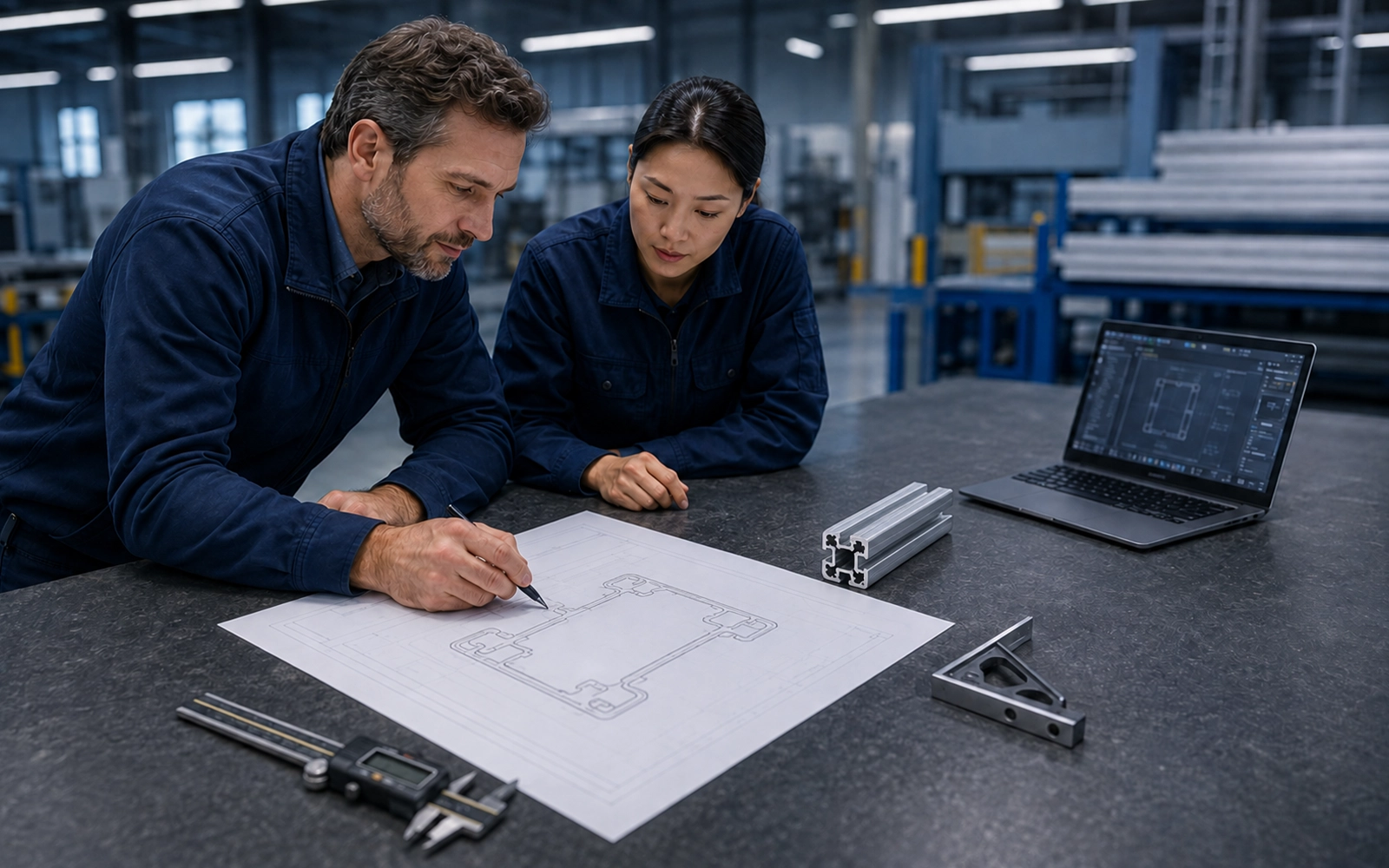
Start with information unlikely to change when the part drawing is finalized. For an aluminum extrusion application, that may include whether the work is primarily straight crosscuts or angled ends; the approximate maximum outside envelope of incoming stock; stock presentation as individual lengths or batches; available floor space; utilities; guarding expectations; and whether the operator will run one family or frequent changeovers. Give ranges rather than a single best-case sample when the production mix is uncertain.
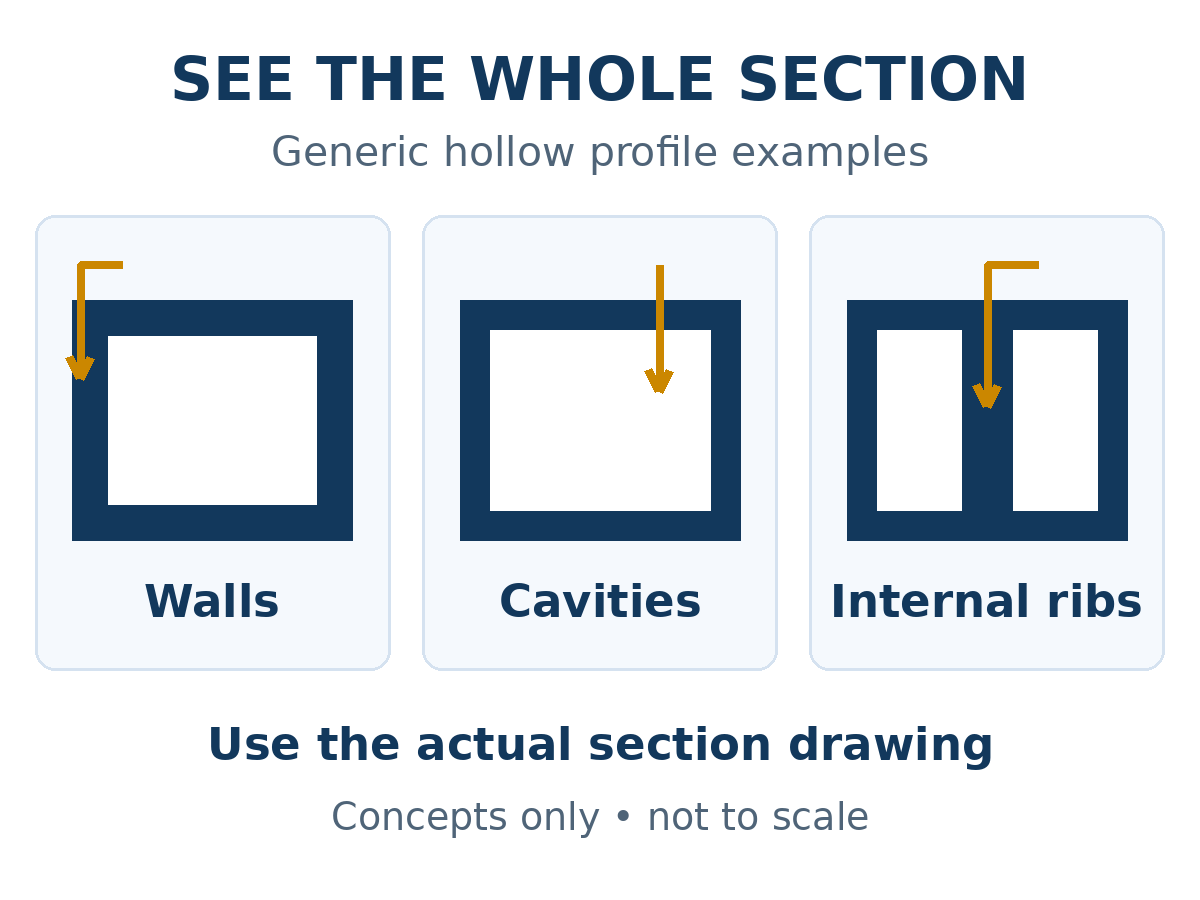
Then separate the finished-part specification from the machine’s possible travel and handling envelope. A saw may physically accept a profile while its clamp contacts, supports, blade path, end datum or part discharge still require engineering. An early fit review should therefore record the stock’s wall, cavity and rib arrangement and any surfaces that must not be marked. Outside width and height alone are not a complete section definition.
The Aluminum Association describes dedicated guidance for preparing extrusion profile drawings and understanding extrusion tolerances. Use the actual supplier drawing and applicable stock standard for the project; do not turn a generic illustration or a nominal catalog envelope into a promise for a particular profile. See the Association’s extrusion drafting and tolerance publications.
Build an assumption register that can survive a revision
A conditional RFQ is useful only when the assumptions are visible to both sides. Put one row per open item in the inquiry and ask the supplier to return the same register with its offer. The point is to expose a change before it silently becomes a machine or acceptance disagreement.
| Open item | Provisional input for the RFQ | Evidence needed before release | Likely purchasing consequence |
|---|---|---|---|
| Stock section and temper | Expected outside envelope, alloy/temper if known, hollow/solid section and sample revision | Released section drawing plus representative incoming stock | Clamp design, support, blade choice or even machine-route review |
| Finished-length definition | Proposed datum and approximate range | Released drawing showing the measured endpoints and tolerances | Stop, feed, fixture and inspection-method changes |
| End form and cut-face condition | Square or angled end, handling and downstream operation | Approved end geometry, finish requirement and example acceptance images if needed | Angle capability, fixturing, blade and deburring scope |
| Volume and part mix | Scenario ranges, number of changeovers and work pattern | Approved production plan, not a sales forecast treated as an order | Automation level, outfeed and labor assumptions |
| Site and handover | Known power, air, space and material-flow constraints | Site survey and agreed installation boundary | Auxiliary equipment and commissioning scope |
Keep the source and date beside each row. If the buyer changes a drawing, it should be possible to answer: Which quoted assumption changed? Which machine interface is affected? Which trial result, if any, remains valid? This is more useful than a vague statement that the supplier will “adjust later.”
Do not confuse a profile sketch with a production-ready stock definition
A sketch may show the profile’s outside rectangle while omitting wall thickness, internal ribs, open slots, bow, finish or the face that can take clamping load. Those omissions matter because support and clamp contact must be assessed on the real incoming stock. Ask for the complete section, stock-length range, any protected surfaces and a labeled sample. If the extrusion die or stock supplier is also changing, identify that as a separate dependency.
For example, a preliminary hollow profile may later gain a central rib. The saw family might still be suitable, yet a planned clamp pad or cut support could now contact a different surface. The correct response is to reopen that interface for review. The simple hollow-section diagram in this article is only a conceptual guide to asking about walls, cavities and ribs; it is not a customer drawing, a Jiurun clamp design or test evidence.
Put finished-length and inspection language on hold until the drawing is controlled
“Cut to length” is incomplete when the drawing has not settled the measurement endpoints. A mitered member can have different long-point, short-point and centerline spans. A straight part can still have an ambiguous datum if a later operation removes an end or if a protective feature affects contact. Decide which dimension the buyer will accept, where it is measured, and how the part is positioned during inspection.
Also distinguish commanded feed motion from measured finished-part length. A machine’s feed positioning statement does not establish the accuracy of a cut part across a new profile, blade, fixture, stock condition and measurement method. Record the required finished dimension, tolerance, sampling method and measuring tool as separate entries. NIST’s discussion of conformity decisions and measurement uncertainty is a useful reminder that the acceptance rule itself should be agreed, rather than inferred from a single reading.
If final tolerance or inspection method is unknown, say so in the RFQ. Request a feasibility discussion and a later trial, not a fabricated precision guarantee. The same principle applies to cut-face appearance, burrs, squareness and any downstream assembly fit.
Ask the supplier for a conditional machine route, not a magic model number
Ask for the process route that follows from the present mix. For a low-volume family with frequent manual changeovers, a semi-automatic route may deserve comparison. For repeated programmed lengths and controlled part flow, a CNC feed route may deserve comparison. The choice depends on the actual section, length range, changeover frequency, operator steps, outfeed and acceptance method. It cannot be made from a headline throughput claim alone.
Request the base machine description and a separate list of proposed fixtures, stock supports, outfeed, guarding interfaces, extraction or lubrication arrangements, software, spares and installation work. A supplier should mark each item as included, optional, buyer-provided or unresolved. If the final section could change the clamp concept, the quote should identify that engineering assumption. Do not combine dimensions or capabilities from different catalog models into a fictional machine.
Video context: The accompanying video from the Jiurun Machinery YouTube channel shows general views of a JR-455CNC aluminum saw and parts of its feed and clamp assembly. It is an equipment illustration only. It does not document the profile, final drawing, configuration, customer, trial, cut quality or performance of the conditional RFQ example here.
Design a trial that will answer the final buying question
Before asking for a performance commitment, agree on what the trial will receive and measure. The sample set should represent the released section and relevant part families, including a difficult end or short part if those drive the purchase. Identify the incoming stock source, section revision, alloy/temper where relevant, surface condition, stock length and any known straightness issue. A substitute profile can be useful for observing basic machine operation, but its result cannot silently stand in for the final material and geometry.
Write the acceptance plan around observable outputs: the exact part dimension and datum, cut-end or surface criterion, sample count, measurement instrument and method, repeatability question, changeover steps, and the recorded machine setup. Record failures and retests against the same criteria. If the drawing changes after a trial, review whether the change affects the blade path, clamp/support interface, datum, part handling or inspection. Retest affected claims rather than declaring every old observation valid or discarding all evidence automatically.
Make the quote and schedule conditional in plain language
Ask the supplier to show the price basis and validity period, scope boundary, assumed stock/drawing revisions, tooling and fixture allowances, commissioning responsibility and the point at which any lead-time estimate starts. For an unreleased part, identify a technical release milestone in the buying schedule. A date for an indicative quote is not the same as a committed delivery date for a final configured machine.
Both sides should agree on how a changed drawing is reviewed before a revised configuration, price or schedule is accepted. The buyer can ask for an option priced separately when one likely design branch would need extra hardware. This makes the decision visible without paying for every hypothetical feature in the base offer. The final commercial terms belong in the parties’ actual agreement; this article is a practical RFQ workflow, not legal advice.
A worked example: hollow extrusion with an unsettled cut datum
Suppose a buyer expects to cut a hollow aluminum frame member, but the internal rib layout and angled-end length datum are still under design review. The buyer can send an outside-envelope range, likely stock lengths, a clearly marked preliminary section, current physical sample, expected part mix and site information. The supplier can discuss saw families and note that clamp contact, fixture design and measured part-length acceptance remain conditional.
The next design release adds a rib and defines the finished length from the long point of a miter to a reference hole made downstream. Those changes should trigger a fresh fixture/datum review and a trial plan that measures the released part consistently. The initial machine-envelope discussion may still be valuable. It does not convert the preliminary sketch or generic equipment footage into evidence of the final result. This example is hypothetical and contains no customer or performance data.
Send a compact package that lets the supplier answer well
- A revision-labeled drawing or preliminary sketch, with every unapproved feature marked.
- The complete expected stock section, stock-length range, alloy/temper and protected surfaces when known.
- A representative physical sample or a clear plan for obtaining one, labeled to its source and revision.
- Finished-part family, likely volume scenarios, changeovers, cut-end needs and downstream operation.
- Site utilities, floor-space and material-flow boundaries.
- An assumption register with owners and target dates for drawing and sample release.
- A request for the base configuration, open engineering decisions, optional items and a drawing-locked trial proposal.
Ask the supplier to return its answers in the same structure. A good response can say “unknown until sample trial” where that is true. It should not hide uncertainty behind an unqualified number.
When should you wait instead?
Pause a purchase release when the unresolved item could change the basic machine route or safety boundary: the incoming stock envelope is unknown, the cut geometry may move beyond the candidate process, no realistic clamping surface has been identified, or the buyer cannot yet define how a part will be accepted. Continue the engineering conversation, but do not turn an indicative budget into final acceptance language.
Once the drawing, stock and acceptance method are controlled, compare the revised offers on the same scope and run the relevant trial. The practical aim is to buy the right aluminum saw for the real part family, while preserving a clear trail of what was known at each decision gate.
Request a conditional aluminum saw review
If your drawing is still moving, send Jiurun the current revision, marked open items, representative stock information and expected production mix. Ask for a conditional machine-envelope review and a list of evidence needed before any finished-part claim. When the controlled drawing and sample are ready, use them to agree on the exact configuration and trial acceptance plan before releasing the order.