
Buying a demonstration aluminum saw can be a sensible option only when the offer names the exact machine being sold and the buyer can evaluate that unit against the intended work. A showroom or trade-show demonstration proves that one run occurred; it does not establish the machine’s service history, present condition, included options, or acceptance after delivery. The price comparison is meaningful only after those differences are written into the quotation. This guide treats an ex-demonstration unit as a conditional purchase scenario; it does not state that JiurunCut currently has such a unit for sale.
Ask five questions in order: What is the unit’s identity and history? Is the as-sold machine complete and safe for the proposed use? Can that unit cut a representative part to the released criteria? What service, documentation and warranty will follow it? What is the delivered, installed and accepted cost compared with a new unit? If a seller cannot answer the first two, a low asking price is not yet a comparable offer.
1. Identify the actual unit, not only its model family
Record the maker, model, serial number or other stable identity, build or commissioning date if documented, current location and owner, control version, and every installed option that matters to your cutting route. Ask whether the same unit in the photograph, quotation, trial and delivery document is the unit you would receive. A model brochure can describe a family; it cannot prove which feeder, clamp, length stop, outfeed support, guard or software package is fitted to this particular machine. Mark any promised addition as a change to the quoted unit, with an installation and verification step.
Request a use history that the seller can substantiate: exhibition or showroom periods, sample runs, training use, relocations, repairs, blade or fixture changes, and any known fault or open service item. Hour-meter or cycle-counter readings can be useful where fitted, but they do not stand alone: ask what they count, whether the control was replaced, and what supporting service records exist. If no reliable history is available, label it unknown and price and acceptance-plan the uncertainty rather than inventing a low-hours claim.
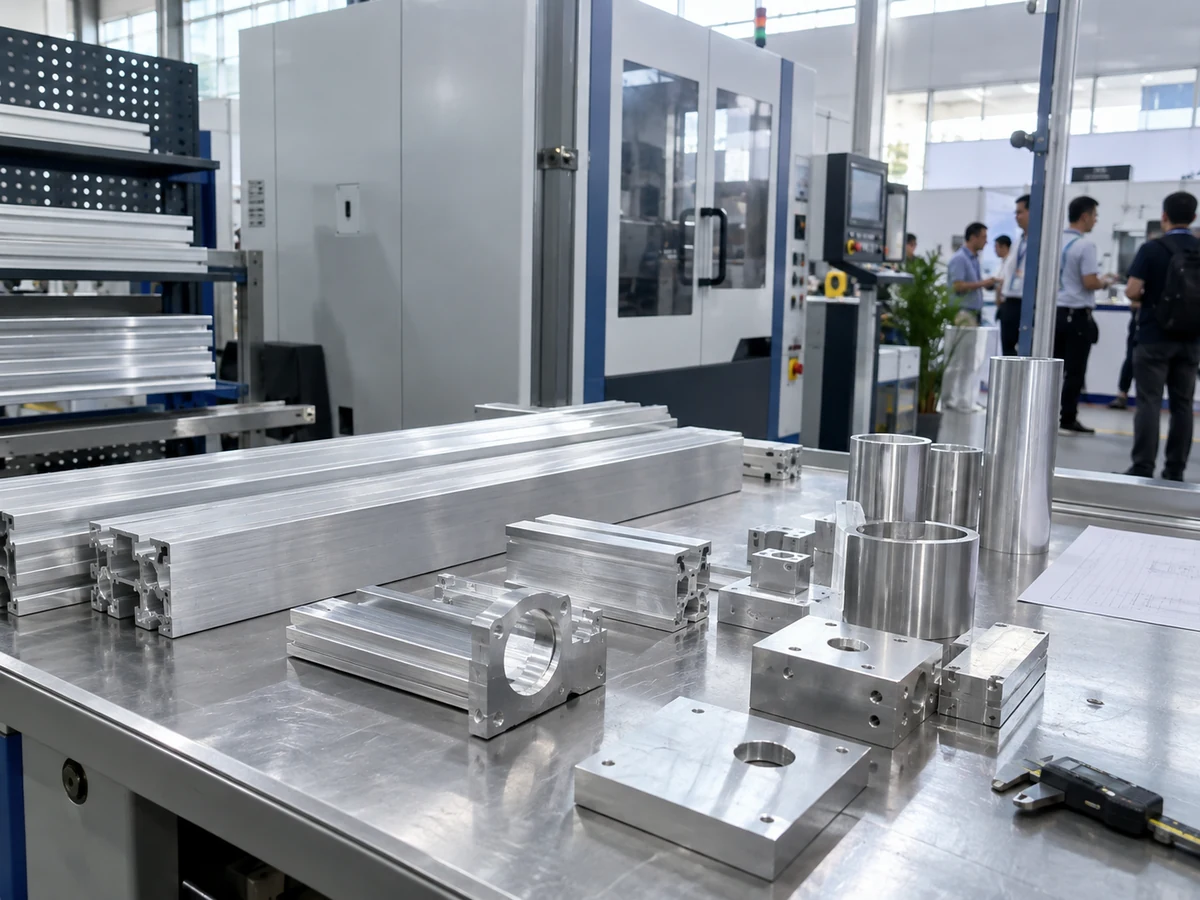
For context, the WordPress-library exhibition image below shows an aluminum sample display and machinery in a demonstration setting. It illustrates why a visual display can start a conversation; it does not document the history or condition of an offered sale unit. If your interest began with a show demonstration, our trade-show follow-up guide covers how to turn that first impression into a separate trial and quotation request.
2. Inspect condition and the complete safety boundary
Inspect the machine as it will be handed over, with the seller’s trained person controlling energy isolation and safe access. Check the visible frame and enclosure, guarding and interlocks, emergency stops, labels, cables and pneumatic or hydraulic connections where fitted, stock supports, clamp contact surfaces, chip handling and lubrication points. Look for damage, missing components, improvised wiring, fluid leaks, corrosion, loose fixings and wear that can change the cut or create a maintenance problem. Do not defeat a guard to complete a demonstration. Record defects as a priced repair and retest obligation, or a reason to stop the purchase evaluation.
The UK Health and Safety Executive’s second-hand equipment guidance emphasizes safe supply and adequate use information for equipment used at work in its jurisdiction. It is a useful prompt to ask about safeguards and instructions, but it is not a universal legal certificate for a machine in another country. Have the buyer’s competent safety team check the rules that apply at the installation site and the actual as-delivered machine.

Guard condition needs a closer record than a full-machine photo. Ask the seller to demonstrate intended opening, closing, reset and restart behavior under the approved procedure, and to identify any replacement panel, hinge or switch included in the offer. The image below shows a guard area on a different documented machine view; it cannot prove that a particular unit’s safety devices work. Keep this safety check separate from cutting accuracy and commercial acceptance.

3. Trial the named unit with the intended part route
Before comparing prices, request a trial on the serial-numbered unit rather than a nearby new example. Send a controlled drawing and revision, stock alloy and temper, section and finish, cut lengths and angles, sample count, acceptable burr and visible-face criteria, and the measurement method. State whether the buyer or seller supplies the blade, clamp pads and stock. If the specified material is unavailable, describe the substitute and limit the conclusion to what it can show. Feed-position repeatability is not the same as finished-part dimensional accuracy; measure the finished parts to the released drawing.
Observe a realistic sequence, not one attractive first cut. Include loading and support, clamping, cutting, part removal, scrap separation, restart after a normal stop, and a changeover if the intended order mix needs it. Record the sample identifiers, machine setup, blade identity, measuring instrument, raw readings, rejected pieces, and any intervention between parts. A condition issue may appear only after several cycles or when the operator changes stock. If the seller repairs or reconfigures the machine after this trial, identify what changed and repeat the affected checks.
Keep factory and site evidence distinct. A trial at the seller’s workshop can support a bounded part and machine claim; it does not verify the buyer’s utilities, footprint, floor, material handling or staff training after installation. The factory-versus-site acceptance guide helps assign each requirement to the right test. If a demonstrated unit will be dismantled, transported and reassembled, reserve a site acceptance step before final release.
4. Define the service and warranty package for this unit
Ask for the machine and electrical manuals, as-built drawings where available, option list, control software access and backup, program handover, maintenance schedule, spare-parts identifiers and service contact. A quick showroom start is poor evidence that the buyer can operate and maintain the unit months later. Confirm what training, installation, remote support and on-site service are included, who pays travel, and which parts or consumables are excluded. If a critical component is obsolete or an option lacks support, include the remedy in the purchase decision rather than assuming the new-machine service package applies.
Write warranty terms for the identified unit: start event, duration, covered assemblies, exclusions, remedy process, transport and labor responsibilities, and the effect of prior use or refurbishment. Do not assume the warranty is the same as a new machine’s. Ask whether any promised refurbishment occurs before the witnessed trial or afterward, and what acceptance evidence closes that work. A lower price with uncertain repair responsibility can be more expensive than a fully specified new-machine quote.
5. Compare the complete delivered decision
Put the ex-demonstration and new-machine offers on one comparison sheet. For each, list the exact configuration, included blade and fixtures, infeed and outfeed, guarding, control and software, trial work, repairs or upgrades, packaging, freight, installation, commissioning, training, warranty and payment milestones. Add the time until the unit is usable, not merely the promised dispatch date. A price difference is valuable only if the demo unit meets the same required output and risk boundary at the buyer’s site.
Make the decision conditional where necessary: buy the named unit only if the missing records arrive, defects are corrected, a representative trial passes, and site acceptance remains available. If the seller cannot hold the unit while those steps occur, document the commercial risk rather than signing against an unspecified example. The arrival check should reconcile the serial number, options and damage before installation; our delivery-check guide covers that later handover.
Equipment video: a general demonstration only
This video from the Jiurun Machinery channel shows a JR-455CNC automatic saw in a general feed-cut sequence. It is not footage of a demonstration machine being offered for sale, a specific serial-numbered unit, a customer’s stock, a safety inspection, or a verified trial or performance result for this article.
What to ask JiurunCut
Send your released part drawing, stock form and finish, target cut mix, required output and site constraints. Ask for a written machine and option proposal and a representative trial plan. If an ex-demonstration unit is actually offered, request its identity, history, as-sold configuration, repair list, warranty and acceptance terms in that same comparison. We can then discuss the proposed cutting route without treating a general equipment video or display photo as proof of the unit you would receive.