
Choose your multi-angle cutting sequence around what assembly needs next. Group compatible same-angle parts when loose members can wait for the remaining families. Consider small mixed-angle frame sets when assembly needs complete sets early. Ask the supplier to compare both plans on your approved order and identify the operator work each requires.
What does assembly need first?
Tell us whether you need loose member batches or complete frame sets. Send a drawing or a clear photo to start the machine discussion.
On this page
What should reach assembly first?
Start with the next operation. Does the team build frames as members arrive, or collect a full order before assembly begins? Does it need an early frame for an agreed fit check? The answer gives the cutting plan a practical purpose.
A tray of accepted side members may be useful stock, but the frame cannot move to its assembly stage until the other required members are ready. Ask production and assembly to agree which result matters: completed member groups, a usable first set, or the whole order ready for handoff.
Keep the approved component definitions unchanged while comparing the sequence. Our aluminum furniture frame guide covers the separate cut-list and connector information.
What belongs in an angle-by-angle batch?
In this planning approach, the workshop groups parts that can use a compatible approved cutting arrangement. It finishes that group before moving to another angle family. Ask whether this reduces repeated setup work on the equipment being proposed.
Matching one angle value is insufficient. Compare the complete end combination, profile identity, orientation and required supporting arrangement. Opposite-handed members may need different steps even when a drawing shows the same angle. The supplier should explain which rows can genuinely run together.
Angle-group production is worth reviewing when assembly can wait and the workshop has a clear place for the loose members. Ask how each group will be collected and reunited with the rest of its frame. Include that sorting work in the comparison.
For the machine discussion, review the JR-550CNC-CORNER automatic multi-angle aluminum cutting machine. Confirm the proposed arrangement for your parts before choosing either sequence.

When do small complete frame sets make sense?
Here, the plan follows a frame set or a small group of sets through its different member families. That may allow assembly to receive the needed combination before every loose member in the full order has been produced. Confirm whether the proposed workflow can achieve that result.
Mixed-angle sets are worth comparing when assembly is waiting for complete combinations, storage for loose groups is limited, or the first set has an agreed review purpose. Ask what angle transitions, program selections, profile turning or other operator actions this plan introduces.
Small sets need not mean cutting each frame separately. Ask whether a manageable sub-batch can supply complete combinations while using compatible member groups within it. For set contents and the release stage, use our aluminum frame kits guide.
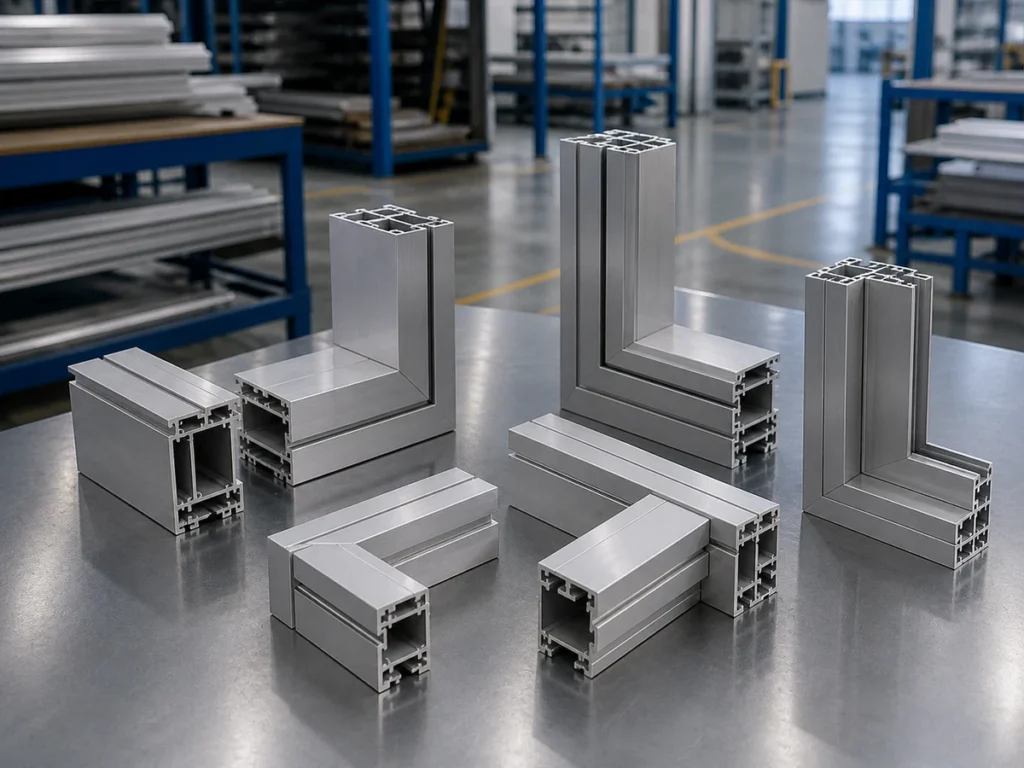
One mixed-angle order, two production plans
Illustrative scenario: A factory is preparing a repeated enclosure-frame order. Its part list includes side members and angled joining members with different end directions. All required cutting positions still need confirmation for the offered machine. Assembly wants a complete set for its agreed fit review before committing the rest of the order to the next stage.
Angle-group plan: Finish the compatible side-member group, then the joining-member groups. The workshop collects loose families separately. Assembly receives its first complete set only after every required family has supplied accepted members.
Set-first plan: Prepare the members needed for the initial review set using a supplier-approved sequence. After the review, the factory can discuss whether to continue with small sets or switch to larger compatible groups for the remaining work.
Compare each multi-angle cutting sequence by its actual steps and the point when assembly can begin. Ask the supplier to demonstrate both plans with your parts before choosing the workflow.
Watch: JR-550CNC Fully Automatic Angle Saw
Jiurun’s own angle-saw video is a general reference for your discussion. Ask for a separate review of your order on the quoted JR-550CNC-CORNER configuration.
Ask us to compare your two plans
Share the part list and say which set assembly needs first. Mark any later operations or missing drawing details.
Compare your multi-angle cutting sequence with the supplier
Use an actual mixed-angle order from your factory. Ask the supplier to show a feasible angle-group sequence and, where supported, a set-first sequence using the same part requirements. Follow the work from the prepared order to collected parts.
- Order preparation: Who arranges the rows and enters or selects each job?
- Between families: What changes automatically, and which adjustments or repositioning remain manual?
- Part collection: Who identifies the members and places them into the required groups or sets?
- First complete set: When are all required members available with the agreed checks completed?
Write down what remains manual in each multi-angle cutting sequence. Automatic feeding and cutting do not describe who rearranges an order, labels parts or forms a kit. If cut-list import, resequencing or automatic identification is proposed, ask for that specific function to be demonstrated and included in the quotation.
Keep the comparison focused on the sequence. Use our saw changeover guide for agreed timing boundaries and our cutting traceability guide for preserving identity through split groups.
What should the quotation say about the sequence?
Keep the exact model and quoted equipment with the agreed multi-angle cutting sequence. Ask for the sequence review to identify:
- The member families and approved arrangement covered by the proposal
- The supported order-entry and job-selection method
- The operator tasks between families and at collection
- Any separately quoted identification, collection or software equipment
- The outstanding checks before the order can be released
The best starting plan is the one your cutting and assembly teams can use under the confirmed conditions. The broader automatic multi-angle machine buying guide covers the wider equipment decision.
Sources and scope
Jiurun’s machinery catalog, physical PDF page 13, identifies JR-550CNC-CORNER and lists automatic feeding, positioning and cutting. This supplies configuration context. The sequence comparison and scenario are buyer-planning guidance; confirm the current equipment and order workflow with the supplier.
Discuss your multi-angle cutting sequence with JiurunCut
Send the information you have and explain what assembly is waiting for. Ask about the proposed machine, order walk-through and equipment scope.