
Aluminum saw clamping should be confirmed against the actual profile, its orientation and the finished-part requirements. A quote that says “pneumatic clamps” still leaves important questions unanswered. Identify which faces may be contacted, how the profile is located, what equipment is included and which representative parts will be reviewed before acceptance.
This guide helps purchasing and engineering teams turn those questions into a clear scope. It is a specification review, rather than a procedure for adjusting a working machine.
Start with three decisions
- Name the profile revision and the intended orientation.
- Mark the surfaces that need protection and the approved locating references.
- Ask the supplier to identify standard equipment, special tooling and the evidence for acceptance.
On this page
Describe the job before choosing aluminum saw clamping
Send a cross-section drawing as well as the finished-part drawing. The section shows the walls, openings, slots and external features that the supplier needs to understand. The part drawing adds the required length, end angles and inspection references.
A width and height alone do not describe a complex extrusion. Two profiles with the same external envelope can have different internal geometry, surface requirements and suitable contact faces. Identify the material and temper from the purchasing specification; an illustration cannot establish either.
State whether the part is cut individually or whether a bundle is being proposed for review. Include the stock length range, finished length range and downstream handling. The supplier needs to assess the whole proposed sequence, including feeding, cutting and removal.
Keep capacity and clamping as separate confirmation items. A section that fits within a saw cutting-capacity diagram still needs a suitable, approved way to be located and restrained. Do not infer that approval from blade diameter.
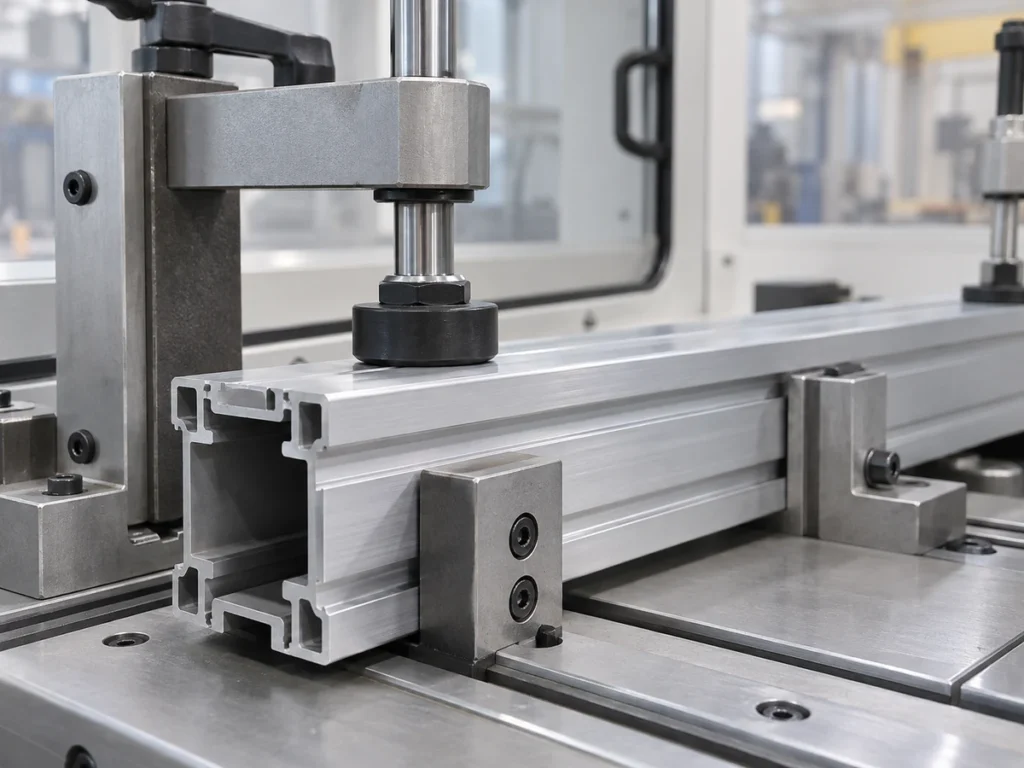
Separate the locating reference from the clamp contact
A locating reference answers “where is this part positioned?” A clamp contact answers “where does the restraint act?” Record both in the review. A contact surface is not automatically the controlling datum for finished-length inspection.
Mark the intended orientation on the section drawing. Identify the face that the supplier proposes to locate against and the faces that may be contacted. Also mark any visible finish, sealing surface, thin feature or slot that needs specific review.
Use plain descriptions that remain meaningful when the drawing is rotated. “Top face” is ambiguous unless the agreed view is shown. A face label and a small orientation sketch are easier to carry into the quotation and handover documents.
Ask how the proposed contact arrangement deals with the profile geometry without changing the drawing requirement. Any special pads, nests or support pieces need identification and supplier approval. A generic picture is useful for discussion, but it cannot validate contact pressure, holding force or clearance.
If the finish matters, define what will be inspected and under what agreed viewing conditions. “No marks” is a request that needs a practical acceptance description. Our guide to protecting visible aluminum surfaces during cutting covers that separate discussion.
Read the quoted equipment scope line by line
Ask the supplier to list the proposed horizontal and vertical restraint devices, profile supports and any special tooling. The useful answer is the configuration for your job, including what is supplied and what remains an option.
Emmegi’s SCA/E documentation describes horizontal and vertical vices and identifies additional clamping and pressure-regulation options. It provides an example of why the equipment scope should distinguish the basic arrangement from optional features. Those features belong to the documented Emmegi product; they do not establish the configuration of a JiurunCut machine.
The Emmegi Precision C2 page separately identifies clamping devices, intermediate supports and optional equipment. For a buyer, the relevant lesson is to name those elements separately in the proposal. The presence of a support or clamp in a product photograph does not prove that it is included in the quoted version.
- Standard supply: identify the proposed devices and their documented scope.
- Job-specific tooling: identify each item, profile family and revision.
- Options: state whether each is included in the price and acceptance review.
- Limits: record any excluded sections, orientations or part lengths.
Do not turn a generic compressed-air supply value into a clamp adjustment instruction. Supply pressure, regulated clamp pressure and actual contact force are different information. The supplier should document the approved arrangement and operating instructions for the specific machine.
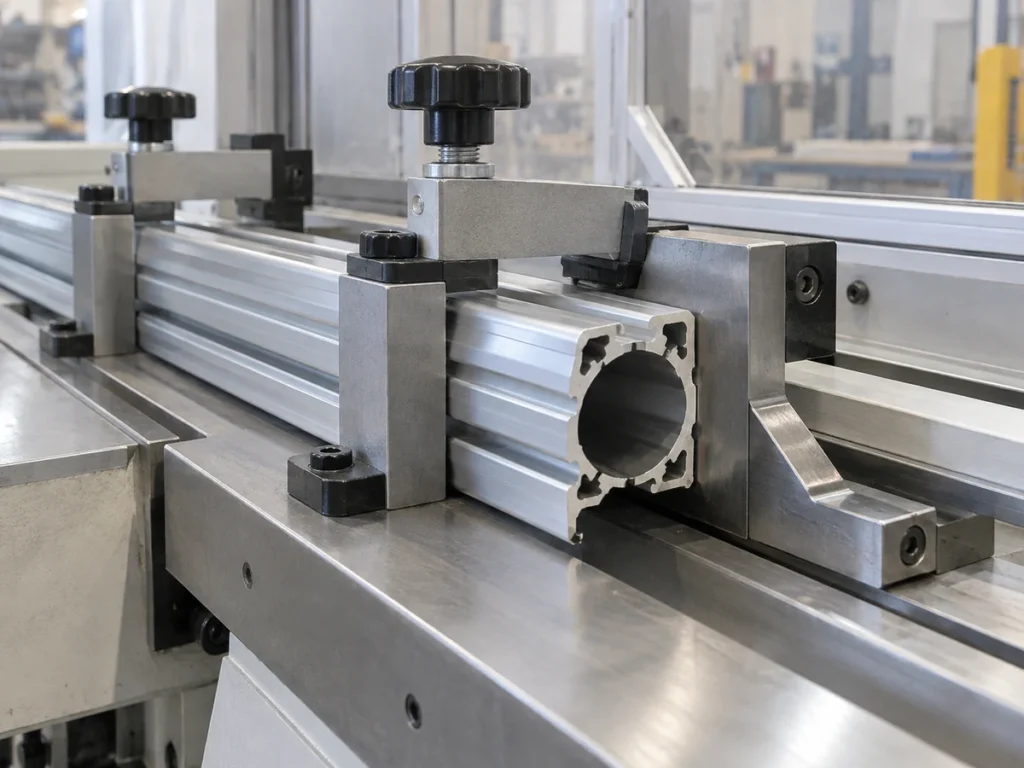
Compare two profile families without assuming shared tooling
Consider a fictional purchase review with profile A and profile B. Both have the same nominal outer width and height. Profile A has a broad flat face; profile B has an additional slot and a different visible surface. No cutting results are assumed in this example.
If a proposal only names the outer envelope, it may leave the second family’s contact arrangement unresolved. Create a separate review row for each family, using the drawing revision and intended orientation. Ask whether the same tooling is proposed or whether a different approved item is needed.
The answer might be shared tooling, separate tooling or a limitation that needs another process review. The buyer should record the supplier’s supported answer. There is no basis to promise interchangeability from the nominal dimensions alone.
Keep drawing and cut-list revision control attached to these rows. If a slot, wall or finish changes, the old tooling approval may need to be reviewed. A reused part number should not hide the change.
For mixed batches, request the handover information that will let the trained team distinguish the approved arrangements. Identify tooling, profile family and relevant documents. Do not replace the machine supplier’s instructions with a buyer-created operating sequence.
Agree on evidence before accepting the arrangement
Select representative parts that cover the meaningful differences in the proposed job. Include the relevant section families, orientations, length ranges and finish requirements. A single easy part may leave a different family unanswered.
Decide which observations belong in the review record: finished length against its agreed reference, end condition, visible contact marks and any drawing-specific feature. Record the applicable limits and the responsible inspection method before interpreting the results.
A photograph can show the sample and arrangement. A dimension record can show individual readings. Neither should be used to claim unmeasured production capability or a guaranteed long-term result. Keep the observed evidence separate from the approved scope.
Specify how an unresolved item will be handled. The supplier may need another sample review, a tooling revision or a narrower stated scope. The record should make that status visible, so the purchase team does not treat an open question as an accepted configuration.
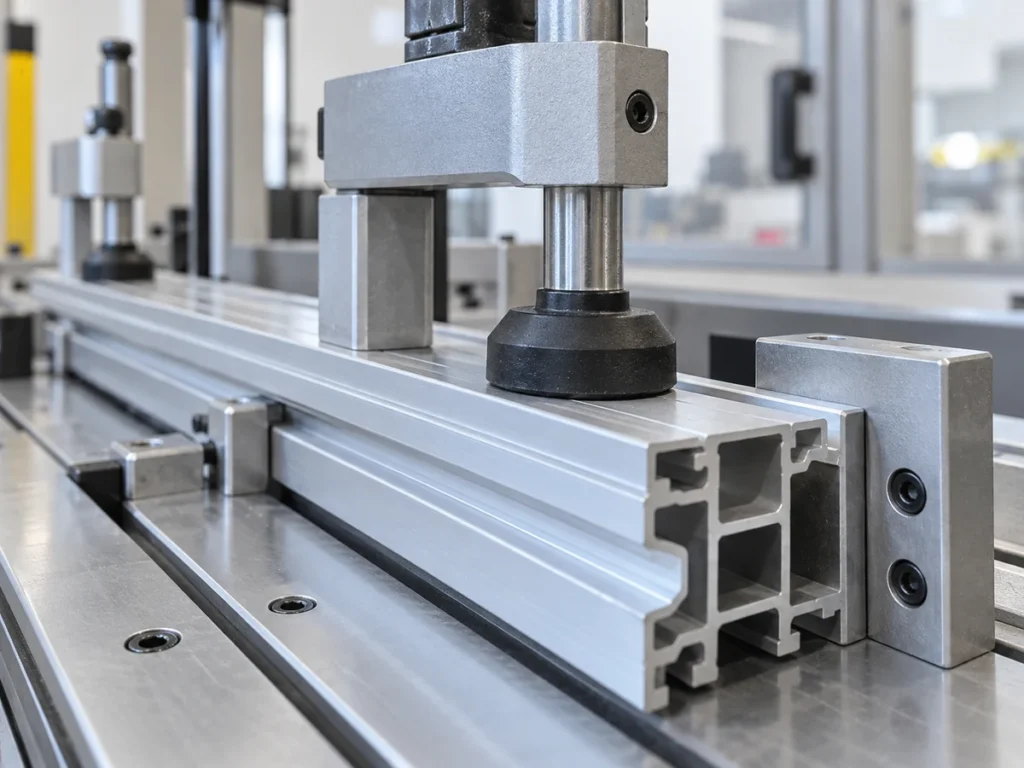
Keep the approved arrangement identifiable at handover
Request a concise document set: profile drawings and revisions, identified tooling, included equipment, applicable limitations, approved operating documentation and the agreed sample-review record. The same names should appear in the quote and handover package.
Clarify responsibility for replacement pads or other wear items. Ask how the correct item is identified and how any change is approved. A visually similar replacement is not enough evidence that it preserves the reviewed contact arrangement.
Use this information with the broader machine installation review. Clamping approval does not replace site preparation, guarding or training requirements. Changes should follow the supplier’s documented process.
Questions buyers ask about aluminum saw clamping
Are horizontal and vertical clamps interchangeable?
Do not assume that. Ask the supplier to show the purpose and approved arrangement of each device for the actual section, orientation and cutting process. The names describe directions; they do not prove equal suitability.
Can one fixture cover all profiles of the same size?
That needs supplier confirmation. Internal geometry, slots, finish and orientation can differ despite the same outer size. Identify the profile families separately and record the reviewed scope.
Can a photo prove that the profile will not deform?
No. A photo is context for discussion. It does not establish applied force, material properties, displacement or acceptable part condition. Agree on the relevant evidence and drawing requirements.
What should I send for a clamping review?
Send the section and part drawings, revisions, material specification, stock and finished length ranges, intended orientation and surface requirements. Include representative samples when requested.
Discuss your profile and tooling scope
Send JiurunCut your drawings and job requirements to discuss a suitable machine proposal and the clamping questions that need confirmation. State the profile families and finish requirements so the review can address the actual parts.