
Side-load case packer aluminum frame cutting should start with the product path, not a machine footprint. A side-load packer groups incoming items, presents them to an open case or tray, transfers the group into that package, and sends the loaded case onward. The infeed, collation, transfer, guarding and discharge can contain different materials and assemblies. A saw quotation becomes useful only when the buyer identifies the approved aluminum members and the stage at which those members must be delivered.
Machine arrangements vary. Brenton describes its XCP flow as product infeed, collation, case-blank handling, case loading and discharge. Its older Mach-4 brochure separately lists a welded main frame and a lightweight aluminum guard package. These are Brenton examples, not Jiurun machines or a bill of material for another builder. They show why a buyer should not label every visible support or enclosure member as an aluminum cut blank.
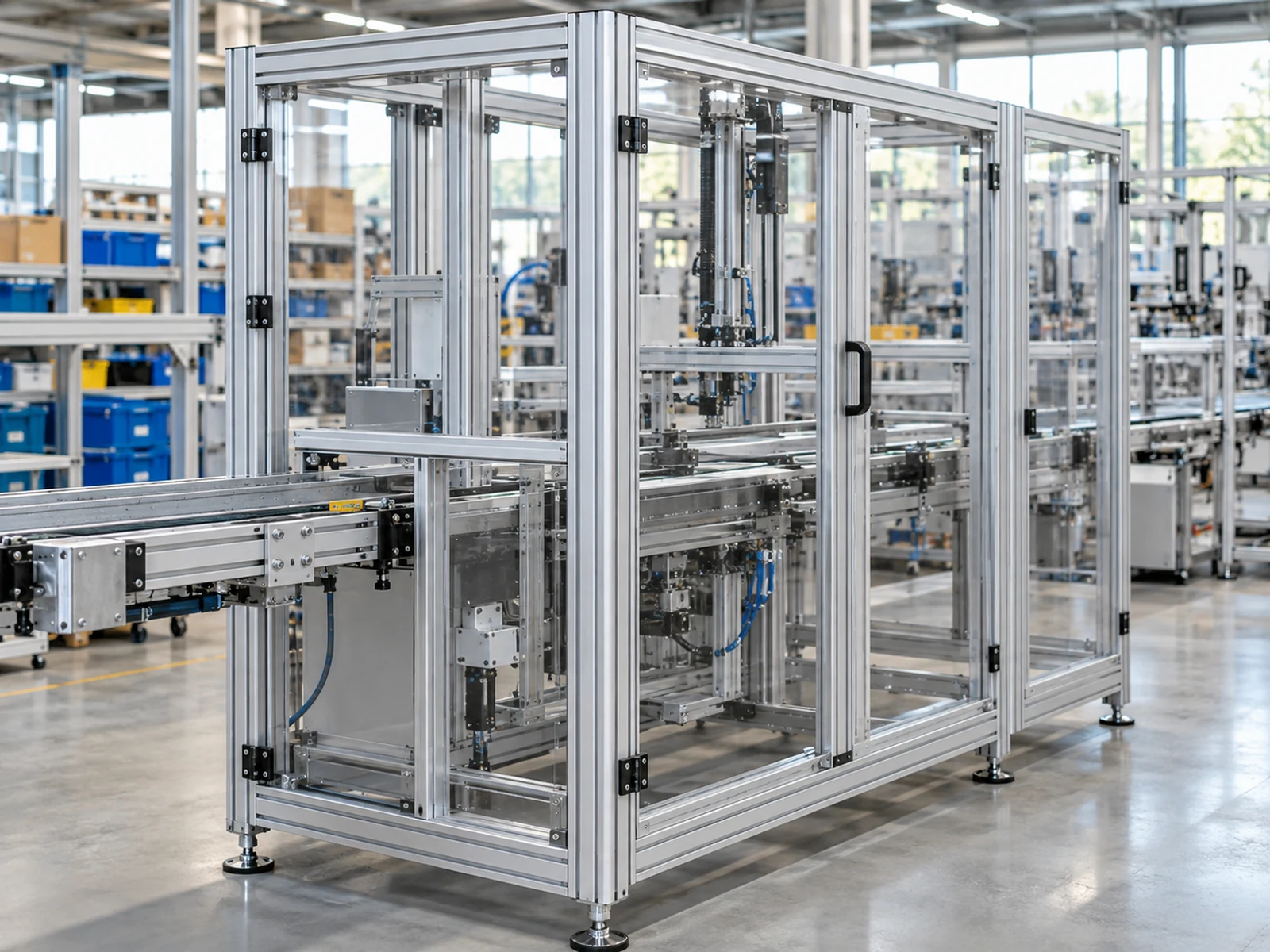
Side-load case packer aluminum frame cutting: map the product path
Walk the approved line drawing from the upstream product infeed to collation, loading, case transfer and discharge. At each boundary, identify the owner of the base, the guide, the moving mechanism and the guard. Some builders use a side-loading motion with a dedicated product transfer; others combine blank forming and loading in one machine. The saw supplier should quote the released part schedule, not infer a frame kit from the words “case packer.”
Potential aluminum candidates might include a fixed infeed-guide support, an adjustable-rail mounting member, a passive transfer-zone perimeter post, a guard-door frame member or an outfeed support. Each is a candidate only if the buyer’s current drawing specifies it as an aluminum extrusion blank. Do not include the pusher, servo mechanism, vacuum device, conveyor belt, tape or glue equipment, interlock, electrical cabinet or formed case in a blank-only estimate. A bought subassembly may already include its own frame and mounting hardware.
Keep the product load path distinct from the machine load path. A guide that locates a carton or bottle may sit on an aluminum rail, but the rail’s section and joining method must be checked against its actual loads and support points by the designer. A visible T-slot is not proof that it carries the moving transfer. The complete machine builder remains responsible for product handling, guarding, stability and performance.
Release the infeed and collation member schedule
For each proposed blank, ask for the part number, drawing revision, section drawing, specified alloy and temper, stock condition, finished cut length, length datum, end condition and quantity per machine. Add the zone and assembly in which the part belongs. Distinguish fixed members from adjustable ones and left-hand positions from right-hand positions. If an adjustable guide is mounted to several repeated bars, label the bars by position rather than assuming equal nominal lengths make them interchangeable.
Request both the longest support and the shortest finish piece. Record incoming bar length, usable offcut rules, visible surface and downstream joining features. The machine’s product width, pack pattern or case size is not a substitute for an extrusion cut dimension. The assembly drawing may define a range of changeovers, while the part drawing defines the blank length and the machining that follows. If holes, threads, slots, connector preparation or coating are performed by someone else, exclude them explicitly from the cut-blank price.
Some guide supports use an open channel or a profile with an asymmetric face. If the approved drawing calls for one, record which face is the locating face, which way the opening must point, and whether the cut end is square or angled. The same outside size can conceal different installation orientations. Do not infer the actual case-packer section from the generic illustration below; the drawing controls.
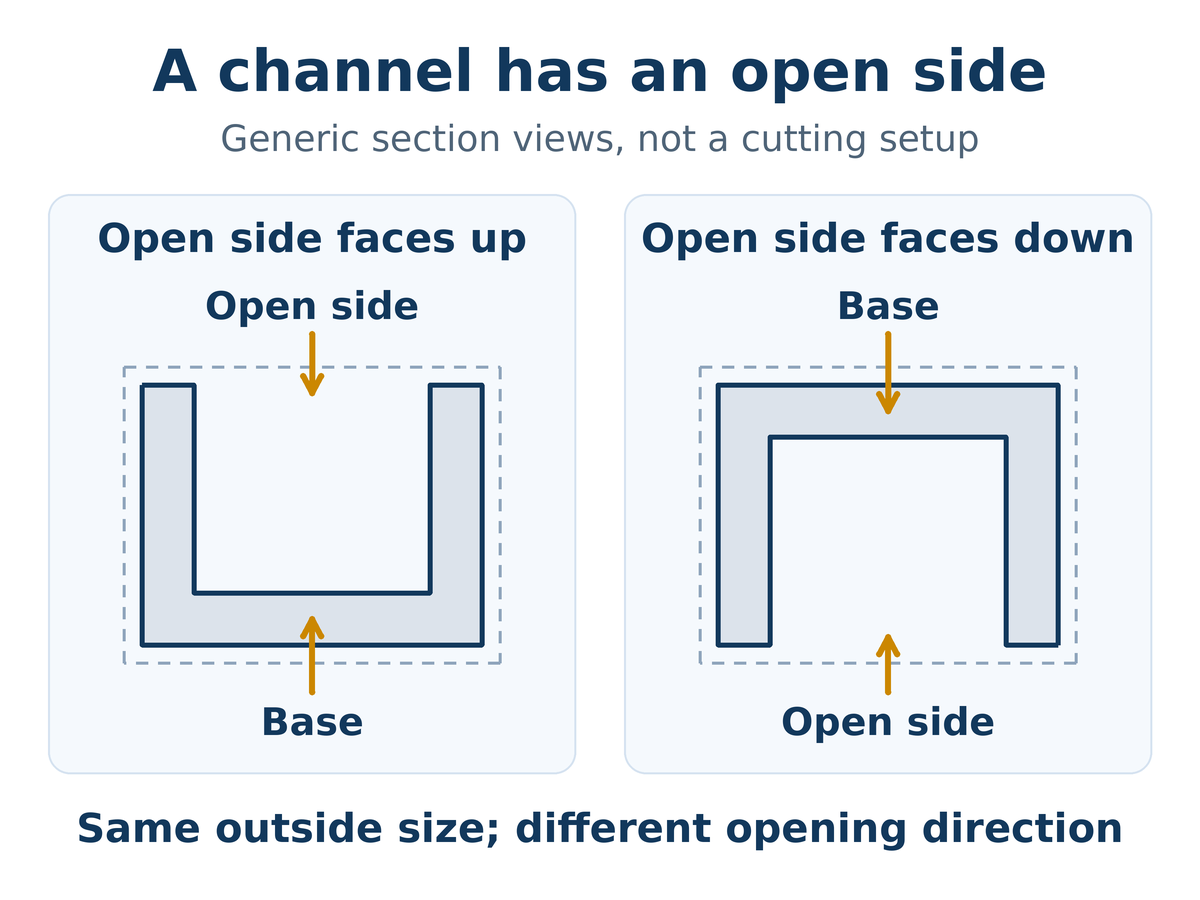
A guide rail often interfaces with a purchased conveyor, a custom bracket or a changeover mechanism. List that interface on the assembly schedule without inventing it as a saw operation. Where an open channel or thin wall needs special support during cutting, send an actual sample or section drawing to the saw supplier. A cross-section outline is more informative for clamping than a broad photo of the machine.
Separate transfer, guard and discharge responsibilities
At the side-load station, distinguish the fixed support structure from the moving pusher or product-transfer equipment. Identify how a member is attached and what part of the load it receives. The machine builder must approve alignment and motion clearances; an accurate loose cut blank cannot prove that a case is loaded without damage. Record any handed end, clearance cut or non-square end on the released part drawing before selecting a saw process.
Guard-frame members need their own receiving criteria. A cut-to-length post does not include transparent panels, hinges, interlocks, fasteners, access-distance assessment or validation of the assembled guard. Brenton’s Mach-4 brochure is an example of an aluminum guard package around a differently constructed machine. It is not a basis to copy its dimensions or protection design. State whether the buyer wants loose guard blanks, prepared members or a complete guard module; those are different purchases.
For outfeed, confirm whether the loaded case moves onto an existing conveyor or a newly supplied transfer. The rail that supports a passive guide can be quoted from its drawing, while the height and flow of the packed case must be accepted at line level. If a case erector is upstream or a case sealer is downstream, identify those interfaces without rolling their frames into this side-load packer’s blank schedule. Our case-erector member guide covers blank feeding and forming, and our carton-sealer guide addresses the closure station.
Trial the actual section before approving a saw route
Give the saw supplier an approved extrusion sample or exact section drawing. Include the longest and shortest members, an asymmetric or open side if present, and any face that must remain unmarked. Ask where the bar is located, how it is clamped, and how the cut piece is supported as it leaves the blade. A double-head saw may be worth discussing for certain paired ends, but the offered machine and fixture must be selected for the actual stock; the photograph below does not establish a required model or setup.

Write acceptance checks before the first cut: finished length from the agreed datum, end squareness or specified angle, burr position, deformation, visible marks and fit for any later connector. Record the measuring method and who releases the first-off part. Repeat the check after a stop adjustment, section change or product-variant change. A controller’s feed-position figure does not by itself establish finished-piece accuracy, and one sample cannot qualify every profile in the case-packer kit.
Keep trial output traceable to drawing revision and stock lot. If a piece fails, identify whether the cause is the supplied section, support, clamp contact, blade selection, stop or downstream handling. Separate rejected pieces from accepted bundles. Our saw-output traceability guide explains the job-to-bundle handoff. None of these saw checks proves collation reliability, load timing, throughput or machine safety; the builder tests those at system level.
Compare quotes at the same delivery stage
Ask every bidder to quote the same part revision and accepted handoff. A blank-only kit covers material, cut ends, inspection, marking and packaging as stated. A prepared-member kit adds defined secondary operations. A ready-to-install guide or guard module includes bought hardware, assembly and its own acceptance work. Comparing a loose extrusion price with an assembled module price hides processing and integration responsibilities.
For side-load case packer aluminum frame cutting, pack each cut member by zone, variant, part number, revision and quantity. Do not mix near-equal infeed, transfer and guard rails in one unmarked bundle. The receiving team should reconcile the kit against the schedule before adding holes or attaching brackets. An engineering change to pack pattern or machine layout may affect only some members; check the affected drawings and already-cut stock before reusing it. The final quotation should state exclusions as plainly as inclusions.
Seven questions for a side-load case packer RFQ
- Which released parts are aluminum saw-cut blanks, and which are steel, bought modules or moving assemblies?
- Who owns the infeed, collation, transfer, guard and discharge drawings and revisions?
- What section, datum, end form, length and count apply to each named member?
- Which product-format adjustments change a part drawing, and which only change assembly settings?
- Which long, short, open-side or visible-face sections should be included in a representative trial?
- Which first-off inspections and traceability fields release each batch?
- Does the purchase end at loose blanks, prepared members or a validated assembled module?
Related equipment video
The following clip from the Jiurun Machinery channel shows a general aluminum saw process. It does not show this side-load case packer, approved stock, a proposed machine configuration, a customer job, a witnessed trial or verified performance.
Need a side-load packer cut-member quote? Send the released aluminum part drawings, zone schedule and representative extrusion through our contact page. We can discuss sawing and checking the specified blanks while the machine builder retains loading, guarding and complete-line acceptance.