
A saw can deliver the correct nominal length and still leave a buyer with unusable cut parts if the tubes arrive with crushed mouths, rubbed finishes, mixed lengths, or an untraceable bundle. Round aluminum tube packaging deserves its own line in the purchase specification. It is a receiving and handling decision, not a decorative wrap added after cutting.
This guide is for buyers ordering cut round tubes from an outside supplier or defining the handoff after an in-house saw. It sets out what to agree before a quote, how to review a representative pack, and what evidence to ask for at dispatch and receipt. It does not prescribe a universal pack: tube diameter, wall, length, finish, quantity, transport route, and the receiving method change the answer.
Define the delivered unit before discussing packaging
Start with the part drawing and purchase order. Identify the alloy and temper, outer diameter, wall thickness, cut length and its tolerance, end-face or burr requirement, any surface that will remain visible, and the required identification level. State whether the supplier delivers individual cut pieces, a counted bundle of one length, or a mixed-order pallet. These are different units of acceptance. A saw setup and its feeding accuracy alone do not establish finished-part dimensional conformity; agree a separate sample and measurement method.
Ask which unit the receiving team can inspect and move without re-sorting: a small sub-bundle, a returnable tray, or a palletized group. If the order contains more than one length or revision, specify whether each can share an outer pallet while remaining separately identified. The quote should define the count per inner pack and per shipping unit, plus who supplies and disposes of packaging materials.
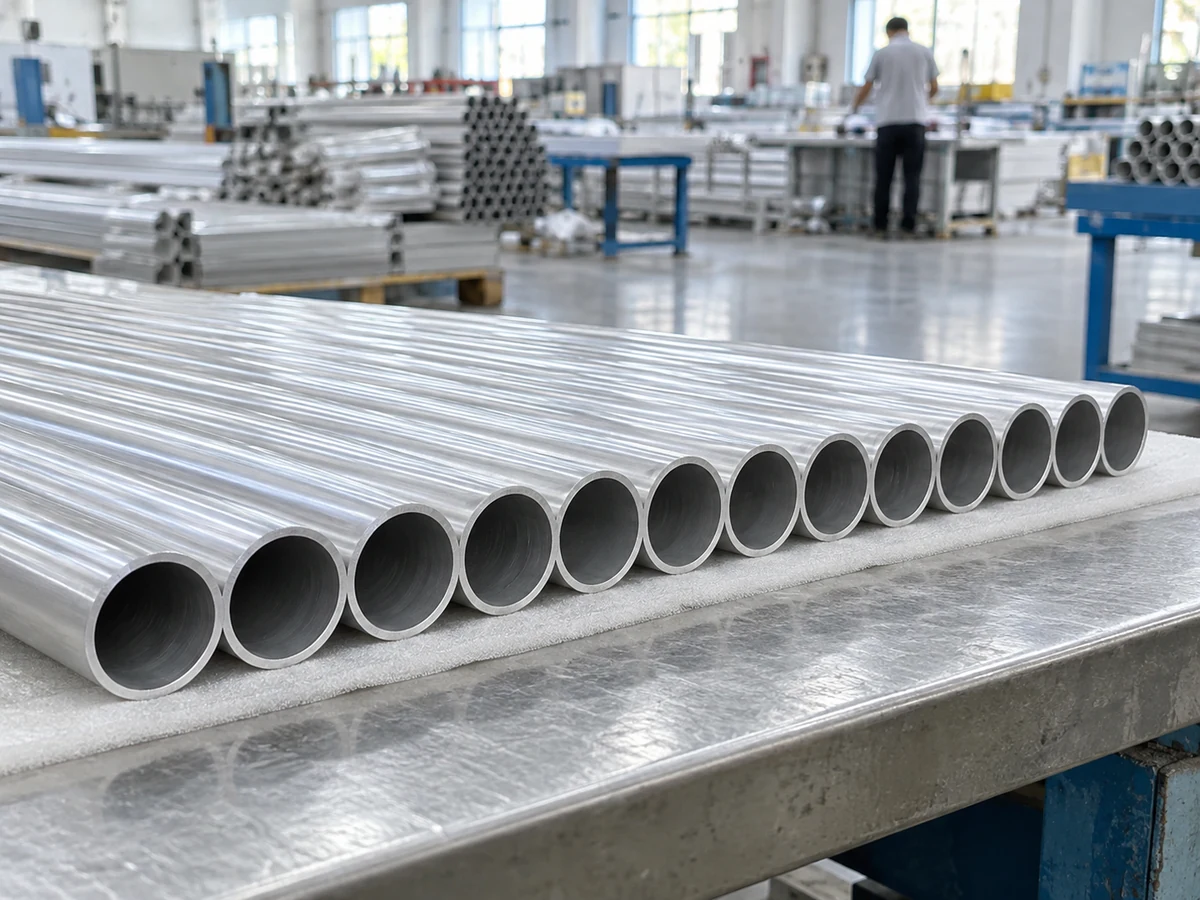
Round aluminum tube packaging: protect cut ends and critical surfaces
A cut tube has exposed rims that can meet a neighboring tube, a strap, a pallet edge, or a fork contact point. For thin walls, a load that looks acceptable from the outside may still distort an end. For decorative or coated tube, tube-to-tube rubbing may create unacceptable marks even when the section remains straight. Tell the supplier which surfaces and ends are critical and what damage will be rejected; then ask for a pack design that keeps those features from becoming contact points.
Possible controls include separators between layers, end caps or edge protection where practical, sleeves for sensitive surfaces, support along long pieces, and a restraint that holds the pack without concentrating force on a few tubes. These are options to evaluate, not a claim that every option is suitable for every diameter or finish. A protective film also needs a removal and residue agreement if the buyer will paint, bond, or inspect the metal later.
The public scope of ASTM B660-23 identifies mechanical damage such as bending, crushing, denting, scratching and abrasion, along with corrosion and water staining, as packaging concerns for aluminum and magnesium products. That scope is a useful risk checklist; compliance with the full practice must be separately specified and checked. For a wet or outdoor route, decide whether the pack needs a moisture barrier, drainage, or a storage limit based on the actual route and finish. Do not assume wrapping alone prevents water staining.
Stop a round bundle from rolling or collapsing
Round stock behaves differently from flat extrusions on a table, rack, pallet, or vehicle. The packaging review should show how the first layer is cradled, how later layers are separated or nested, and what prevents a bundle from shifting when a strap loosens or a pallet is lifted. A flat pallet deck with tightly banded tubes may still need a positive anti-roll feature. The supplier should explain what the loader and receiver may safely lift, and whether a partially opened pack remains stable.
For a United States reference, OSHA’s material-storage rule at 29 CFR 1910.176(b) calls for stored materials to be stacked, blocked, interlocked, and height-limited so they are stable and secure against sliding or collapse. FMCSA’s cargo-securement summary separately addresses cargo likely to roll, including chocks, wedges, a cradle, or equivalent restraint. These are jurisdiction-specific references, not a transport design or a substitute for the carrier’s securement plan. Agree which party designs the shipping unit and which party secures it on the vehicle.
Ask for a packing sketch or photos of a representative unit showing support points, end clearance, separator placement, strap contact, and a safe access direction for unloading. A top-down photo alone hides many of the failure points.

Keep length groups and lot identity readable after the wrap comes off
Receiving errors often begin when a label describes the outer pallet but not the smaller unit that operators actually open. Specify a human-readable label for each independently handled bundle: purchase order, part number and revision, cut length or length group, quantity, alloy/temper when required, supplier lot or heat reference where available, and the date or dispatch reference. Put the label where it survives normal handling and can be read before a bundle is opened. If barcode scanning is required, agree a test label and the receiving system’s field format before production.
Do not confuse mill identification with a buyer’s finished-part label. ASTM B666/B666M-20 covers identification marking of aluminum and magnesium mill products; order-specific pack labels, cut-piece counts, and receiving disposition still need to be defined in the purchasing agreement. If several cut lengths share one shipment, require a visible separation and reconciliation rule so a missing piece does not get attributed to the wrong length group.
The count method should also be explicit. Will the supplier count every accepted piece after cutting, count by verified tray positions, or reconcile a packing list against sub-bundle quantities? Who records scrap and rework? A promised total is weaker than a count tied to a labeled, inspectable unit. For an adjacent but different problem, see our square tube accepted-count and pack handover guide; square sections do not create the same rolling-control question.
Price and approve the complete shipping unit
Request a quotation with separate assumptions for cutting, deburring or end treatment, inspection, inner separation, end and surface protection, bundle or tray, labels, outer pallet or rack, loading, and any returnable packaging loop. If a supplier quotes only a price per cut, the buyer cannot compare the total delivered cost or know who absorbs repacking after a trial failure. The broader complete shipping-unit comparison explains this commercial boundary; this article focuses on the round tube’s ends, contact surfaces, and rolling behavior.
A round aluminum tube packaging specification should be approved through a representative pack trial before the main order. Include the shortest and longest relevant cut lengths, the lightest and heaviest practical bundle, and the most sensitive finish in the order. Record the as-packed unit, label legibility, count reconciliation, lift and handoff method, condition after the real route or a mutually agreed handling simulation, and the receiver’s unpacking sequence. Decide in advance which evidence will close the trial and who approves a change to the pack design. A sample photo cannot substitute for inspection of the delivered unit.
What to request from the supplier
- The part drawing and acceptance plan, kept separate from saw feeding or positioning claims.
- A packing-unit definition: pieces per sub-bundle, units per pallet or rack, and separation of each length, revision, or lot.
- Contact and restraint details for cut ends, critical surfaces, support points, and anti-roll stability.
- Sample label fields, packing-list reconciliation, and a method for correcting discrepancies.
- A trial plan that includes transport, receipt, unpacking, and a clear approval owner.
- A quote identifying packaging, handling, and returnable-container responsibilities.
The following short video is from Jiurun Machinery’s own YouTube channel. It shows general aluminum cutting equipment in operation. It does not show the round tubes, packaging arrangement, model configuration for this order, a customer shipment, a packaging trial, or performance evidence discussed above.
If you are specifying a cut round tube order, send the tube drawing, required quantity and length mix, finish criteria, expected handling route, and receiving method through our contact page. We can discuss the cutting-equipment side of the requirement and the evidence a supplier should agree before a packaging decision is approved. Confirm any machine capability or pack responsibility against a written proposal for your actual application.