
Semi-automatic aluminum saw controls deserve their own line in a purchase specification. A buyer can receive a convincing cutting video, yet still not know how the operator starts a cycle, where hands and stock are at that moment, what must be reset after a stop, or whether the demonstrated arrangement is included in the quote. Treat the start control as part of a complete staffed sequence rather than a button in isolation.
This guide helps a buyer request evidence for a proposed semi-automatic saw. It does not identify the control arrangement of any specific Jiurun model or replace the manufacturer’s instructions, a machine-specific risk assessment, or local safety review. Ask the supplier to show the exact offered configuration and document what a trained operator is expected to do before, during, and after each cut.
Semi-automatic aluminum saw controls: define the cycle boundary
First write down where one cycle begins and ends for your work. Does the operator place a profile against a stop, hold or adjust it, command a clamp, initiate the saw motion, wait for the blade to return, release the part, and then inspect it? Which steps are automatic on the quoted release, and which remain the operator’s task? Request a sequence chart showing the required state of the clamp, guard and cutting head at each transition. The chart should use the names printed on the actual controls rather than marketing terms such as “one-touch operation.”
Write separate cases for a normal first cut, a repeated cut from the same stock, and the first cut after a section change. If a changed profile needs a different stop, pad, support or parameter, count that as a new setup. A short cutting stroke cannot stand in for the complete accepted-part cycle. The related operator reach and loading-height guide addresses the surrounding material route; this control review focuses on the moment work passes from the person to the machine.
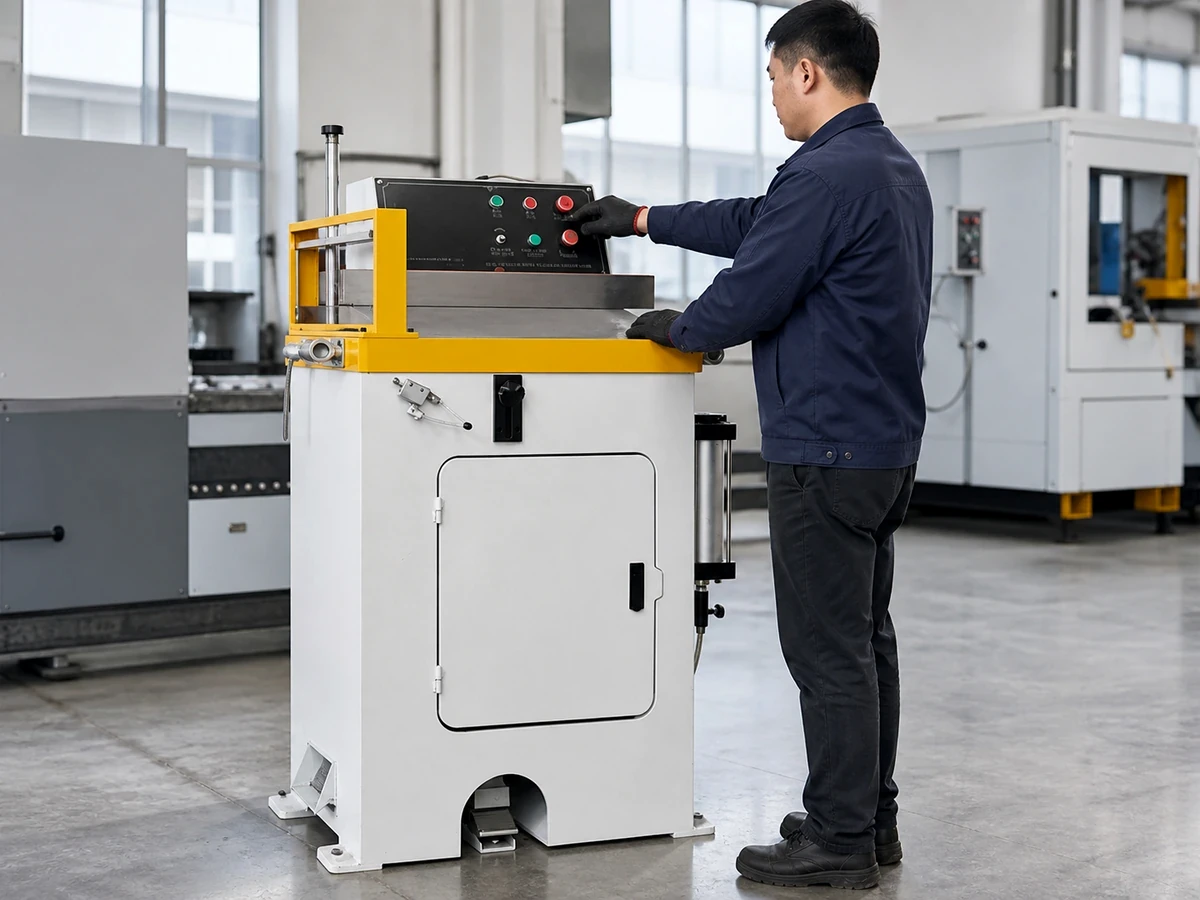
Map hands, stock and clamp before actuation
Bring the actual profile drawing and a representative length to the discussion. Mark the datum face, surfaces that must not be marked, any flexible wall or fin, and where support is needed outside the saw. Ask the supplier to show where the operator’s hands are while locating stock, closing the clamp and initiating the cut. The answer may differ between a short rigid blank and a long or awkward extrusion. If the demonstrated cut needs another person to steady the bar, an unquoted support table, or a hand position that conflicts with the documented procedure, the buyer has found a configuration gap rather than a production result.
Request a marked layout of the control station, clamp contact points, infeed and outfeed supports, part collection area, and normal walking route. The JR-455Q clamp-trial guide deals with profile contact and cut-part acceptance. Here the question is narrower: can the operator reach and use the quoted start arrangement while following the approved loading and guarding procedure? A photograph of a clamp or a cover cannot establish that answer for the delivered machine.
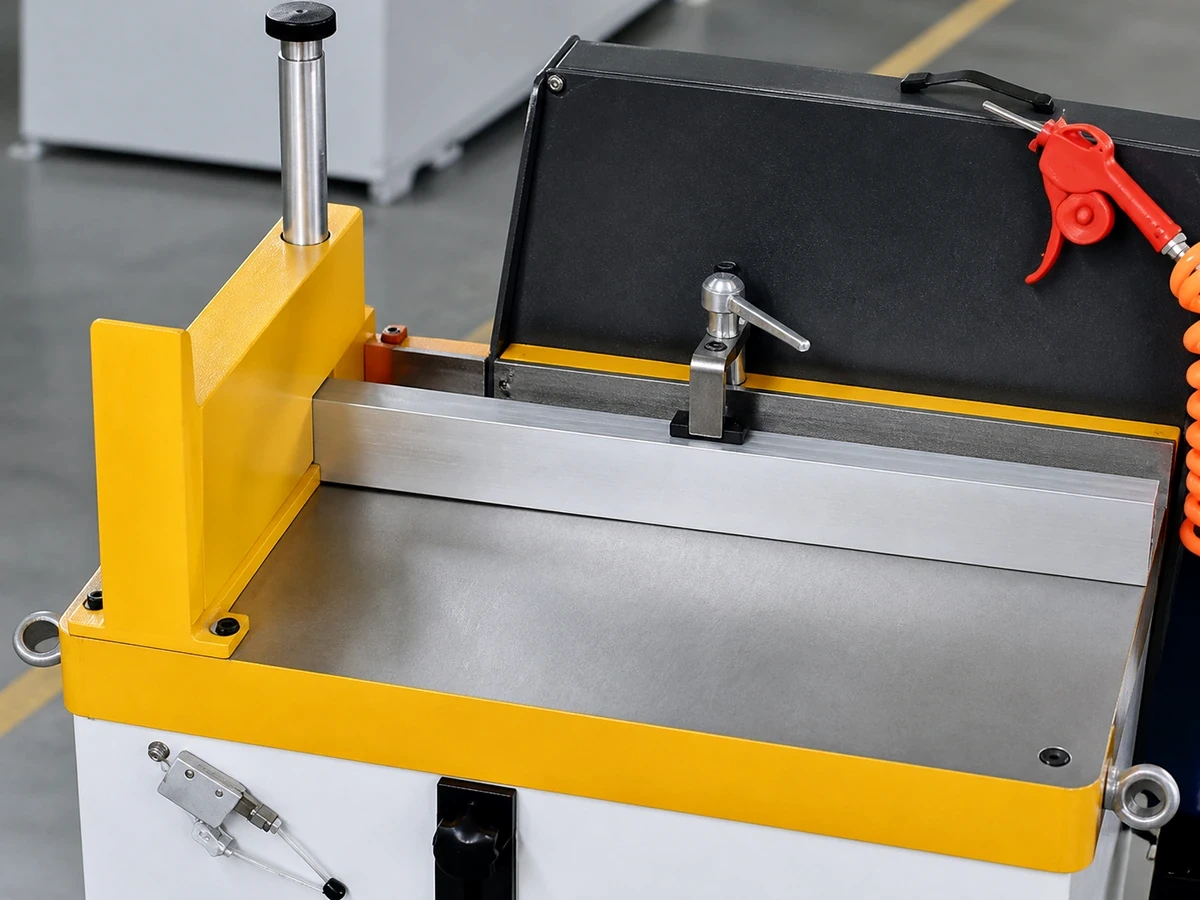
Compare offered actuation options without assuming equivalence
A push button, foot-operated control, two-hand arrangement or another start method may be proposed in a quotation. These are questions to put to a supplier, not a claim that Jiurun supplies every option or that one method is automatically suitable. Ask which method is standard on the exact release, which is optional, whether a quoted change alters the control circuit or guarding, and which documents identify the installed components. Require the seller to demonstrate the chosen arrangement in the same staffed sequence you will use for acceptance.
Do not choose a foot control merely because it leaves hands free, or a two-hand device merely because its name sounds protective. The relevant question is whether the complete control and guarding design fits the actual hazard, stock size, operating mode and applicable site requirements. Have qualified personnel review the proposed design and the machine’s instructions. Do not defeat a guard or improvise a start test. General references such as OSHA’s machine-guarding overview can help frame a review, but they cannot certify a Jiurun configuration or settle requirements outside their jurisdiction.
Witness normal, interrupted and restart sequences
Ask the supplier’s trained operator to demonstrate the documented normal sequence on the quoted machine. Observe the status before loading, the signal that stock is secured, the action that starts cutting, the visible or audible indication of completion, and the point at which the part can be removed. Record who made each adjustment and whether the result used any accessory omitted from the price. Do not infer internal logic from an exterior video or from the position of one switch.
The quotation should also explain what happens after a normal stop, an emergency stop, a power interruption, or a utility loss relevant to the offered version. Ask whether and how the operator checks the blade and clamp state before restarting, what must be reset, and what instructions govern clearing a fault or jam. These are documentation and witnessed-demonstration requests, not instructions to create a fault during a trial. A controlled supplier-led demonstration or a documented walk-through is preferable to unplanned interference with a running saw.
Record a buyer witness matrix, not a promotional cycle time
Agree the acceptance sheet before a sample cut. Each row should identify the released drawing and revision, stock ID, section and incoming length, setup or fixture used, quoted control option, operator action at cycle start, observed clamp/guard state, part ID, inspection result and any exception. Include the first piece after setup and after a profile change; those are the moments when an apparently simple control sequence can reveal extra handling. If several cuts are timed, state whether the clock includes loading, support adjustment, part pickup, inspection and rejected pieces.
Judge the trial against your drawing’s acceptance criteria, not a general “clean cut” label. Define finished-length datum, cut-face or burr condition, permitted marks, gauge, sample quantity and disposition of setup pieces. Keep the control observations separate from cut-quality observations: a smooth cycle does not prove accepted dimensions, and one accepted sample does not prove the control arrangement is suitable for a production shift. The buyer and supplier should sign exceptions and retest decisions against the same version of the witness sheet.
Tie the controls to the quotation and local approval
Ask for a quote schedule naming the machine release, control method, guard and access arrangement, clamp and support accessories, electrical and utility requirements, manuals, training and spare control components. Mark whether each item is included, optional, buyer-supplied or to be engineered after sample review. If a showroom demonstration uses a different control panel, additional support or altered guarding, reconcile that difference before treating its result as evidence for the proposed purchase.
Site acceptance should follow the exact delivered configuration and the facility’s competent safety review. The UK HSE guidance on manually fed pivoting-head metal-cutting circular saws illustrates why machine design and operator access matter, but it concerns a specific saw class and is not a blanket specification for this equipment. Ask the supplier for the documents and demonstrations that apply to the actual saw, then have your own qualified personnel evaluate them under the rules that govern your site.
Related equipment video: general operating context only
The JiurunMachinery video below shows a related JR-455Q semi-automatic cutter, its exterior control area and a guarded cutting-zone view. It is general equipment footage. It does not show or prove the cycle-start method discussed above, your material, the quoted model configuration, a customer installation, a witnessed trial, accepted-part measurements or production performance. Verify those points with the exact offer and your own witness sheet.
What to send with the RFQ
Send the profile drawings, planned stock lengths, protected faces, mix and expected staffed workflow. Request a version-specific sequence chart and layout, the offered start-control method, guard/access documentation, a sample witness plan and an itemized quotation. State who will approve the control arrangement on your site and which acceptance results must be demonstrated before sign-off. Share this package with the JiurunCut team so the proposal can answer a defined operating question rather than a generic request for a semi-automatic saw.