
Self-service bag drop frame cutting starts with a supply decision. Many airport bag-drop units are purchased as integrated equipment. A cut aluminum support member is only a possible subcomponent when the system owner has released a drawing and chosen that manufacturing route. Before requesting an aluminum saw quote, separate a frame blank or kit from the complete bag-drop unit, conveyor, scale, scanner, controls, guarding and airport acceptance.
SITA describes modular bag-drop units with alternative loading orientations, while Amadeus describes a bag-drop system that combines a passenger interface, conveyor and bag-tag scanning. These are examples of system scope, not JiurunCut products or approved drawings for a particular terminal. Use the actual equipment supplier’s latest documents for every project.

1. Self-service bag drop frame cutting: confirm the supply boundary
Ask the bag-drop integrator whether the purchase is for a complete unit, a retrofit module, a manufactured support frame, a prepared kit, or individual saw-cut profiles. Put that answer on the RFQ cover sheet. A standard unit may arrive with all its structural parts already made. In that case, buying a saw for hypothetical bag-drop frame cutting would not reflect the retained workload.
If the integrator releases a separate aluminum member list, identify who supplies the extrusion, who cuts it, who drills or taps it, who assembles it, and who checks the completed unit. Keep purchased sensors, screens, belt sections, scale parts, wiring and software outside the saw-cut scope unless a supported contract explicitly assigns them.
2. Freeze the lane layout and equipment interfaces
A self-service lane can use different approach, loading and discharge arrangements. SITA’s bag-drop brochure shows that tagging, weighing and bag injection may be combined or separated across touchpoints. The approved airport layout must tell the frame supplier which physical arrangement applies. Give the station footprint, conveyor direction, service side, passenger-facing side, floor interface and the limits of the existing baggage handling system.
Mark the edges that must clear the belt, luggage path, doors, maintenance access and any required accessible interface. The integrator determines those clearances and compliance requirements. The cutting shop should receive resulting part lengths and end details, not infer them from a marketing image or terminal plan.
3. Release each profile and protected face
Provide a current drawing and part number for every approved aluminum section. Include section geometry, alloy and temper where specified, finish, stock length, purchase source and orientation. A visually similar T-slot or hollow profile may take a different connector or enclosure panel. Require written approval for substitution before stock is cut.
Identify the passenger-visible face and any surface that mates to a bracket or cover. State whether coating or anodizing happens before or after sawing. Include stock condition and allowable handling marks in the RFQ. If the frame is hidden inside a finished module, do not silently apply a cosmetic criterion borrowed from its outer shell; use the actual drawing and acceptance plan.
4. Put finished-length datums and end work on the cut list
For each member, show the drawing revision, quantity, finished length, measuring datum, end angle, orientation and tolerance. Distinguish the saw blank from the assembled distance between joints. Show whether a connector, plate or end cap consumes part of the nominal frame span. Mark handed pieces and any holes or slots to be machined after cutting.
Keep a separate operation column for drilling, tapping, deburring, labeling and assembly. A saw supplier should not price a simple straight cut as if it includes all downstream preparation. Conversely, a buyer comparing prepared kits should check that every bidder includes the same end work.
5. Review the saw setup on representative stock
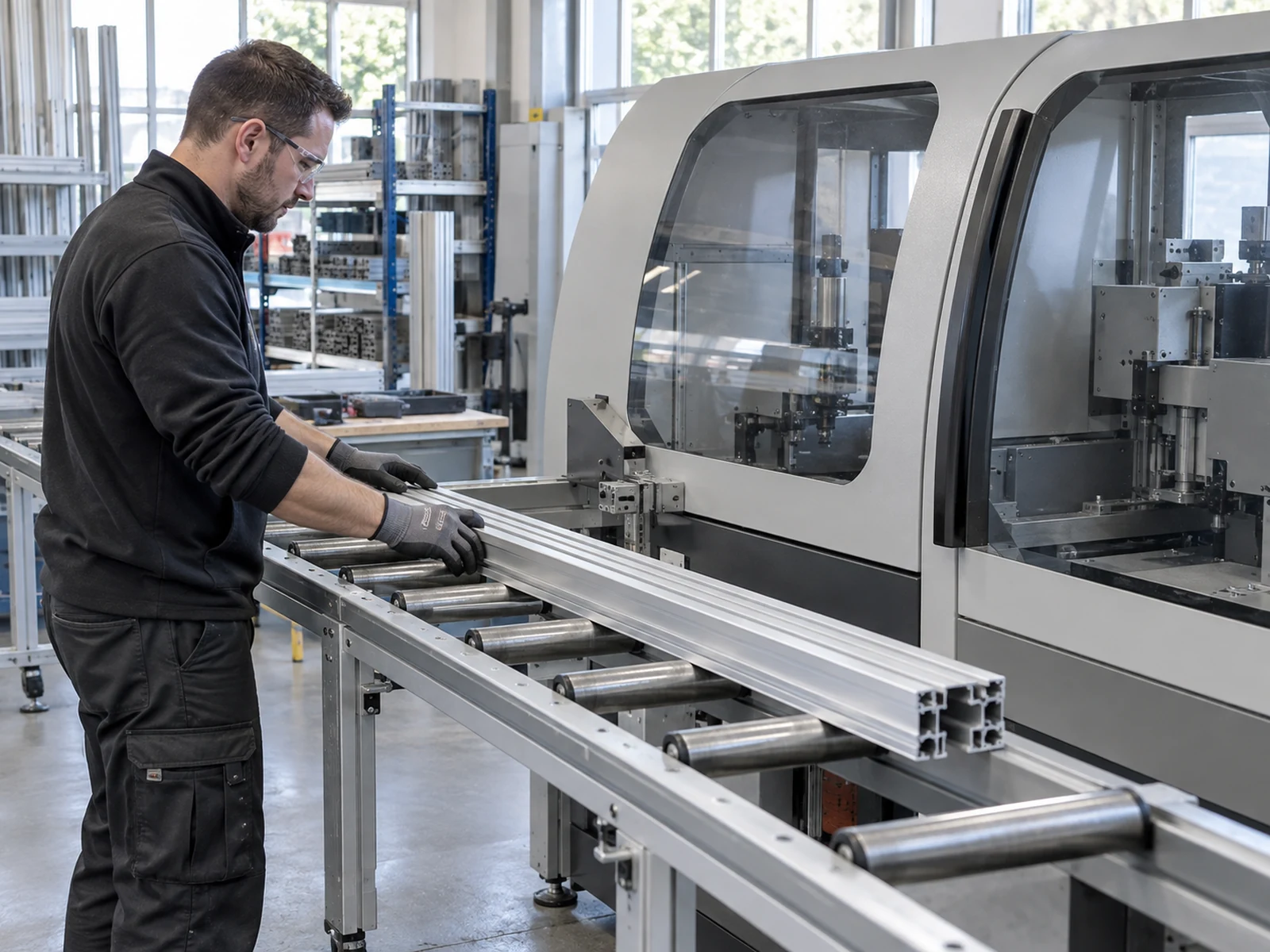
If the airport equipment supplier or its approved fabricator retains these frame members, send representative extrusion and drawings to the saw vendor. Review infeed and outfeed support, clamping contact, fence datum, blade clearance, remnant handling and the longest and shortest members in the mix. A frame may combine wide posts with narrow cover rails that need different locating plans.
Ask the saw vendor to show how the profile will be supported without twisting or marking protected faces. Record the actual stock, tooling and setup proposed in the machine offer. A demonstration with an unrelated bar can illustrate equipment operation, but cannot establish a cut result for this project’s material, tolerance or delivery rate.
6. Agree on first-off evidence without overstating it
For self-service bag drop frame cutting, select a first-off set that covers each profile family, end geometry, protected finish and setup change. Record the profile identity, drawing revision, stock lot, machine setup, measuring datum, finished length, angle where relevant, cut-end condition and visible marks. Define who measures each feature and how out-of-tolerance or damaged pieces are held.
Send accepted members to the responsible assembler for the agreed fit check. A correct saw cut does not prove scale accuracy, scanner performance, bag tracking, conveyor safety, accessibility or completed airport acceptance. Keep those system tests with the equipment integrator and airport owner. If the layout or interface changes, issue a revised cut list and repeat affected first-off checks.

7. Compare quotations at the same handover point
Ask each bidder to state whether its price covers raw stock, saw-cut blanks, machined and labeled members, an assembled support frame, or a complete bag-drop module. Quote the same quantities and revision. Separate packaging, traceability, first-off reports, scrap, changeover and transport from the base cut price. For a saw purchase, include stock handling, fixture plan, operator changeover, sample test and service scope.
| RFQ item | Buyer supplies | Supplier returns |
|---|---|---|
| Supply boundary | Approved cut-kit or complete-unit scope | Inclusions and exclusions |
| Geometry | Released profile and member drawings | Cut list, datums and first-off method |
| Interfaces | Integrator-approved lane and bracket layout | Member handover at defined revision |
| Acceptance | Cut-part criteria and system owner | Cut-part evidence, with system tests excluded |
A low price per cut is difficult to compare with an assembled station price. Use the same delivery stage and responsibility split throughout the comparison. Our airport desk frame guide covers a different airport structure; our parcel dimensioning frame guide shows a related but separate measurement-system boundary.
What the Jiurun Machinery video shows
The following video from Jiurun Machinery’s own channel is a general aluminum saw example. It does not show a bag-drop unit, the aluminum profile or model configuration of this RFQ, an airport customer, a project trial, a guaranteed cut rate, or any completed-system acceptance.
Common buyer questions
Does a catalog bag-drop unit automatically create an aluminum cutting workload?
No. Confirm that an approved drawing actually assigns separate frame members to your factory or supplier before buying a saw or ordering cut stock.
Can a clean first-off cut approve the entire bag-drop system?
No. It checks the specified aluminum member. The integrator and airport owner retain the equipment, installation and operating acceptance.
What should I send for a useful saw quotation?
Send the released member drawings and profile samples, quantities, cut datums, finish restrictions, first-off criteria and the named owner of the assembled system.
Ready to scope the saw work? Send the approved frame cut list and representative stock through the JiurunCut contact page. We can review a cutting-machine direction against those inputs while the bag-drop supplier remains responsible for the completed unit and its acceptance.