
Short answer: a safety light curtain can be one part of a properly designed safeguarding system, but it does not automatically replace the physical guard around an aluminum circular saw. A beam can detect a person crossing a defined plane and trigger a stop. It cannot itself catch a blade fragment, contain flying chips, or close an opening that can be reached from the side. The safe answer depends on the actual saw, its stopping performance, the material path, and a documented risk assessment.
This guide is for buyers comparing quotations or reviewing a proposed retrofit. It is not a specification for installing a protective device. Ask the machine builder and a qualified machine-safety professional to validate the complete arrangement for your jurisdiction and application.
What each safeguard is expected to do
A physical enclosure or fixed guard separates people from the cutting zone and may also help contain chips or ejected material, depending on its design. An interlocked movable guard can prevent hazardous motion while access is open, provided its control system and stopping behavior are suitable. A safety light curtain is an electro-sensitive device: interruption of its detection field is used to command a safety stop. The safety light curtain is a detection boundary, not a solid shield. OSHA lists flying chips and rotating parts among machine-guarding hazards; the guard selection must address the hazards that actually exist at the point of operation. See the OSHA machine-guarding overview and 29 CFR 1910.212.
That distinction matters on an aluminum saw. A cut can produce chips and offcuts as well as expose a moving blade. A proposed safety light curtain may help control human approach to a selected opening while the physical enclosure still handles blade and ejection hazards. A quotation that removes the enclosure merely because it adds beams needs much more scrutiny.

Check the approach path before discussing a device
Start with a drawing of the saw in its intended line, not an isolated product photo. Mark the operator loading side, infeed and outfeed, cut zone, maintenance doors, rear access, and any space where a person could stand after crossing the detection plane. Long aluminum extrusions can make openings necessary; those openings also change how someone might reach around, under, or behind the safeguard. The question is whether every hazardous approach is addressed by the complete design, including while loading a profile, clearing an offcut, or adjusting a stop.
Ask the supplier to show the proposed safety light curtain location on that layout and explain any side or rear barriers. If a person can cross the beam and remain between it and the blade, the control strategy needs to address that position and reset behavior. Omron’s safety light-curtain precautions explicitly discuss preventing access without crossing the field and avoiding a person remaining in the hazardous zone.
Verify stopping performance on the actual machine
Detection is useful only if hazardous motion stops before a person can reach it. A defensible safety distance depends on measured stopping time, sensor response, control response, and the approach geometry. It cannot be copied from another saw or a catalogue example. Ask for the stopping-time measurement method, results under the relevant operating conditions, the design calculation, and the validation record. Rockwell Automation’s safety light-curtain application guide explains that the device provides no physical barrier and that stopping time is part of the distance assessment.
For a circular saw, pay particular attention to blade run-down after power is removed. A red button or a beam-interruption demonstration alone does not show that the blade becomes inaccessible before hazardous motion ends. Our separate blade run-down buyer check covers the evidence to request; use the current machine’s measured values for the proposed safeguard.
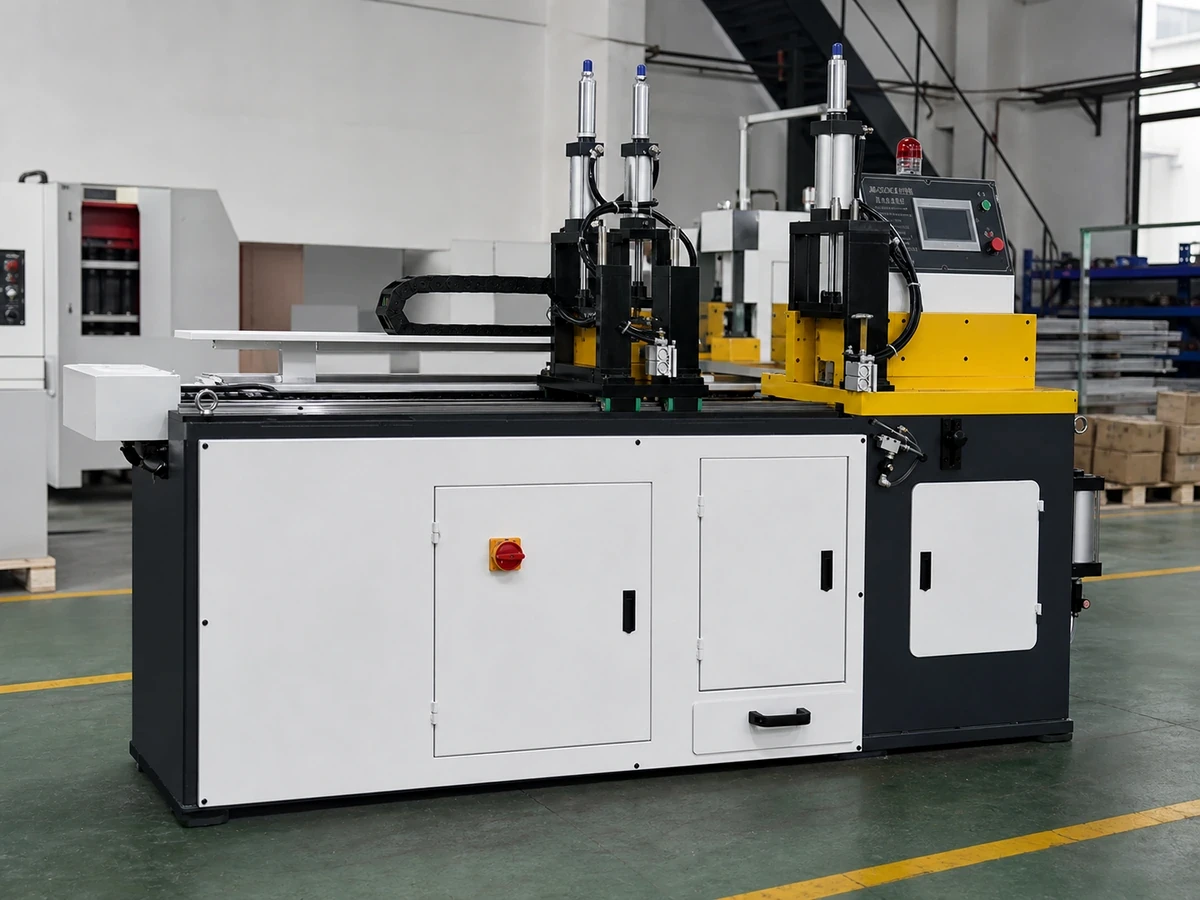
Keep chip containment and profile flow in the same review
Show the supplier the longest and shortest pieces, profile cross-sections, bundles if used, and the planned offcut route. A safety light curtain placed across a normal material path may be interrupted by every workpiece. A design that avoids nuisance stops by leaving a broad unprotected gap may introduce a reach path. The solution has to be engineered around both material flow and access control; do not assume a control setting fixes a physical opening.
Separately ask what contains chips, coolant spray, and displaced parts. A safety light curtain does not perform that function. Review the enclosure, guards, extraction or collection arrangements, and the workpiece clamping path as separate items. The guard-opening fit trial is useful when a tall extrusion changes the space available around the blade.
Ask for a control and reset explanation
The quote should identify what happens when a beam is broken during a cut, who can restart the machine, where reset is located, and what an operator can see from that location. Ask how the system handles a power loss, fault, blocked field, and an opened maintenance guard. Request a wiring and safety-function description plus the commissioning test plan. A reset must not by itself create an unexpected start. The designer should show how the proposed devices work together rather than presenting each switch or sensor as an isolated feature.
These are procurement questions, not instructions to wire or bypass a safety circuit. The applicable standards, required performance, and validation method depend on the machine and the place where it will be installed. Have a qualified specialist determine those requirements.
Seven questions to put in the RFQ
- Which specific hazardous approaches does the proposed curtain detect, and which guards address the remaining approaches?
- What physical protection remains for chips, offcuts, and blade-related ejection hazards?
- Where are the detection field, side barriers, infeed, outfeed, and maintenance access shown on one layout?
- What stopping time was measured on the offered machine, under what conditions, and how was the safety distance calculated?
- Can anyone stand beyond the beam or reach the blade without crossing the field? How is that situation prevented or detected?
- What happens during field interruption, fault, power recovery, reset, and restart?
- What documents and witnessed tests will be delivered before acceptance?
Attach the actual profile drawings, sample lengths, and intended line layout to the RFQ. Request a marked-up layout and a written safety-function explanation alongside the commercial offer. This makes competing proposals easier to compare and avoids treating an added sensor as proof that an existing guard can be removed.
What the equipment video can and cannot show
The Jiurun video below shows an automatic aluminum cutting machine and its general operating view. It is useful for discussing where material enters and where a buyer would ask about access. It does not document a light-curtain installation, stopping-time test, guard certification, or the protective performance of the machine proposed for your project.
Buyer takeaway: specify the safety outcome and ask for machine-specific evidence. A safety light curtain may complement a physical guard in a validated design. Whether it can replace any particular guard component must be decided from the full hazard and access assessment, not from a product label or a photo.